
Reports & Research
Explore proprietary research packed with data, insights, and real-world findings to help carriers make smarter decisions.

AI in Insurance: How to Stay Ahead of the Curve
Artificial intelligence is reshaping the P&C insurance industry, offering new ways to streamline underwriting, enhance risk management, and navigate evolving regulations.
But as AI adoption accelerates, insurers must ensure they’re using these technologies effectively—balancing innovation with compliance.
Our latest guide explores the most impactful AI applications in insurance, including:
- AI-powered underwriting and predictive analytics
- How regulators are shaping the future of AI in insurance
- Best practices for integrating AI while ensuring fairness and transparency
As AI-driven tools become the new standard, insurers who adapt early will gain a competitive edge.
Download our free guide to leverage these innovations while staying aligned with evolving regulations.

The Truth About Roof Age: 5 Critical Insights Every Insurer Should Know
For insurers, accurate roof age data is essential. Yet, self-reported information often falls short.
Our research shows that 1 in 5 homeowners underreport roof age by an average of 8 years. These discrepancies create hidden risks that can impact underwriting, pricing, and overall portfolio performance.
How can insurers get a more accurate picture?
AI-driven insights provide 97% nationwide coverage, combining verified roof age with real-time condition data for a more comprehensive risk assessment.
Download our latest research for a breakdown of five critical insights that every insurer should know about roof age.
Plus, get access to The Roof Age Advantage, an exclusive video that unveils how AI is setting a new standard for risk evaluation.
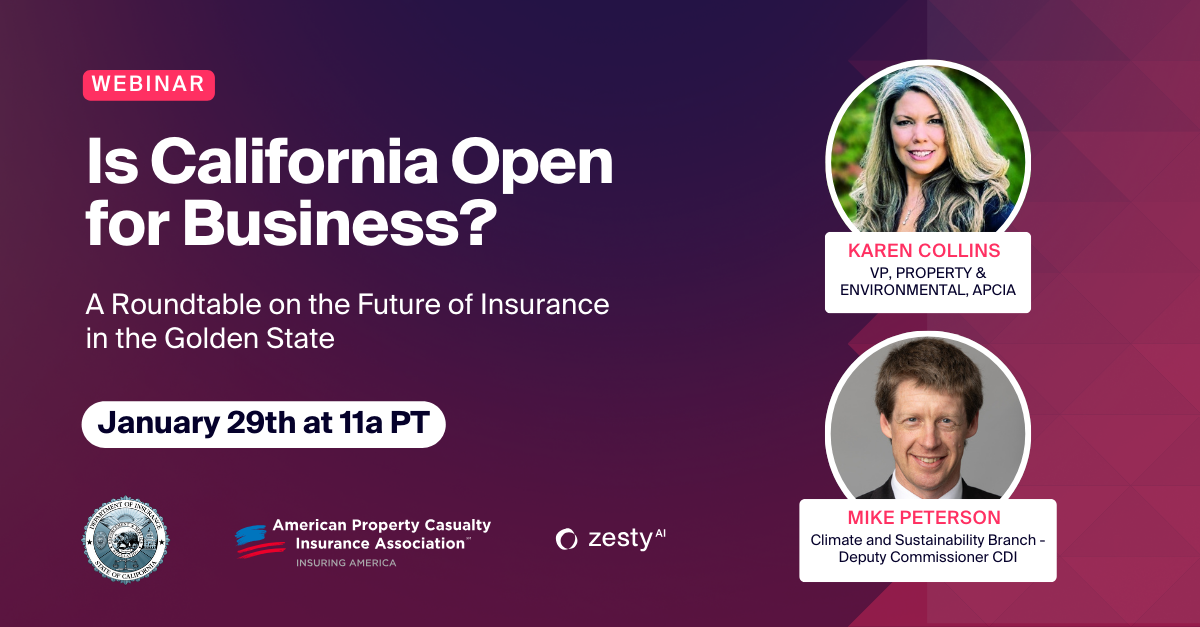
Now Streaming: Navigating California's Evolving Insurance Landscape
The California Department of Insurance (CDI) has introduced significant updates as part of its Sustainable Insurance Strategy. These new bulletins and draft regulations aim to accelerate regulatory approvals, embrace forward-looking models, and address critical reinsurance challenges.
But what do these changes mean for insurance carriers—and how can you prepare?
On January 29, 2025, we hosted a webinar, California’s Evolving Insurance Landscape: The Future of Insurance in the Golden State.
Designed for Legal & Compliance professionals, Product Managers, Underwriters, Actuaries, and Risk & Innovation leaders, the discussion featured expert insights from:
- Michael Peterson, Deputy Commissioner of Climate & Sustainability, California Department of Insurance
- Karen Collins, VP, Property & Environmental, APCIA
- Bryan Rehor, Head of Regulatory Affairs, ZestyAI
Missed the live event but want to gain actionable insights from industry leaders at the forefront of California’s insurance evolution? Watch on demand now!
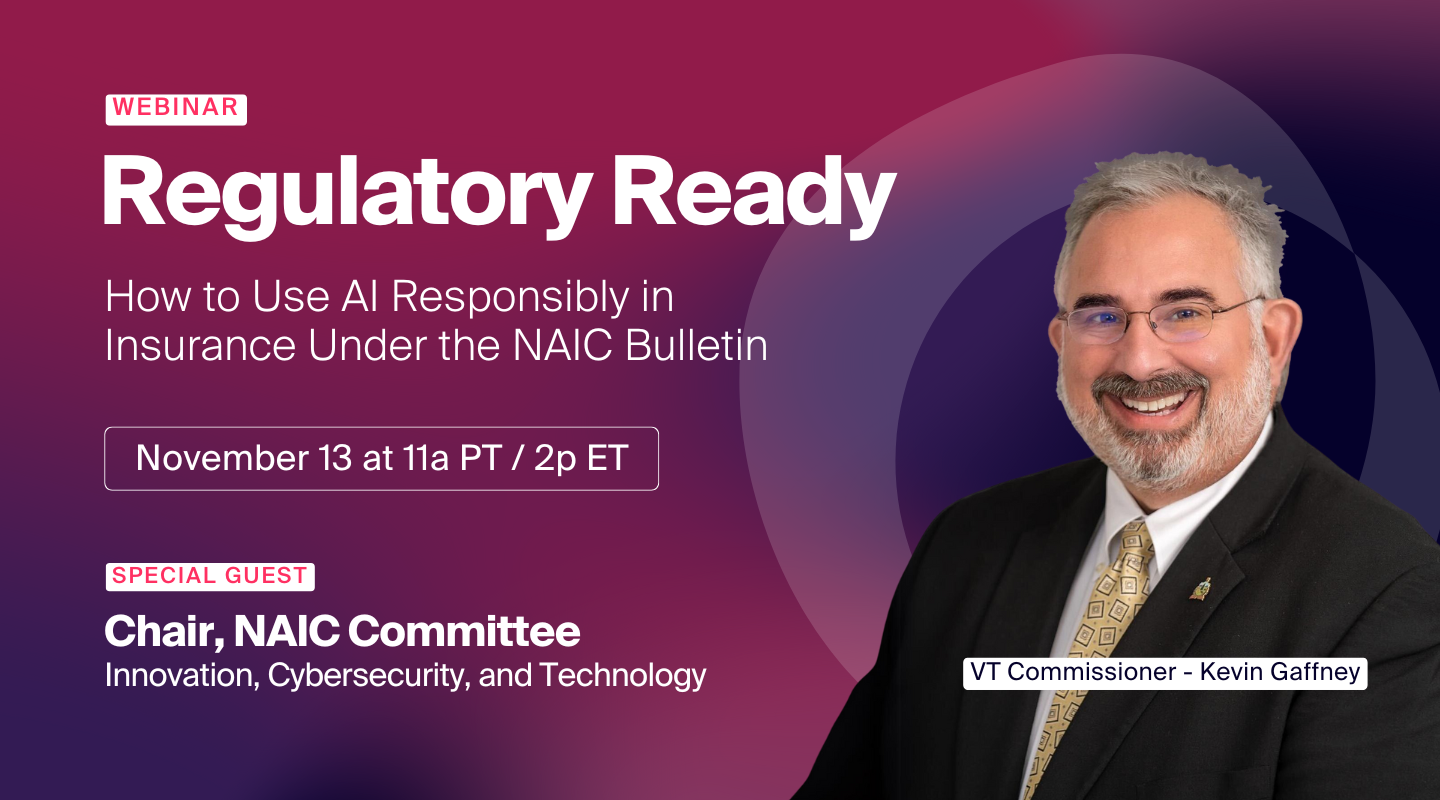
Webinar: Regulatory Ready - How to Use AI Responsibly in Insurance
Gain a deeper understanding of the NAIC bulletin's principle-based approach to AI regulation and what it means for carriers.
Regulatory Ready: How to Use AI Responsibly in Insurance Under the NAIC Bulletin
AI innovation is revolutionizing the insurance industry, but with these advancements come new regulatory challenges. To ensure responsible use of AI in insurance, it’s essential to stay informed about the latest regulatory frameworks.
Join us on November 13 at 11 PT / 2 ET for an exclusive webinar where we’ll break down how to navigate AI regulations under the NAIC Model Bulletin.
In this session, led by
- Kevin Gaffney, Vermont’s Commissioner of Financial Regulation and Chair of the NAIC’s Innovation & Tech Committee
- Bryan Rehor, Director of Regulatory Strategy at ZestyAI
you'll gain critical insights on how to align AI usage with evolving regulatory expectations.
What You’ll Learn
This webinar will provide practical takeaways that can help insurance professionals understand and comply with the latest AI standards:
- NAIC Model Bulletin Overview: Understand the core principles behind the NAIC’s AI regulation framework.
- Ensuring AI Compliance: Learn how to ensure responsible AI usage according to NAIC standards.
- Preparing for Regulatory Oversight: Get ready for closer state-level inspections and regulatory scrutiny.
- Vendor & Partner Compliance: Ensure that your partners meet regulatory requirements for transparency and fairness.
- Interactive Q&A: Take advantage of the opportunity to ask our experts about the complex world of AI and insurance compliance.
Meet the Experts
Kevin Gaffney
Vermont Commissioner of Financial Regulation
As an expert in AI regulations and the NAIC’s Model Bulletin, Commissioner Gaffney will provide key insights into how insurance companies can effectively implement responsible AI practices. His experience in overseeing state-level financial regulation will offer attendees a unique perspective on aligning AI innovation with compliance.
Bryan Rehor
Director of Regulatory Strategy at ZestyAI
Bryan Rehor will offer practical advice on maintaining AI compliance while harnessing the full potential of AI innovation. His expertise lies in guiding insurers through regulatory demands, ensuring that AI practices meet industry standards while avoiding common pitfalls.
Why You Should Attend
This webinar is tailored for professionals in insurance, particularly those in Executive, Legal, Compliance, Product Management, Underwriting, Actuarial, Risk, and Innovation roles.
Whether you’re navigating the complexities of AI regulation or preparing for the next steps in compliance, this session will provide actionable insights to help you move forward confidently.
Bonus Content
By registering for the webinar, you’ll receive our interactive guide:
“When Innovation & Regulation Meet: What Insurers Need to Know About AI and Regulatory Compliance.”
This resource will deepen your understanding of how to stay compliant while leveraging the power of AI in your insurance operations.
Don’t miss out!
Register for the webinar and ensure your spot in this exclusive event.
.png)
The State of the Industry: AI Adoption in Climate Risk Management
A survey of insurance professionals highlights AI models gaining traction, key insurer priorities, and the impact of transparency and regulatory concerns.
Facing Unprecedented Climate Challenges
The insurance industry is facing unprecedented challenges as natural catastrophic events like convective storms and wildfires become more frequent and severe. Traditional risk models, which often rely on broad territory-based segmentation, are struggling to keep up with these dynamic environmental threats. This has led to significant financial losses for insurers, who are now seeking more accurate and proactive methods to predict and manage climate risk.
AI Adoption in Property and Casualty Insurance
To shed light on the adoption of these cutting-edge techniques, ZestyAI conducted a survey of over 200 executives in the Property and Casualty (P&C) insurance sector. The survey reveals which AI-based models are gaining traction, what features insurers prioritize, and how transparency and regulatory concerns are shaping the industry. It also highlights the specific risks that are top of mind for carriers today.
AI Transforming Risk Assessment Models
The industry is turning to AI-based risk assessment models that offer a new level of precision. Companies like ZestyAI are leading the charge, providing tools that enable insurers to assess risk on a property-by-property basis, considering both individual property features and their interaction with surrounding environmental factors. These advanced models are transforming the way insurers underwrite policies, optimize portfolios, and align coverage with actual needs.
Dive deeper into our findings and explore the full report by clicking below.
Access the Report
Case Study: Adapting to Escalating Severe Convective Storm Risk
Insights from a 5-year retrospective on ZestyAI’s models in action
The Rising Threat of Severe Convective Storms
The past few decades have seen a dramatic rise in the frequency and intensity of severe convective storms, resulting in significant financial repercussions for the insurance industry. In the last year alone, insured losses from severe convective storms reached an astounding $60 billion, marking an average annual growth rate of over 11% over the past twenty years. This alarming trend means a new approach is needed to manage and mitigate the escalating risks associated with severe weather events.
In the last year alone, insured losses from severe convective storms reached an astounding $60B, marking an average annual growth rate of over 11% over the past twenty years.
The traditional methods of risk assessment and management are no longer sufficient to cope with the increasing unpredictability and severity of these weather events. As the risk evolves, so must the solutions. Changing risks call for innovative solutions that leverage advanced technology and data analytics to enhance the accuracy and effectiveness of risk modeling.
A New Approach
ZestyAI’s Z-HAIL and Z-WIND models are specifically designed to address the challenges posed by severe convective storms. In a new retroactive case study, we explore the performance of these models on a carrier’s book of business over the prior five years, highlighting their effectiveness in delivering comprehensive coverage and precise risk segmentation.
Key findings from the case study include:
Comprehensive Coverage with High Accuracy
One of the standout results from the case study is the exceptional hit rate of 99.7% achieved by Z-HAIL and Z-WIND. This shows the models were able to accurately identify and assess the risk of severe convective storms for nearly all the properties in the carrier's portfolio.

Strong Risk Segmentation
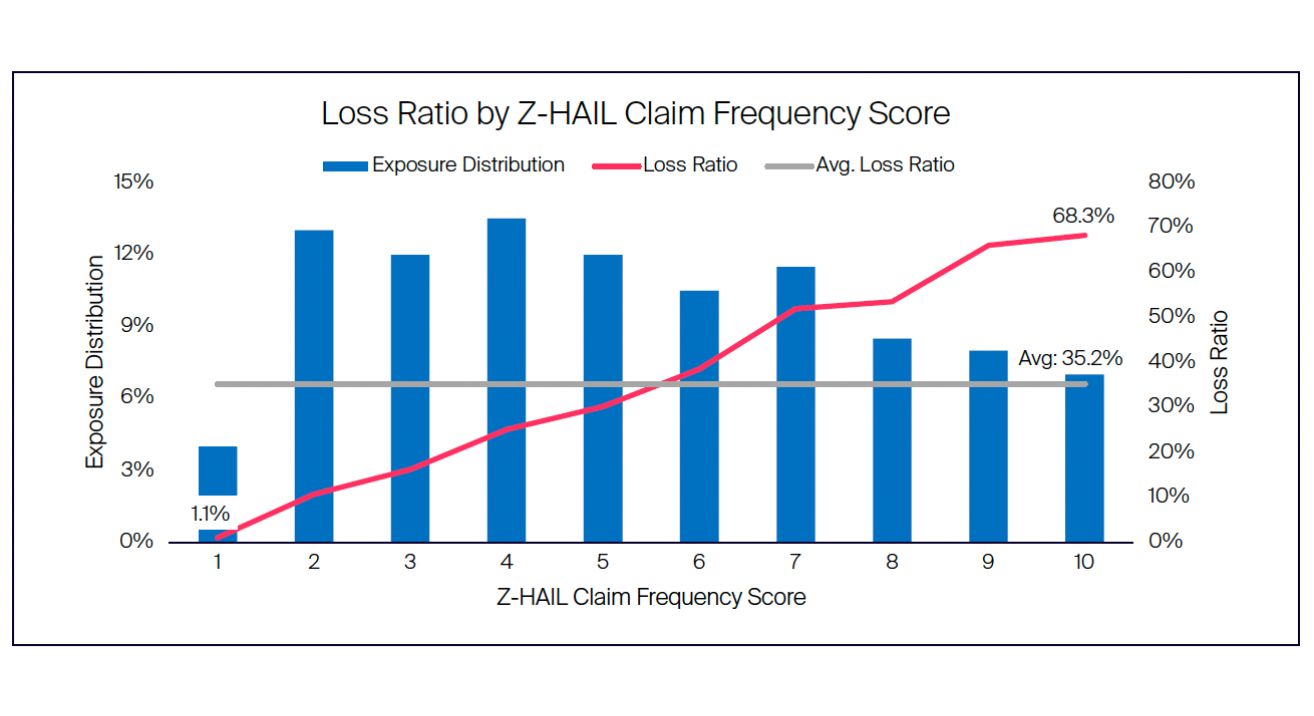
The models demonstrated remarkable capability in risk segmentation, with Z-HAIL generating a lift of 62X and Z-WIND achieving a lift of 9.7X. This means that the models were able to effectively differentiate between high-risk and low-risk properties, even within small geographic areas such as a single zip code. Accurate risk segmentation allows insurers to tailor their policies and pricing strategies more precisely, leading to better management of their risk exposure.
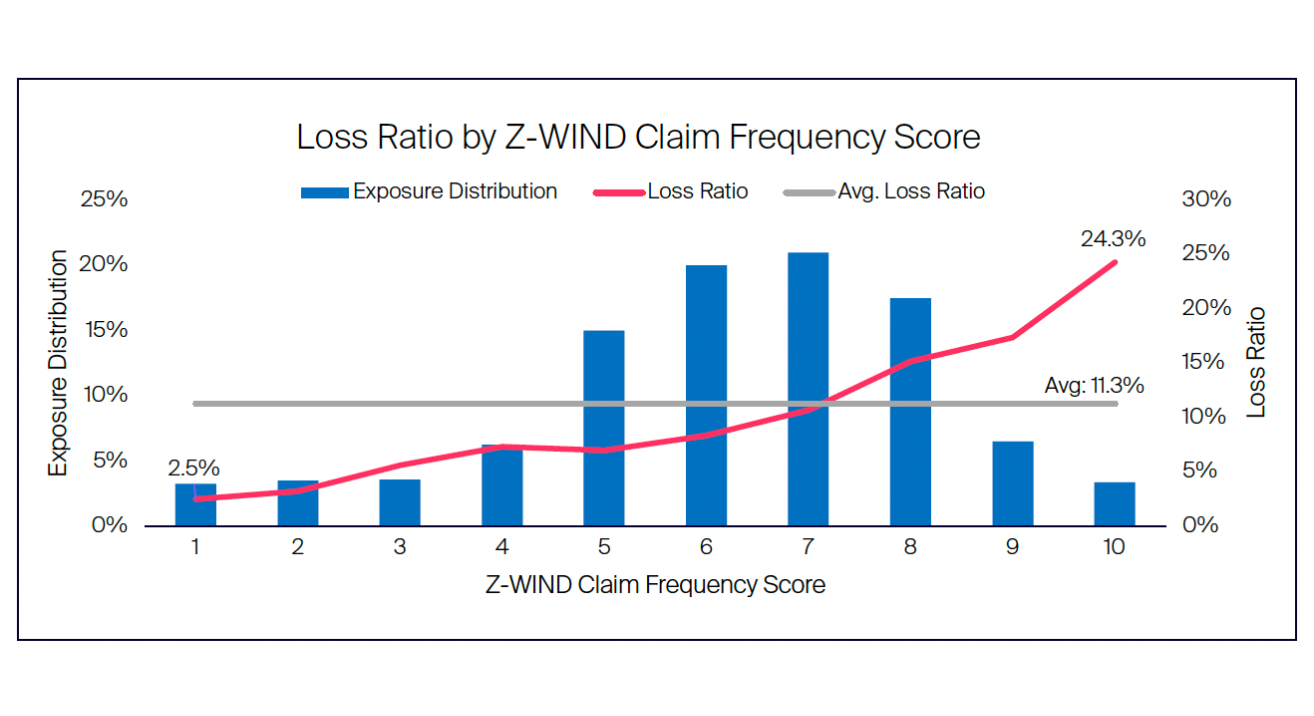
Improved Combined Ratio
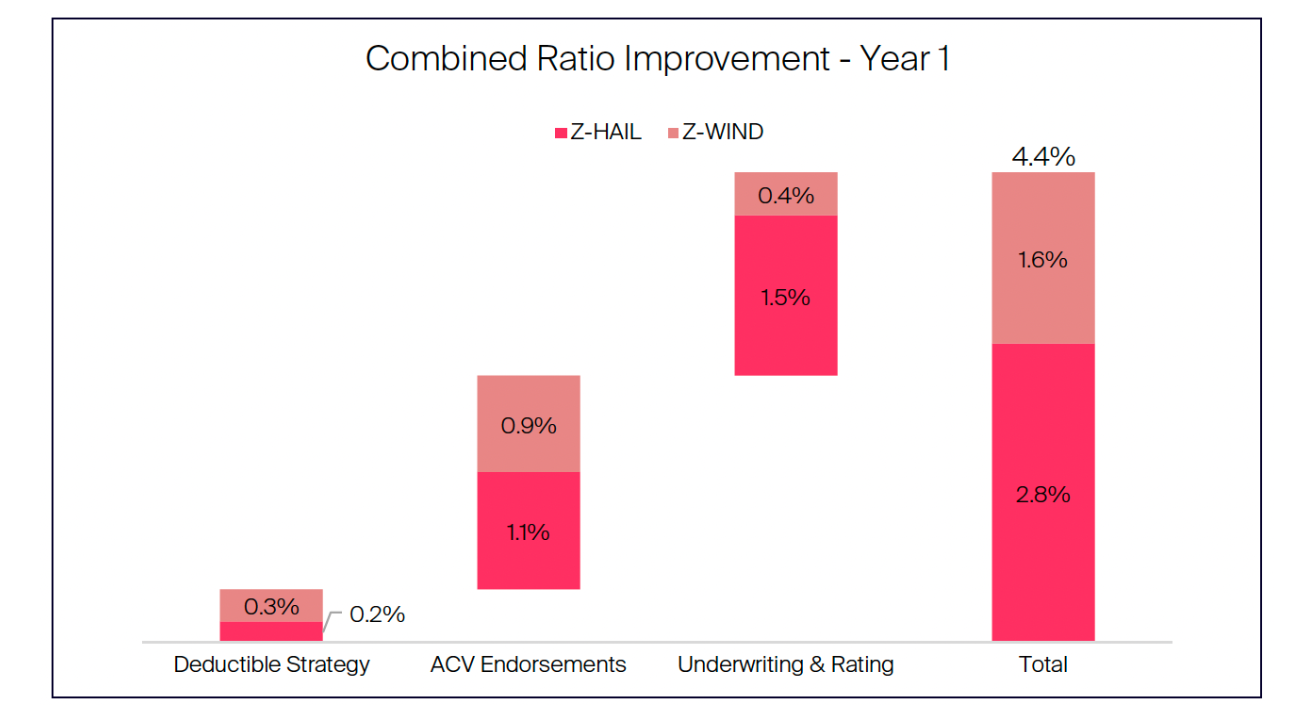
Implementing Z-HAIL and Z-WIND would significantly enhance a carrier’s combined ratio, calculated to be approximately 4 points in the first year. This improvement can be attributed to the models’ ability to optimize underwriting, rating, and the application of deductibles and Actual Cash Value (ACV) endorsement strategies. By accurately assessing the risk and applying appropriate measures, insurers can reduce their loss ratios and improve overall profitability.
The Need for Innovative Solutions
As severe convective storms continue to pose significant challenges to the insurance industry, adopting innovative solutions like ZestyAI’s severe convective storm models can help insurers better manage this escalating risk.
These models provide comprehensive coverage, accurate risk segmentation, and improved financial performance. By embracing advanced technology and data-driven analytics, insurers can navigate the complexities of severe weather events and safeguard their portfolios against future losses.
To learn more about the detailed findings and benefits
Download the full case study.
.png)
Now Streaming: The Hidden Redesign of P&C Insurance
What 2 Million Filings Reveal About 2026 Product Strategy
P&C Insurance Is Being Rewritten - Quietly but Rapidly.
Filings from the last three years show faster shifts in P&C products than at any point in recent history - and those changes are now surfacing at scale.
Endorsements, exclusions, deductibles, and appetite resets are reshaping coverage and competitive positioning across carriers. But the pace isn't uniform. National carriers, regionals, MGAs, and farm bureaus are moving in different directions - and most teams don't have visibility into how quickly competitors are adjusting forms and filings.
This session breaks down the signals that matter for 2026 product strategy.
Drawing on 2M+ carrier filings, Stephanie Kuczynski reveals the real trends reshaping P&C product strategy headed into 2026.
You'll learn what's accelerating, where carriers diverge, and how to translate these shifts into action.
What You Will Gain
- Which changes are accelerating fastest — and where carriers diverge. State-by-state adoption patterns for endorsements, deductibles, and coverage restrictions.
- How strategies differ by carrier size and focus — niche players vs. nationals. The creative, targeted approaches emerging from regionals and MGAs versus the broad strategies deployed by national carriers.
- Where regulators are drawing the line on coverage restrictions. Prepare for closer state-level inspection, due diligence, and shifting expectations across markets.
- How these shifts impact 2026 product strategy and competitive positioning. Why the pace and direction of changes matter — and how to ensure your strategy reflects where the market is heading.
Watch Now
Southern Oak Expands Use of ZestyAI After Nine Months of Proven Impact
Florida-based insurer broadens its use of ZestyAI as property-level intelligence becomes integral to portfolio management
ZestyAI today announced that Southern Oak Insurance Company has expanded its partnership with ZestyAI following nine months of demonstrated impact on portfolio decisions across its Florida homeowners portfolio.
Southern Oak initially adopted ZestyAI in 2025 to gain clearer visibility into property-level risk in one of the most complex and loss-prone insurance markets in the U.S.
Z-PROPERTY applies computer vision and machine learning across aerial imagery, building permits, tax assessment records, and other verified data sources to evaluate properties in 3D—assessing structural condition, exposure, and characteristics that influence claim frequency and severity across perils, including roof complexity, materials, and condition.
Tony Loughman, CEO of Southern Oak Insurance Company, said:
“Within months of deploying ZestyAI, it became clear that property-level intelligence needed to play a larger role in how we evaluate and manage risk. Expanding our partnership allows us to build on that foundation with greater confidence in the data behind our decisions, particularly in a market where roof condition, complexity, and exposure can materially impact outcomes.”
The expanded partnership reflects Southern Oak’s continued focus on proactive risk management in Florida’s volatile insurance environment, where traditional data sources often fail to capture the real condition and vulnerability of individual homes.
“Southern Oak’s decision to expand just nine months in is a strong signal of the value property-level intelligence delivers when it’s put into production,” said Attila Toth, Founder and CEO of ZestyAI.
“With Z-PROPERTY embedded in its risk decisions, Southern Oak sees risk more clearly, acts earlier, and makes more defensible decisions in a highly regulated, high-risk market.”
ZestyAI’s models are built with transparency, validation, and regulatory readiness at the forefront, giving insurers confidence to rely on them in portfolio decisions. The platform is used by leading insurers to improve underwriting accuracy, manage exposure, and reduce loss volatility across weather- and non-weather-driven perils.
Lilypad-Centauri Partners With ZestyAI to Strengthen Coastal Portfolio Using AI-Driven Risk Analytics
Lilypad-Centauri adopts roof and parcel-level insights to sharpen exposure data and strengthen risk decisions
ZestyAI today announced that Lilypad-Centauri is using ZestyAI’s Roof Age and Z-PROPERTY™ solutions to enhance its view of property risk across coastal homeowners and dwelling fire portfolios.
Lilypad-Centauri focuses on delivering stable and reliable coverage to homeowners and property owners in hurricane- and catastrophe-exposed coastal communities. By leveraging ZestyAI’s building attributes and parcel-level characteristics, Lilypad-Centauri gains a clearer view of property risk and how exposure accumulates across its coastal portfolio.
Lilypad-Centauri, through its managing general agency, is deploying two of ZestyAI’s proven solutions to gain a more granular, defensible view of property risk:
- Roof Age delivers verified roof age by cross-validating building permit records with over 20 years of aerial imagery, detecting roof replacement events, and assigning confidence scores across 97% of U.S. properties.
- Z-PROPERTY™ applies AI to high-resolution aerial imagery to assess roof complexity, materials, and condition, while evaluating parcel-level features such as vegetation overhang, yard debris, and secondary structures that influence claim frequency and severity across multiple perils.
“Coastal properties present a unique combination of exposure, from roof condition and construction features to how the parcel is maintained,” said Tony Hare, Chief Operating Officer & Chief Underwriting Officer of Lilypad-Centauri.
“ZestyAI’s roof and parcel-level analytics give us a clearer, property-level view of the homes we insure, helping us reduce uncertainty and better manage portfolio volatility.”
“Lilypad-Centauri is building a more resilient coastal portfolio by replacing exposure unknowns with verifiable property‑level truth,” said Attila Toth, Founder and CEO of ZestyAI.
“Granular, regulator-approved analytics bring confidence to the risk and capital decisions behind reliable customer protection.”
ZestyAI works closely with regulators to ensure transparency, validation, and continuous monitoring of its AI-driven models. Its portfolio of risk models has secured nearly 100 approvals from regulators nationwide, giving insurers confidence they can be deployed immediately with the accuracy and transparency regulators demand.
ZestyAI Provides AI-Driven Risk Analytics for Marsh McLennan Agency
MMA’s Private Client Services division adopts wildfire, roof, and parcel-level insights to drive better outcomes for its high-net-worth clients
ZestyAI, the Risk and Decision Intelligence Platform for the insurance industry, today announced that Marsh McLennan Agency (MMA), a subsidiary of Marsh (NYSE: MRSH), has adopted its risk analytics
By leveraging three cutting-edge solutions from ZestyAI, Z-FIRE™, Roof Age, and Z-PROPERTY™, the MMA Private Client Services team was able to improve wildfire risk evaluation for these homeowners by analyzing detailed property data and loss history and assessing roof age and condition using high-resolution aerial imagery. This strategic deployment enhanced their ability to offer more precise, customized insurance and risk management solutions for their clients’ high-value homes.
“Safeguarding the lifestyles and legacies of our clients requires a forward-looking approach to risk,” said Robert Pritula, Senior Vice President, National Placement and Solutions Leader of MMA’s Private Client Services division.
“We are always looking for new ways to leverage cutting-edge technologies that will allow us to offer clients tailored and effective solutions to mitigate the threats facing their most valuable assets, including their homes.”
“MMA has built its reputation on exceptional client service and proactive risk management,” said Attila Toth, Founder and CEO of ZestyAI.
“With granular risk analytics backed by industry standards and proven accuracy, they are leading the way in how high-value portfolios can be protected with confidence.”
ZestyAI works closely with regulators to ensure transparency, validation, and continuous monitoring of its AI-driven models. Its portfolio of models has secured more than 80 approvals from regulators nationwide, including Z-FIRE™, which has been approved across every wildfire-prone state, giving insurers confidence they can be deployed immediately with the accuracy and transparency regulators demand.

What Winter Storm Fern Reveals about Interior Water Losses and Systemic Risk
ZestyAI Product Insights
Winter Storm Fern has evolved into a historic catastrophe for the U.S. insurance industry. Between January 23-27, 2026, the storm shattered records by placing over 230 million Americans under severe winter alerts, with a death toll of 85 as of February 3rd.
Preliminary industry estimates place insured losses at $6.7 billion, potentially making Fern the third-costliest U.S. winter storm on record, trailing Elliott (2022) and Uri (2021). The crisis is far from over. The National Weather Service warns of a "historic duration" of extreme cold, with temperatures 15 to 25 degrees below average, that continues to hamper mitigation efforts.
For carriers, Fern is a complex, multi-peril challenge. Claims teams are navigating a surge of freeze-related losses, ice-driven structural damage, and widespread business interruptions across 34 states.
To understand the stakes, one needs to look no further than February 2021, when Winter Storm Uri brought Texas to its knees and generated over $11 billion in insured losses from a single state. Fern’s footprint is broader, and its secondary effects are still unfolding.
The Cold Hard Numbers from Storm Uri: Why Claims Explode Below 5°F
Our analysis of the 2021 Storm Uri reveals a striking relationship between temperature deviation and claim frequency for the non-weather water and freeze perils. Using data from multiple carriers, we tracked daily claim rates against minimum temperatures: before, during, and after the storm window (February 11-20, 2021).
The results show how rapidly falling temperatures can transform a routine winter pattern into a systemic loss event, allowing us to monitor the market’s response in real-time as conditions deteriorated, peaked, and normalized.
The results are dramatic:
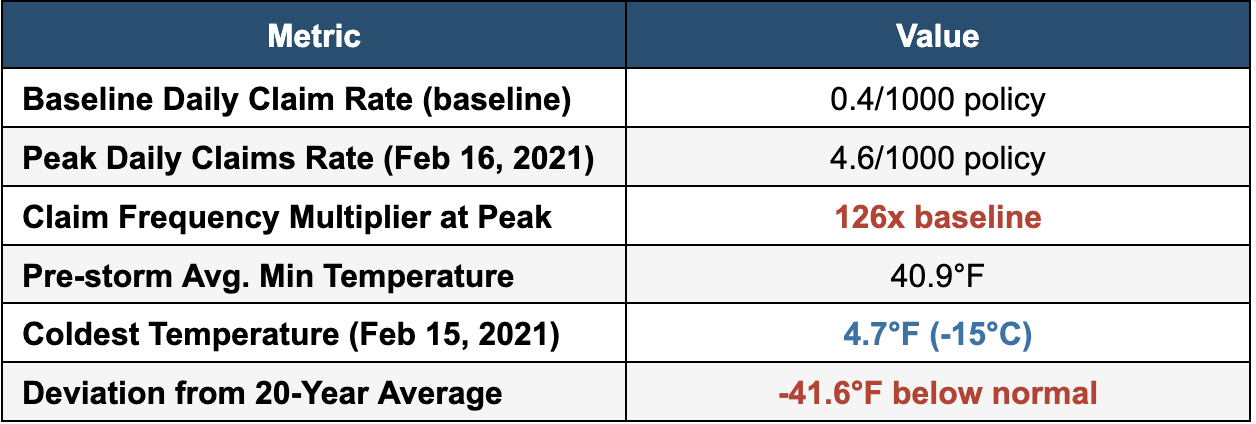
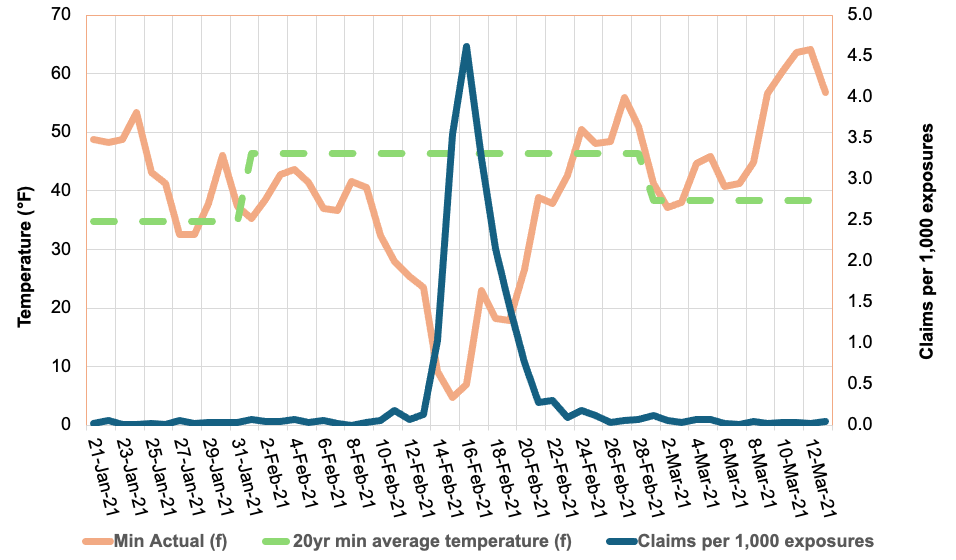
Figure 1: Daily claim rates (blue line) surged 126X above the baseline in a temporal spike as temperatures (orange line) plunged below the 20-year average (dashed green line) during Winter Storm Uri.
The chart reveals a clear inverse relationship: as minimum temperatures dropped from the mid-40s°F to below 5°F, daily claim rates didn’t just rise, they increased 126X, from a baseline of 0.04% to 0.46% at the peak. This dramatic surge underscores the significant consequences of extreme cold events on insurance liability.
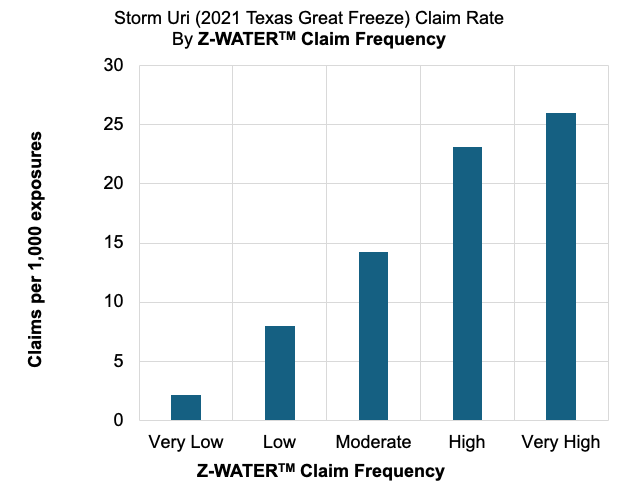
Figure 2: ZestyAI’s Z-WATER™ demonstrated an 11X increase in claim frequency between ‘Very High’ and ‘Very Low’ risk tiers during Winter Storm Uri
We used ZestyAI’s Z-WATER™ to segment the property-specific non-weather water risk across the 10-day storm window. Z-WATER™ is a risk model that accounts for how plumbing design, local climate, and infrastructure reliability interact to drive non-weather water and freeze losses. By capturing real-world dynamics, such as temperature swings that stress pipes and electrical grid failures that amplify claims, the model delivers a scientifically grounded view of property-level risk.
The results were definitive: properties that Z-WATER™ scored as ‘Very High’ risk filed 26 claims per 1,000, compared to just 2.2 claims per 1,000 for those scored as ‘Very Low’, an 11X increase in claim frequency.
This accurate segmentation reveals a clear path to managing volatility. Z-WATER™ provides a deep understanding of a home’s resilience across the full spectrum of loss mechanisms, from everyday plumbing failures to expensive outlier events like Storms Uri and Fern. By enabling precise intra-territory risk splitting, the model allows carriers to price and underwrite more reliably, ensuring premiums reflect the true risk profile while protecting the portfolio against systemic losses.
The January 2026 Storm: History Rhyming?
While we can already see the immediate impact of Winter Storm Fern, the primary difference between Fern and Winter Storm Uri is the duration of the freezing event itself, rather than any changes in how quickly policyholders are filing their claims.
As shown in Figure 1, NWW claims rise rapidly as temperatures fall and taper off quickly once conditions normalize. The risk in prolonged cold events lies in how long properties stay below the Plumbing Design Temperature; the longer the freeze, the greater the likelihood of systemic plumbing failure.
During Winter Storm Uri, extended sub-freezing conditions significantly increased the number of days in which vulnerable properties were exposed to frozen pipe failures, driving aggregate losses to historic levels. Fern is now exhibiting a similar duration profile, with sub-freezing conditions persisting for up to 10 consecutive days across parts of the Northeast. The National Weather Service has warned this “could be the longest duration of cold in several decades,” raising the likelihood of elevated losses even if individual claims remain tightly clustered in time.
For carriers, the warning signs are already flashing:
- The Power Failure Multiplier: During the storm's peak, over 1 million customers lost power. In the South, where homes lack the heavy thermal insulation of northern properties, a power outage is the primary driver of catastrophic pipe bursts. Without active heating, a property can reach the "burst threshold" within hours.
- The $30,000 Claim Severity Benchmark: Recent State Farm data underscores the high stakes of these events. Winter water damage claims totaled over $628 million, with the average claim payment now exceeding $30,000. For carriers, this high per-claim severity means even a moderate frequency surge can quickly erode Q1 margins.
- Regional Fragility in the South: While the initial assessments are still surfacing, early industry estimates for privately insured losses from Winter Storm Fern puts the damage at $4 billion to $7 billion. With Texas and Tennessee identified as the hardest-hit states, carriers are facing a "Uri-style" scenario in which infrastructure wasn't designed for a 10-day deep freeze.
From Reactive to Predictive: Solving the $6.7 Billion Freeze Risk Equation
The 2021 Texas freeze taught us that traditional approaches to freeze risk are highly insufficient. Many properties that experienced burst pipes were in areas that rarely see extended freezing temperatures, meaning they lacked adequate winterization.
This is where predictive analytics becomes essential. By modelling the interaction between property-level vulnerabilities and local temperature thresholds, carriers can better identify which properties are most vulnerable to freeze events before the damage actually occurs.
Key Risk Drivers Identified in Our Latest Analysis:
- The Design Mismatch: The greatest risk isn't just the cold; it's the sudden change in temperature. Properties in states like Texas or Tennessee face a higher risk because they are built to release heat, not trap it. They lack the heavy insulation and deep-buried pipes needed to survive a 10-day freeze.
- The Power Grid Vulnerability: Our analysis shows that areas prone to power outages face a compounded risk. In the South, a home’s primary defense is its heating system so when the power fails and the heater stops, the "burst threshold" can be reached in just a few hours.
- Building Vulnerabilities: Our analysis shows that older homes and properties with plumbing routed through exterior walls are disproportionately represented among $30,000 non-weather water losses.
The Bottom Line for Carriers
The 2021 Texas freeze was a pivotal moment for the industry, generating more than 500,000 claims and $11.2 billion in insured losses in a single state. Today, Winter Storm Fern represents an even broader systemic threat, with weather alerts impacting 230 million people across more than 30 states.
While the final tally for Fern is still developing, the data is already clear: temperature shocks drive claims at exponential rates. With early industry assessments estimating privately insured losses between $4 billion and $7 billion, it is evident that the prolonged duration and geographic anomaly of extreme weather events are the primary drivers of this volatility.
For carriers looking to protect their Q1 margins, predictive analytics are no longer a luxury; they are a requirement. By analyzing property-level characteristics, regional vulnerabilities, and historical temperature deviations, you can move from reactive claims handling to proactive risk management.
The question isn't whether another major freeze will occur, but whether your portfolio is prepared for the next 126-fold surge.
Learn More About Z-WATER
ZestyAI’s Z-WATER™ provides the industry’s most granular view of interior water risk, helping carriers accurately and reliably assess properties in areas prone to temperature shock events. By analyzing detailed property-level characteristics alongside historical weather patterns and regional risk factors, our advanced models predict the likelihood of Non-Weather Water (NWW) and freeze claims as well as their associated severity. This deeper level of analysis empowers carriers to make smarter pricing decisions before the next major storm hits.
Methodology: Analysis based on aggregated claims from multiple Texas carriers during Winter Storm Uri (February 2021). Temperature data reflects mean daily minimums across the exposure footprint, weighted by ZIP Code to account for geographic density. The claim/exposure ratio was calculated by dividing daily claims by the average policy-day exposure.
-----------------------------------------------------------------
1CNN Weather, "More than 230 million people under alerts for potential ice, heavy snow and extreme cold," January 2026. [link]
2Fox News, "Noem coordinates with Mississippi officials as state recovers from deadly winter storm," January 2026. [link]
3Insurance Innovation Reporter, “KCC Estimates $6.7 Billion in Insured Losses from Winter Storm Fern,“ February 2026 [link]
4Texas Department of Insurance, "Insured Losses Resulting from the February 2021 Texas Winter Weather Event," March 2022. [link]
5Fox Business, “More than 1 million Americans lose power as monster winter storm sweeps across the US,” January 2025 [link]
6Carrier Management, “Frozen Pipes Lead to $628M in Losses for State Farm,” January, 2026 [link]
7 Barrons, “Winter Storm Fern Packed a Wallop. Now the Cost Estimates Are Rolling In.,“ February 2026 [link]
Logic Underwriters Adopts ZestyAI to Strengthen Texas Property Underwriting with AI-Powered Hail and Wind Models
Storm and property insights help inform risk-aligned coverage decisions
ZestyAI today announced that Logic Underwriters has adopted ZestyAI’s Z-PROPERTY™, Z-HAIL™, and Z-WIND™ solutions to improve underwriting and rating precision across its personal and commercial property portfolio in Texas.
Texas is the most expensive severe convective storm market in the United States, with hail and damaging wind driving billions of dollars in insured losses every year.
"Texas is one of the most challenging storm markets in the U.S., and we need tools that match that reality," said Bill Motz, Director of Operations, Logic Underwriters.
"ZestyAI's detailed property insights and dedicated hail and wind models will help us continue to provide exemplary service to our clients—from more accurate risk assessments to better loss prevention guidance in increasingly volatile weather conditions."
ZestyAI’s property-specific hail and wind models predict the likelihood and severity of storm-driven claims by analyzing how local climatology interacts with detailed property characteristics—helping underwriters to distinguish meaningful differences in risk within the same rating territory. Each model is trained on validated claims data, offering transparent explanations of the key factors driving risk.
Z-PROPERTY applies AI to high-resolution aerial imagery and multi-source data to assess roof condition, structural complexity, and parcel-level features such as vegetation overhang, yard debris, and secondary structures—factors that directly influence claim frequency and severity across multiple perils.
“Logic Underwriters is exactly the kind of forward-looking partner that is redefining underwriting in high-exposure states,” said Attila Toth, Founder and CEO of ZestyAI.
"This collaboration shows how property-level intelligence can support underwriting excellence and disciplined decision-making while helping policyholders better understand and protect their properties. When insurers can identify specific risk factors like roof condition or vegetation overhang, they can provide actionable guidance that helps clients reduce their exposure and minimize losses."
ZestyAI’s severe convective storm models are approved in 30 states, spanning the nation’s highest-exposure hail and wind markets, and used by leading insurers across the country.
See How Insights Turn Into Decisions
ZestyAI transforms data into action. Get a demo to see how the same AI powering our reports helps carriers make faster, smarter, regulator-ready decisions.