
Resources
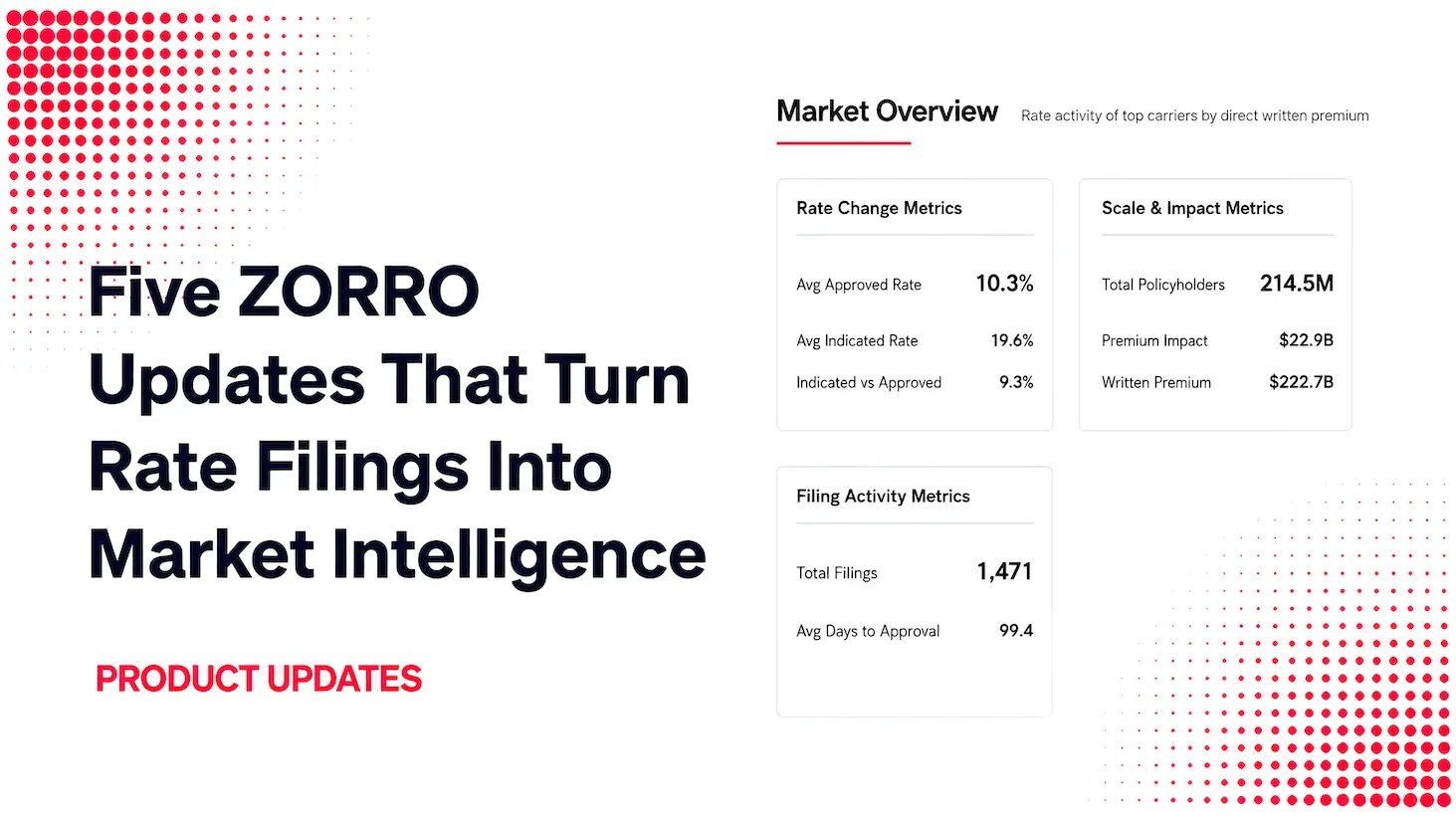
Five ZORRO Discover Updates That Turn Rate Filings Into Market Intelligence
Rate filings are where competitors reveal their strategy. Every day, competitors signal where they are heading: which segments they want, which risks they are retreating from, which states they are prioritizing, and how regulators are responding. That information is public, but it is scattered across filings, PDFs, exhibits, objections, revisions, and supporting documents. Most teams still need to stitch that picture together manually: finding the relevant filings, extracting the data, adding market context, and interpreting what it means for pricing, product, and competitive strategy. The latest ZORRO Discover release adds five capabilities that help remove the biggest bottlenecks in filing research: benchmarking rate activity, researching objections, interpreting filings in market context, monitoring competitor moves, and getting filing data ready for analysis. Together, these updates reflect the pace of innovation behind ZORRO Discover: a platform built to expand how carriers use agentic AI for competitive and regulatory intelligence.
1. Reading Competitor Filings in Market Context
A filing is easier to interpret when teams know the carrier’s market position.
A rate change from a carrier with meaningful market share in a state may deserve more attention than a similar filing from a smaller writer. Without that context, teams can spend the same effort on filings that carry very different competitive weight. To assess the importance of a filing, an analyst usually has to look up market share for that carrier in a separate source, then return to the filing to interpret what it means.
The new Market-Share-Aware Chat brings annually reported carrier size and market position into ZORRO Discover responses.
Teams can run filing research with each carrier's market position in mind, so activity from the most relevant competitors surfaces first rather than getting lost among smaller, regional filings. For example, a search for separate wind/hail percentage deductibles in Texas may surface filings from carriers of very different sizes, making market context essential. ZORRO Discover can prioritize results from carriers with larger market positions, helping teams focus on the competitors most likely to shape the market.
The impact: a more focused competitive strategy based on relevant competitors, without switching between filings, market-share reports, and separate data sources.

2. Responding to Regulator Objections with Precedent
When a state department of insurance raises an objection, the response can shape the speed, defensibility, and outcome of a filing.
Teams need to know whether other carriers have faced a similar issue, how they responded, which responses succeeded, and which arguments drew more pushback. That requires digging through old filings, objection letters, response documents, and supporting exhibits. The right precedent may exist, but finding it is slow and inconsistent.
The new Objection Research helps teams find relevant precedent across more than two million filings.
Teams can surface similar objections, review how other carriers responded, and compare how regulators handled comparable issues. For example, a carrier in Florida facing an objection on its hurricane deductible methodology can see which responses succeeded on comparable filings and build on what worked, helping the team craft a stronger response and move through review faster.
The impact: faster objection resolution, fewer manual research cycles, and a clearer path to filing approval.
3. Knowing the Moment a Competitor Files
Important filings often surface too late.
Teams may discover a competitor filing through a manual SERFF check, a colleague, a meeting, or a leadership request. By then, the filing may already be approved, or the window to respond may be limited.
The new Watchlist helps teams monitor the carriers, states, lines of business, filing types, and rate-impact thresholds that matter to them. When a matching filing appears, ZORRO Discover delivers alerts by email and in-app.
For example, a homeowners carrier in Texas can monitor its top five competitors for material rate changes, track a specific line of business across the state, or set an alert on a keyword like "wildfire deductible" to catch relevant filings as they appear. That gives the team more time to brief leadership, evaluate the move, adjust pricing assumptions, or prepare a competitive response.
The impact: earlier visibility into competitor activity and less reliance on manual filing checks.

4. Turning Filing Tables into Analysis-Ready Data
Rate filings often include valuable data in tables, exhibits, factors, assumptions, relativities, and supporting schedules. Much of that data is locked inside PDFs.
Extracting it manually requires opening the document, finding the right table, copying or retyping values, and rebuilding the structure in a spreadsheet. That work is slow and can introduce errors.
The new Table Extraction pulls filing tables and exhibits into clean CSV files in one click, preserving structure and values for analysis.
For example, an actuary running competitor rate analysis in New Jersey can export rating factor tables directly from ZORRO Discover rather than manually copying data between PDFs.
The impact: analysis-ready data in minutes, without manual transcription.

5. Benchmarking Your Rates Against the Market
Before a carrier commits to a rate strategy, it needs a clear read of the market.
Understanding rate activity in a state or line of business means locating the relevant filings, extracting rate changes, comparing carriers, normalizing formats, and identifying which moves are material. That requires filing searches, PDF review, spreadsheet work, and manual normalization, repeated every cycle.
The new Rate Intelligence Dashboard brings key rate activity into a single view.
Pricing, actuarial, and product teams can compare rate changes across carriers, states, and lines of business. They can see who is moving rates, how large the changes are, which markets are seeing the most activity, and which filings carry the greatest business impact. For example, a carrier preparing for a Texas rate review can see how approved rate changes from competitors have trended over the past year and whether its planned action is directionally aligned with the market.
The impact: faster competitive benchmarking and better-informed rate review decisions.

The Bigger Picture
Each update removes a specific filing research bottleneck. Together, they shift filing research into a market intelligence workflow
ZORRO Discover brings assembly, analysis, and interpretation into one workflow.
Filings become structured, contextualized, monitored, exportable, and easier to interpret through an insurance-specific intelligence layer. The platform is built on ZestyAI's regulatory and competitive intelligence expertise, including experience with more than 200 filing approvals.
ZORRO Discover helps insurance teams turn millions of filings into citation-backed insights that reveal pricing trends, competitor moves, regulatory patterns, and market signals with up to 20X greater research efficiency. Get access to ZORRO Discover today.

ZestyAI Named to Chartis Insurance Risk Analytics50
ZestyAI has been recognized in the Insurance Risk Analytics50, a report that identifies the leading providers of insurance risk analytics technology across the global market.
Part of Chartis’ broader STORM research program, the Insurance Risk Analytics50 evaluates vendors based on the depth and breadth of their analytics capabilities, with particular focus on how data science, AI, and advanced statistical techniques are integrated into insurance workflows. This year’s report highlights the evolving landscape of insurance analytics, examining the new models, technologies, and operating frameworks enabling carriers to make more data-driven decisions.
This recognition reflects the foundation of what we’ve built at ZestyAI: a Risk Decision Intelligence Platform that combines property-level intelligence, predictive AI, and agentic automation to help P&C insurers underwrite more accurately, allocate capital more efficiently, and adapt to a rapidly changing risk landscape.
ZestyAI’s models — spanning wildfire, severe convective storm, non-weather fire, and non-weather water risk — are validated against real-world loss outcomes and designed with the transparency and explainability that insurers and regulators increasingly demand.
The industry momentum reflects the growing need for this approach. Over the past year, ZestyAI surpassed 200 regulatory approvals nationwide, added 26 new insurance customers, and expanded relationships with leading organizations such as Berkshire Hathaway, the California FAIR Plan, and CSAA. In 2025 alone, ZestyAI’s technology helped enable coverage for nearly one million families and businesses that were previously considered difficult or uneconomical to insure.
The insurance industry is undergoing a fundamental shift in how risk is understood, evaluated, and managed. We’re proud to be recognized by Chartis as part of this transformation and remain committed to helping insurers build more resilient, sustainable portfolios through trusted AI.

ZestyAI Strengthens Leadership Team to Accelerate Next Phase of Growth
David Friend joins as CFO and John Ross as SVP of Client Development as the company scales its AI platform across the P&C industry.
ZestyAI today announced the appointments of David Friend as Chief Financial Officer and John Ross as Senior Vice President of Client Development. Both executives bring decades of experience across insurance and enterprise technology and join ZestyAI as insurers increasingly adopt the company’s AI-powered platform for underwriting, pricing, and portfolio management.
The hires come as ZestyAI turns cash flow positive, more than doubles product usage, surpasses 200 regulatory approvals, and adds 26 new carrier customers.
Friend brings more than two decades of experience scaling high-growth enterprise software companies. He most recently served as CFO of Quantum Metric for five years as it scaled through the $100M annual recurring revenue milestone. Earlier, as an investor at Bain Capital Ventures, he partnered with founders building category-defining enterprise software companies. At ZestyAI, he leads finance, accounting, and corporate development.
Ross brings nearly two decades of P&C insurance experience across carriers, insurtech, and data and analytics providers, with a track record of leading teams that drive growth through a relentless focus on customer service. He joins ZestyAI from LexisNexis Risk Solutions, where he ran the Auto and Home portfolio and led the industry's largest commercial relationships across personal lines insurers. At ZestyAI, he leads client development, ensuring customers realize measurable value through precision underwriting, improved rate segmentation, and enhanced access to reinsurance capital.
"David and John are exactly the leaders we need at this stage," said Attila Toth, Founder and CEO of ZestyAI.
"David has built and scaled the financial foundation of high-growth enterprise software companies, and John has spent his career inside the P&C insurance market helping carriers turn data into better underwriting and portfolio decisions. They strengthen how we operate as a company and how we partner with customers as AI becomes core decision infrastructure across the insurance enterprise."
“ZestyAI is operating at the intersection of two major shifts in enterprise software — the move to AI-native platforms and the transition from systems of record to systems of intelligence,” said David Friend.
"The carriers pulling ahead are using property intelligence and agentic AI to underwrite more accurately, deploy capital more efficiently, and respond to risk faster. ZestyAI is built to give them that edge. I'm looking forward to helping more carriers put it to work."
"What drew me to ZestyAI is a rare combination: a company with the technology to genuinely change this market for the better, and the opportunity to do it in partnership with carriers, reinsurers, and ultimately the consumers they serve," said John Ross. “I've spent my career helping insurers turn data into better decisions in challenging markets and move beyond the inertia that too often defines the industry," said John Ross.
"ZestyAI combines property intelligence, predictive modeling, and agentic AI to give carriers a precise view of risk across their portfolio and materially improve how they manage it.”
A Year of Momentum
In the past year, ZestyAI has:
- Turned cash flow positive while more than doubling product usage across underwriting, rating, and reinsurance workflows
- Added 26 new clients, including Applied Underwriters, California Casualty, Lemonade, and Marsh
- Expanded commercial relationships with 12 existing enterprise customers through new agreements, including Berkshire Hathaway, the California FAIR Plan, and CSAA
- Surpassed 200 regulatory approvals nationwide, spanning multiple products and perils
- Launched ZORRO, its agentic AI platform, and ZORRO Discover™ — which reduces manual regulatory and market research by 95% for underwriters, product leaders, and executives
- Launched Z-SPARK™, a property-level fire risk model grounded in modern fire science with 30× greater accuracy than traditional methods
- Welcomed Scott Stephenson, former Chairman, President, and CEO of Verisk Analytics, to its Board of Directors
Building on its continued leadership in wildfire risk analytics, in 2025 ZestyAI significantly expanded the adoption of its severe convective storm, wind, hail, and non-weather water suite of models, reinforcing its evolution into a multi-peril decision intelligence platform. That precision gives carriers something rare in catastrophe-exposed markets: the confidence to grow. Insurers using ZestyAI are writing policies they otherwise couldn't have priced — expanding their books while maintaining underwriting discipline.
In 2025 alone, that translated into coverage for nearly one million families and businesses previously considered difficult or uneconomical to insure.
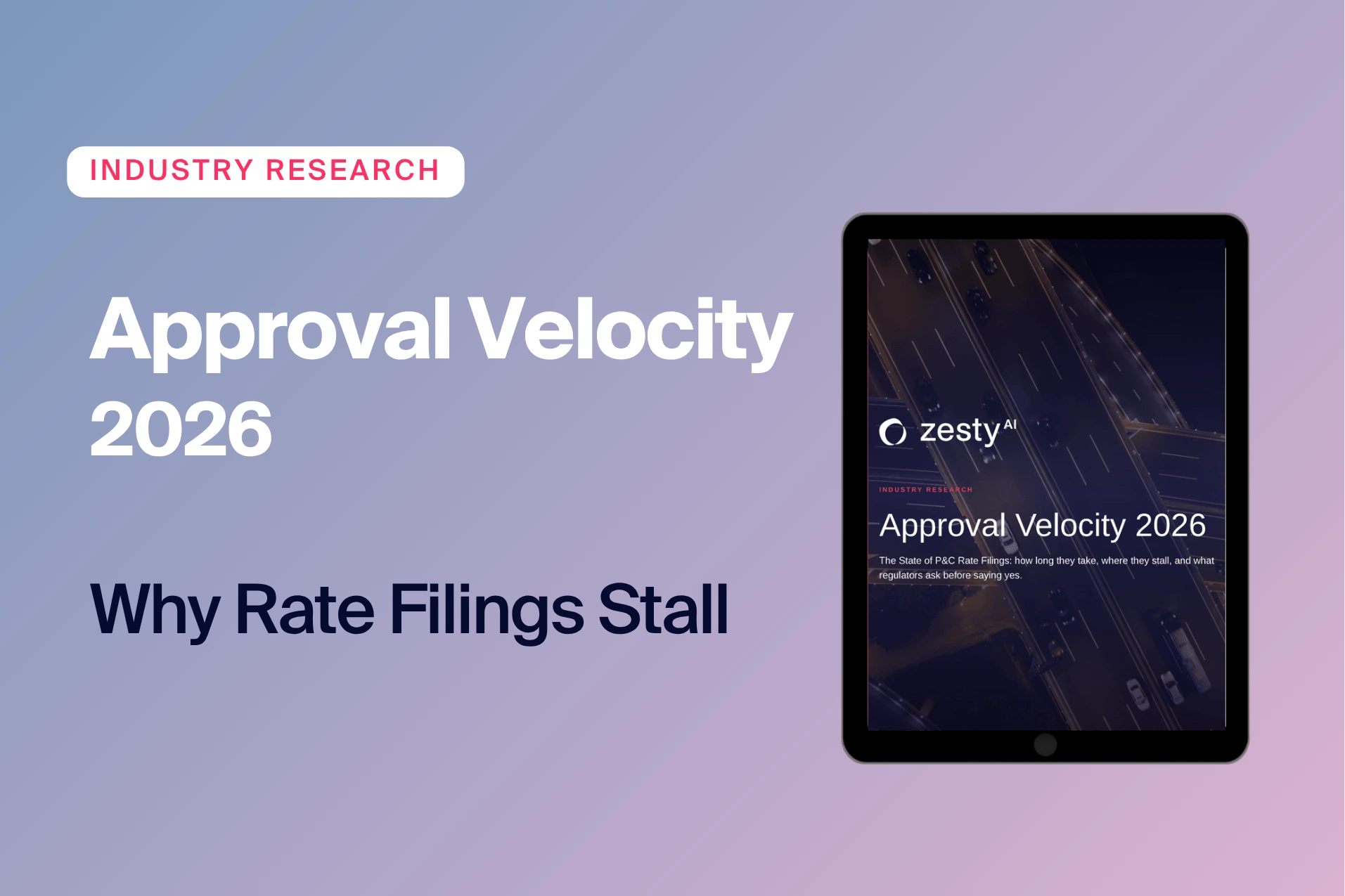
How Long Does It Take to Get a P&C Rate Filing Approved? New Data Across All 50 States
The answer depends less on what you file and more on where you file.
A rate filing submitted in Wisconsin can be approved in a single day. A similar filing in California can take more than eight months. Across the United States, that gap now exceeds 250 days
For P&C insurers, approval velocity is no longer a back-office compliance metric. It is a business constraint that affects pricing agility, product availability, rate adequacy, admitted-market competitiveness, and the shift toward Excess & Surplus.
ZestyAI analyzed 20,183 approved P&C rate filings across all 50 states and the District of Columbia for the 12 months ended May 8, 2026. The analysis covers the three highest-volume filing lines in the country: Homeowners, Personal Auto, and Commercial Property.
The analysis was conducted using ZORRO Discover, ZestyAI’s AI-powered regulatory and competitive intelligence platform for P&C insurance, which indexes more than 2 million regulatory filings and 200 million pages.
The result is the Approval Velocity 2026 report: a state-by-state benchmark of how long P&C rate filings take to get approved, where regulator objections occur most often, and what filing teams can do to reduce avoidable delay.
Key Findings
Across every approved P&C rate filing in the last 12 months, 20,183 across homeowners, commercial property, and personal auto, ZestyAI found six patterns that matter for underwriting, actuarial, product, and regulatory teams:
- Approval times vary by more than 250 days between the fastest and slowest states. Wisconsin and South Dakota close most filings in 0–2 days; California, New York, and Maryland can take 6–8 months.
- 44% of approved rate filings drew at least one regulator objection. Across the dataset, 8,776 filings received at least one formal objection letter before approval.
- A single regulator objection adds a median of 38 days to approval time. In some states, the added delay exceeds 150 days.
- Personal lines draw materially more scrutiny than commercial lines. Homeowners filings received objections 53% of the time. Personal Auto filings received objections 51% of the time. Commercial Property filings received objections 34% of the time.
- Personal Auto objections are highly concentrated. GLM and rating-factor construction support is the dominant objection theme in more than 20 states, making it the most repeatable documentation opportunity in the dataset.
- Filing friction is one operational force accelerating the shift toward E&S. When admitted filings take months to clear, carriers face longer periods of rate inadequacy, missed effective dates, and heavier operational burden.
Approval Times Vary by More Than 250 Days Across States
Across Homeowners, Personal Auto, and Commercial Property filings, the gap between the fastest and slowest states exceeds 250 days.
The fastest states move quickly. Wisconsin, South Dakota, Alabama, and Arkansas close many filings in zero to two days. The slowest jurisdictions, including California, New York, Maryland, New Jersey, and South Carolina, can take six to eight months.
This pattern appears across all three lines studied. Whether a filing moves quickly or stalls is driven more by the state than by the line of business.
For carriers, that makes state-level approval velocity one of the most important variables in filing strategy. A national approval assumption is not useful. Filing teams need state-specific expectations for effective dates, launch sequencing, objection planning, and resource allocation.
44% of Approved Filings Drew at Least One Regulator Objection
Of the 20,183 approved filings analyzed, 44% — or 8,776 filings — drew at least one formal objection letter from the state Department of Insurance before approval. Across the 12-month dataset, regulators issued more than 35,000 individual objection letters.
The cost of an objection is significant: when a filing draws one, it takes roughly four times as long to approve compared to a filing that clears without comment. The median delay an objection adds is 38 days across all lines.
The objection rate is meaningfully higher for personal lines than commercial. Homeowners filings drew objections 53% of the time. Personal Auto drew objections 51% of the time. Commercial Property, where DOIs apply lighter regulatory scrutiny to commercial pricing, drew objections 34% of the time.
That is not simply a quality-of-filing issue. It reflects a deliberate regulatory posture: state DOIs apply heavier scrutiny to consumer-facing personal lines pricing.
Homeowners Rate Filings: The Most Contested Line
4,297 approved filings. 53.2% objection rate. Median approval time: 36 days.
Homeowners is the most contested of the three lines studied. It is also the most heterogeneous: unlike Personal Auto and Commercial Property, where objection themes cluster around one or two dominant patterns, Homeowners themes are highly state-specific.
CAT-exposed states focus on catastrophe model documentation
In CAT-exposed states, regulators frequently focus on catastrophe model support.
Florida, Hawaii, Maryland, Montana, and South Carolina show strong focus on hurricane-model vendor disclosure, catastrophe-model documentation, FCHLPM compliance, and ASOP 38/41 attestations.
Hawaii and South Carolina stand out. Hawaii homeowners filings drew objections 92% of the time. South Carolina homeowners filings drew objections 95% of the time.
For carriers filing in CAT-exposed states, catastrophe model documentation should not be treated as supporting material. It should be treated as a core filing asset.
Consumer-protection states focus on policyholder impact
In consumer-protection states, regulators focus heavily on how rate changes affect individual policyholders.
Arkansas, Georgia, Kansas, Mississippi, New York, and Pennsylvania show greater scrutiny of individual-policyholder rate impacts.
New York is the clearest example. Its dominant homeowners objection theme is aggressive individual-policyholder rate capping, including strict maximum-percentage-change limits. New York’s median homeowners approval time was 220 days, the slowest homeowners approval timeline in the dataset.
For carriers, actuarial indication alone is not enough. Filing packages need to explain how rate changes affect individual policyholders, not just the overall rate level.
Actuarially rigorous states focus on model construction and reconciliation
California, Iowa, and Nebraska show greater scrutiny of GLM construction, trend support, and indication reconciliation.
California homeowners filings received objections 100% of the time in the dataset. That reflects the granular line-by-line reconciliation required under the state’s Prior Approval Rate Application and Standard Exhibits Template.
For actuarial teams, every model choice, trend assumption, and reconciliation step needs to be regulator-ready before submission.
Fastest and slowest states for Homeowners filings
The slowest Homeowners states were New York at 220 days, California at 197 days, and New Jersey at 177 days.
The fastest Homeowners states were Wisconsin at 0 days, South Dakota at 1 day, and Alabama at 2 days.
When an objection lands in a slow state, the delay compounds. In Georgia, the median homeowners filing closed in 30 days without an objection and 187 days with one, a 157-day swing. Washington and New York each added more than 140 days when an objection was issued.
Personal Auto Rate Filings: The Highest Objection Volume
6,339 approved filings. 50.7% objection rate. Median approval time: 33 days.
Personal Auto generated more individual objection letters than any other line in the study — 12,793, compared to 12,310 for Homeowners and 10,486 for Commercial Property. The median objection in Auto adds 39 days to approval time, the largest penalty of any line. California's median of 246 days is the slowest in the entire dataset.
GLM and rating-factor support dominates Personal Auto objections
Unlike Homeowners, Personal Auto objection themes are highly concentrated.
GLM and rating-factor construction support is the dominant objection theme in more than 20 states. This reflects regulators’ sharpened focus on segmentation methodology as carriers introduce new rating constructs, telematics programs, credit-based scoring models, and by-peril rating approaches.
The practical implication is significant. Carriers introducing new rating factors can build one regulator-ready documentation package and reuse it across many states.
That package should include variable selection rationale, model form support, hold-out validation, lift analysis, multicollinearity testing, indication reconciliation, bias testing, and a clear explanation of how rating factors affect policyholder premium.
This is not just a compliance exercise. It is a speed advantage. Better model documentation can reduce back-and-forth and help carriers move faster through high-scrutiny states.
Fastest and slowest states for Personal Auto filings
The slowest Personal Auto states were California at 246 days, Maryland at 142 days, and New York at 131 days.
The fastest Personal Auto states were Wisconsin at 0 days, South Dakota at 1 day, and New Mexico at 3 days.
The with-objection versus no-objection gap is stark. The median Personal Auto filing without an objection closed in 9 days. With an objection, the median increased to 52 days, nearly six times longer.
New York had the widest swing: 71 days without an objection versus 200 days with one.
Commercial Property Rate Filings : Faster Overall, But Risky at the Slow End
9,547 approved filings. 34.3% objection rate. Median approval time: 13 days.
Commercial Property is the least contested line in the analysis, with the lowest objection rate and the fastest overall median approval time. Most commercial property filings clear without ever drawing a regulator comment. When they do draw one, though, the delay is severe: the median commercial property filing closes in 7 days without an objection, and 33 days with one — nearly five times longer.
ISO and AAIS loss cost support drives many Commercial Property objections
Sixteen states share the same dominant Commercial Property objection theme: ISO/AAIS Loss Cost Multiplier adoption and support.
For carriers deviating from ISO loss costs, the filing package should include a standardized comparison exhibit that allows reviewers to verify the deviation quickly.
That exhibit should show the ISO baseline, the company loss cost multiplier, the resulting rate by class, support for deviations, and expected impact on indicated and selected rates.
This is one of the highest-value documentation opportunities in the dataset because the objection theme is both common and predictable.
Fastest and slowest states for Commercial Property filings
The slowest Commercial Property states were California at 252 days, Maryland at 210 days, and New York at 108 days.
The fastest Commercial Property states were Wisconsin at 0 days, Alabama at 1 day, and Arkansas at 1 day.
Maryland illustrates the risk at the slow end. The median Commercial Property filing there closed in 124 days without an objection and 259 days with one, a 135-day gap. New York increased from 41 days without an objection to 145 days with one.
Four Patterns That Hold Across All Three Lines
The Approval Velocity 2026 report reveals four consistent patterns across Homeowners, Personal Auto, and Commercial Property.
State posture dominates line-of-business posture.
Whether a filing takes days or months is determined more by where you file than what you're filing. California, New York, Maryland, and South Carolina are slow in Homeowners, Personal Auto, and Commercial Property alike. Wisconsin, South Dakota, Arkansas, and Alabama are fast across all three. Carriers building multi-state filing plans should treat state posture as the primary variable.
Personal lines draw materially more scrutiny than commercial.
Homeowners and Personal Auto filings draw objections more than half the time. Commercial Property filings draw objections about one-third of the time.
This is not necessarily a quality-of-submission problem. It reflects a deliberate regulatory posture. State DOIs apply heavier review to consumer-facing personal lines pricing.
Objection themes vary by line
Homeowners objections are highly state-specific. CAT-exposed states focus on catastrophe model support. Consumer-protection states focus on policyholder impacts. Actuarially rigorous states focus on model construction and reconciliation.
Personal Auto objections are more standardized. GLM and rating-factor support is the dominant issue in more than 20 states.
Commercial Property objections are also concentrated. ISO/AAIS LCM adoption and support is the dominant issue in 16 states.
Each line needs a different preparation strategy.
Many objections are avoidable
A significant share of objections are not substantive disputes over rate adequacy. Many are procedural asks that can be anticipated before submission.
Examples include Connecticut requiring the Rate Matrix and Readable Language Certification, Illinois requiring Maximum and Minimum Percentage Change values plus a rate-impact breakdown under the Rate/Rule tab, Michigan requiring the P&C Rate/Rule Filing Checklist v5 with a matching SERFF number, and Ohio requiring INS 4012 with Ohio and countrywide profit and loss data.
These issues are preventable. Filing teams that build state-specific pre-submission checklists can remove avoidable delay from the approval process.
Why Approval Velocity Matters for P&C Insurers
Approval velocity is the time between when a carrier submits a rate filing and when the state Department of Insurance approves it.
That timeline has become a strategic constraint. In fast states, carriers can respond quickly to changing loss costs, catastrophe exposure, and underwriting performance. In slow states, pricing updates can sit in review for months, leaving teams managing business against rates that may no longer reflect current risk.
For underwriters
Slow approval velocity means pricing can lag the actual risk environment.
When a rate filing takes 150, 200, or 250 days to approve, underwriters may continue writing business under rates that no longer reflect current loss costs, catastrophe exposure, inflation, or portfolio strategy.
That gap is especially important in states exposed to wildfire, hurricane, severe convective storm, non-weather water, and other fast-changing loss drivers.
Approval velocity should inform underwriting strategy. In slow states, carriers may need tighter appetite management, more disciplined renewal segmentation, and earlier filing preparation to avoid prolonged exposure to stale pricing.
For actuaries
For actuaries, the data shows where stronger support can reduce delay.
In Personal Auto, GLM and rating-factor support is the dominant objection theme in more than 20 states. In Commercial Property, ISO/AAIS LCM support is the dominant objection theme in 16 states. In Homeowners, state-specific documentation is critical, especially for catastrophe models, individual policyholder impacts, and indication reconciliation.
Actuarial teams should treat objection prevention as part of model deployment.
The best filing support does not simply show the selected rate. It explains the path from data to indication to selected rate to policyholder impact in a way the regulator can verify.
For product managers
For product managers, approval velocity changes launch planning.
A product rollout that assumes uniform regulatory timing will be wrong. Fast states may clear in days. Slow states may not clear for months.
That means product teams should plan state sequencing around approval velocity, not just market opportunity. In some cases, the best launch path may be to move quickly in fast-approval states while preparing more robust documentation for high-friction states.
Approval velocity should be part of the product roadmap, especially when launching new rating variables, by-peril rating structures, telematics programs, catastrophe model updates, or major segmentation changes.
The E&S Market Signals Hidden in The Data
There is a structural consequence that extends beyond filing operations. The harder it becomes to clear admitted rate filings — particularly in CAT-exposed, high-cost personal lines markets — the more carriers shift volume to the Excess & Surplus market, where filings are not subject to DOI rate review. The P&C E&S market has set record share in each of the past three years.
This report quantifies one of the operational pressures driving that shift. When a homeowners carrier in New York faces a 220-day median approval cycle, or when every single California filing in a given line draws at least one objection, the admitted market becomes operationally expensive in ways that compound over time: missed effective dates, rate inadequacy during the review window, and filing resources tied up in back-and-forth cycles rather than productive work.
For CEOs, chief underwriting officers, chief actuaries, and product leaders, approval velocity should be viewed as a market strategy input, not just a filing metric.
State Benchmarks at a Glance
For quick reference, here are the median approval times for the slowest and fastest states in each line:
Homeowners
- Slowest: New York (220d), California (197d), New Jersey (177d)
- Fastest: Wisconsin (0d), South Dakota (1d), Alabama (2d)
Personal Auto
- Slowest: California (246d), Maryland (142d), New York (131d)
- Fastest: Wisconsin (0d), South Dakota (1d), New Mexico (3d)
Commercial Property
- Slowest: California (252d), Maryland (210d), New York (108d)
- Fastest: Wisconsin (0d), Alabama (1d), Arkansas (1d)
Methodology
The Approval Velocity 2026 report covers approved rate filings in all 50 states and the District of Columbia for the trailing 12 months ended May 8, 2026, across Homeowners, Personal Auto, and Commercial Property. Filings that change only forms or rules without a rate change were excluded, as were withdrawn filings. Filings with a 0% overall rate impact were included alongside filings with positive or negative changes; carriers use 0% filings to modernize pricing architecture while holding aggregate premium constant. Approval time is measured from submission date to the date the state DOI closes and approves the filing.
The analysis was conducted using ZORRO Discover, ZestyAI's AI-powered competitive intelligence platform for P&C insurance, which indexes 2 million+ regulatory filings and 200 million+ pages.
For the full state-by-state data, approval time charts, and objection theme breakdowns for all 51 jurisdictions across all three lines, download the complete Approval Velocity 2026 report.
.webp)
Wildfire Risk in 2026: The Property-Level Signals Carriers Can’t Ignore
2025 exposed a new wildfire reality: property-level risk is reshaping underwriting, pricing, and portfolio strategy.
What is the 2026 wildfire outlook for insurers?
The 2026 wildfire season is forcing carriers to reassess wildfire exposure at the property level. ZestyAI’s analysis of 2025 fire perimeters shows that structural loss, risk concentration, and emerging drought patterns are shifting the underwriting conversation beyond traditional wildfire maps. For underwriters, actuaries, and product leaders, the priority is clear: identify which properties are most likely to be reached, damaged, or destroyed before the next fire season.
For the full property-level analysis, state risk profiles, 2025 case studies, and regulatory overview, download the complete Wildfire Season Preview 2026.
Key Findings
- The 2025 wildfire season burned 5.1 million acres — below the five-year average — but destroyed 18,385 structures, more than 2.5 times the average, with nearly 90% of structural loss driven by the January Los Angeles fires.
- Properties in ZestyAI's highest wildfire risk tier were roughly 500 times more likely to fall within a wildfire perimeter in 2025 than properties in the lowest tier.
- Across three 2025 case studies in Oregon, Utah, and North Carolina, properties inside fire perimeters were concentrated in High or Very High risk classifications at 11 to 15 times the statewide average.
- In 2025, California accounted for 92% of all U.S. residential properties that fell inside wildfire perimeters, even though only about 11% of its properties score High Risk.
- Colorado's HB25-1182, effective July 1, 2026, requires insurers using wildfire models to explain scores, account for mitigation, and resolve policyholder appeals within 30 days.
- The 2026 drought outlook shows improving conditions in California but extreme and exceptional drought developing across the central Rockies and parts of the U.S. South — expanding the wildfire risk footprint beyond traditional Western exposure zones.
Why 2025 Changed the Wildfire Risk Conversation for Carriers
The 2025 wildfire season exposed how quickly insured loss can concentrate when fire reaches dense residential areas. Nationwide, 18,385 structures were destroyed, more than 2.5 times the 2021–2025 average. Nearly 90% of that structural loss came from the January Los Angeles fires, where the Palisades and Eaton fires destroyed nearly 16,000 structures.
Those losses showed how wildfire exposure is changing for P&C carriers. Ember-driven fire can move through dense neighborhoods far from the traditional wildland-urban interface, creating severe property loss in areas that may not look extreme through conventional wildfire maps.
For underwriting, actuarial, and product teams, the implication is direct. Wildfire risk has to be evaluated at the property level, using factors such as defensible space, roof materials, vegetation, structure characteristics, surrounding fuels, topography, and local fire behavior. Two homes in the same neighborhood can carry materially different risk based on the conditions around the individual property.
Carriers preparing for the 2026 wildfire season need visibility into which properties are most likely to be reached by fire, which are most likely to be damaged or destroyed, and where risk is concentrating across the portfolio before the next major event occurs.
ZestyAI's Wildfire Season Preview 2026 draws on property-level analysis of every residential property that fell within 2025 wildfire perimeters, three regional case studies validating model performance across distinct fire environments, and an overview of the emerging regulatory landscape reshaping how insurers assess and communicate wildfire risk.
How Wildfire Exposure Varies Across U.S. Properties
ZestyAI analyzed every residential property across the U.S. using Z-FIRE, then analyzed which properties fell within 2025 wildfire perimeters to understand where exposure actually occurred. The results show a highly uneven risk landscape, with significant variation across states, regions, and individual properties.
Nationally, roughly 91% of properties score Low Risk, 6% score Medium Risk, and 3% score High Risk under ZestyAI's Z-FIRE model. But in 2025, properties in the High Risk tier were far more likely to fall within wildfire perimeters than those in the Low Risk tier — by a factor of approximately 500.
That separation matters for carriers because wildfire exposure is not evenly distributed across a book of business. A small share of properties can represent a disproportionate share of exposure when fire activity overlaps with dense development, vulnerable property conditions, and elevated local fire potential.
State-level exposure adds another layer of complexity. The share of High Risk properties varies significantly by state. Montana, for instance, carries a much larger proportion of High Risk properties than the national average. But high risk-tier concentration does not alone explain where losses occur — actual exposure also depends on where fires ignite, how they spread, and how many properties sit in their path.
Three states illustrate how differently the same risk tiers translate into actual exposure:
California had only about 11% of properties in the High Risk tier in 2025, yet accounted for 92% of all U.S. properties that fell inside wildfire perimeters. The scale of fire activity, combined with dense development near wildlands and major fires moving through populated neighborhoods, turned a limited High Risk segment into a dominant share of national exposure.
Texas is weighted heavily toward the lower end of the risk spectrum, with approximately 94% of properties classified Low Risk and 2% High Risk. Fire incidence within risk tiers reflects that lower baseline exposure.
Colorado shows a more distributed profile — about 70% Low Risk, 17% Medium Risk, and 12% High Risk — with fire incidence rates that track its more balanced risk distribution.
These state profiles reinforce a core finding: wildfire exposure cannot be assessed through a single national average or a fixed risk threshold. Local fire behavior, development patterns, and property density all determine how risk translates into actual loss.
Where Wildfire Risk Is Shifting in 2026
The 2026 wildfire outlook points to a broader and more complex risk footprint for P&C carriers.
Drought conditions are improving in parts of California, but elevated dryness is developing across the central Rockies and parts of the U.S. South. That shift matters because drought can dry fuels, stress vegetation, and make fire behavior more responsive to wind, heat, and ignition sources.
For carriers, the underwriting concern is not limited to where wildfire has historically been most severe. It is where changing fuel conditions, property density, and local weather patterns are creating new pockets of exposure.
The 2025 season already showed signs of this expansion. Major wildfire events occurred in Arizona and Oklahoma, and the Black Cove Fire in North Carolina demonstrated how quickly wildfire can become relevant in markets where it has not traditionally been treated as a primary underwriting peril. That fire was driven by dry conditions, wind, and heavy storm-damaged fuels left by Hurricane Helene.
The 2026 outlook reinforces the need for carriers to reassess wildfire exposure beyond legacy high-risk geographies. Underwriting, actuarial, and product teams should evaluate where wildfire risk is rising across the portfolio, which properties are most exposed, and whether existing pricing, eligibility, and renewal strategies reflect the current risk environment.
A static view of wildfire territory is no longer enough. Carriers need a property-level view of exposure that can adapt as drought conditions, vegetation, development patterns, and fire activity shift across regions.
How Z-FIRE Performed Across 2025 Wildfire Events
ZestyAI evaluated Z-FIRE performance across three 2025 fires representing distinct regional settings and fire environments: a Pacific Northwest WUI fire, a Mountain West fire in rugged lower-density terrain, and a Southeast fire in a region where wildfire has not historically been a primary underwriting concern.
Across all three events, properties inside fire perimeters were concentrated in High or Very High classifications at 11 to 15 times the statewide average. That consistency matters for carriers validating wildfire models across different geographies, fire environments, and portfolio segments.
Flat Fire, Oregon (August 2025)
The Flat Fire was a Central Oregon wildland-urban interface fire that grew to more than 23,000 acres in under a week. Of the 107 Z-FIRE-scored properties that fell inside the perimeter, 95% had been classified as High or Very High before the fire. None were Low or Very Low.
Statewide, roughly 8 in 100 Oregon properties carry a High or Very High wildfire risk score. Inside the Flat Fire perimeter, more than 95 in 100 did — approximately 11 times the statewide average. For carriers with Central Oregon exposure, the implication is direct: the fire did not reach a random cross-section of properties. It reached a concentrated group that had already been identified as materially more exposed.
Monroe Canyon Fire, Utah (July–September 2025)
The Monroe Canyon Fire burned through rugged, lower-density terrain in south-central Utah, growing to more than 73,000 acres over 54 days. Every scored property inside the perimeter had been classified as High or Very High before the fire. 80% were Very High; 20% were High. None were Medium, Low, or Very Low.
Statewide, only 9% of Utah properties are classified as High or Very High. Inside the Monroe Canyon perimeter, that share was 100%. The Very High concentration was even sharper: only 2% of Utah properties fall in the Very High classification statewide, compared with 80% inside the perimeter.
Monroe Canyon illustrates a specific underwriting challenge: in lower-density Mountain West terrain, the affected population may be small — cabins, second homes, rural recreational properties — but the properties that fall inside a large fire perimeter are not random. They are the ones already scored highest. Geographic and ZIP-code views can show where exposure is located; property-level scores show which specific properties carry the most risk.
Black Cove Fire, North Carolina (March 2025)
The Black Cove Fire started in Polk County, North Carolina after a downed power line ignited dry vegetation in the Green River Gorge. Hurricane Helene had deposited heavy storm-damaged fuels in the area six months earlier. Drought and wind helped the fire become one of the most active early-season events in the eastern United States in 2025.
Inside the Black Cove perimeter, 84% of properties had been classified as High or Very High before the fire arrived — 64% High and 19% Very High. None were Low or Very Low. Statewide, only 5% of North Carolina properties are classified as High or Very High. Inside the perimeter, that share was 84%, more than 15 times the statewide average.
Black Cove is the most important case study for carriers reconsidering their exposure in non-traditional wildfire markets. The fire occurred in the Southeast, in a state where wildfire has not historically been treated as a primary underwriting peril. The signal was there before the fire. Carriers that treat wildfire as a Western-only concern are operating without visibility into a growing share of their exposure.
How Wildfire Modeling Regulations Are Changing in 2026
Wildfire regulation is moving from model permission to model accountability. Carriers increasingly need to explain how wildfire scores are used, recognize mitigation, support policyholder appeals, and document model governance.
Across the West, four states are pursuing that standard through different paths.
California has tied wildfire model adoption to coverage obligations through its Sustainable Insurance Strategy. Carriers using approved wildfire catastrophe models must write a proportional share of homes in high-risk areas relative to their statewide market presence. A carrier with 10% of the California market must write at least 8.5% of homes in high-risk zones. Meeting that obligation requires property-level risk assessment — not just catastrophe model outputs — to distinguish individual homes worth writing from those that are not.
Colorado's HB25-1182, enacted in 2025 and effective July 1, 2026, requires insurers that use wildfire risk models to explain how models are used, account for property-specific and community-level mitigation, provide annual notices about wildfire risk scores and available discounts, and create an appeal process for disputed scores. Appeals must be acknowledged within 10 days and resolved within 30 days. The law moves wildfire modeling from a permissioning question to an accountability standard.
Washington's Senate Bill 5928 would require insurers to disclose wildfire risk scores when they are used in coverage or pricing decisions, explain the factors driving the score, and provide plain-language steps homeowners can take to improve it. Wildfire scores can no longer operate as a black box.
Oregon repealed its statewide wildfire hazard map in 2025 after public pushback against classifications that were too broad to reflect property-specific characteristics. The state is now moving toward a more granular, property-level approach. For insurers, the Oregon experience illustrates the risk of relying on broad geographic classifications: when scores cannot distinguish vulnerable homes from better-protected ones, or when policyholders cannot understand what drives their rating, the regulatory and consumer response can be swift.
Beyond state-level rules, the NAIC Model Bulletin on the Use of Artificial Intelligence Systems by Insurers, adopted in December 2023, establishes national governance expectations for AI-based underwriting tools. As more states adopt the bulletin's guidance, wildfire models will increasingly be evaluated on how they are governed, tested, explained, and monitored — not only on predictive performance.
What Carriers Should Prioritize for Wildfire Underwriting in 2026
Wildfire underwriting in 2026 requires more than identifying high-risk geographies. Carriers need a sharper operating model for how wildfire risk is segmented, monitored, validated, and explained across the policy lifecycle.
1. Segment wildfire risk at the property level
Broad geographic proxies can miss the variation that matters most for underwriting and pricing. ZIP codes, static wildfire maps, and community-level classifications may show where exposure exists, but they cannot reliably distinguish the individual properties most likely to be reached, damaged, or destroyed.
Property-level risk segmentation gives underwriting, actuarial, and product teams a more precise view of exposure. It can support new business eligibility, renewal decisions, pricing refinement, mitigation targeting, portfolio concentration management, and reinsurance planning.
The 2025 wildfire season reinforced the need for that precision. Properties inside fire perimeters were not a random cross-section of the market. They were disproportionately concentrated in higher-risk classifications before the fires occurred.
2. Monitor mitigation and property conditions continuously
Wildfire risk changes between policy cycles. Defensible space can be cleared or allowed to regrow. Roof materials can be replaced or deteriorate. Vegetation conditions shift with drought, storms, land use, and seasonal growth.
For carriers, mitigation recognition cannot be a one-time underwriting event. It requires current data on the property and its surroundings, along with the ability to explain how mitigation affects eligibility, pricing, or renewal decisions.
This is becoming both an underwriting priority and a regulatory expectation. As states move toward greater transparency around wildfire scores, carriers need defensible ways to identify mitigation, reflect it in risk decisions, and communicate the impact to policyholders.
3. Validate wildfire models across multiple fire environments
Wildfire exposure is no longer confined to one familiar pattern. Carriers may face risk in dense California neighborhoods, Western wildland-urban interface zones, rugged Mountain West terrain, rural recreational areas, and emerging non-traditional markets in the Southeast.
Model validation should reflect that diversity. A wildfire model that performs well in one region or fire environment may not provide the same signal across an entire book of business.
Carriers should require evidence that wildfire models separate risk across the geographies and property types represented in their portfolios. That means evaluating performance against observed fire outcomes, not only relying on theoretical risk assumptions or broad hazard classifications.
4. Prepare for explainability, governance, and appeals
Wildfire modeling is moving into a more accountable phase. Carriers increasingly need to explain how scores are used, identify the factors driving risk, recognize property-level and community-level mitigation, and support policyholder appeals.
This changes what underwriting and actuarial teams need from wildfire models. Predictive performance still matters, but it is not enough on its own. Carriers also need transparency, documentation, governance, and operational workflows that can stand up to regulatory and policyholder scrutiny.
For 2026, the strongest wildfire strategies will combine accurate risk segmentation with explainable decision-making. Carriers that can see risk clearly, act on it consistently, and explain it credibly will be better positioned for underwriting discipline, regulatory readiness, and profitable growth.
Frequently Asked Questions
What is the 2026 wildfire outlook for P&C insurers?
The 2026 wildfire outlook points to a broader and more complex risk environment for P&C insurers. Drought conditions are improving in parts of California, while elevated dryness is developing across the central Rockies and parts of the U.S. South. For carriers, the key issue is not only where fires may occur, but which properties are most likely to be reached, damaged, or destroyed when wildfire moves into populated areas.
Why do insurers need property-level wildfire risk models?
Insurers need property-level wildfire risk models because wildfire exposure can vary sharply from one home to the next, even within the same neighborhood. Defensible space, roof materials, vegetation, topography, structure characteristics, surrounding fuels, and local fire behavior can all affect whether a property is reached, damaged, or destroyed. ZIP codes, static maps, and broad geographic classifications cannot capture that variation with enough precision for underwriting, pricing, renewal, and portfolio management.
How many structures were destroyed in the 2025 wildfire season?
18,385 structures were destroyed in the 2025 wildfire season — more than 2.5 times the 2021–2025 average. Nearly 90% of that structural loss came from the January 2025 Los Angeles fires (Palisades and Eaton), which together destroyed nearly 16,000 structures and generated an estimated $40 billion in insured losses. Total acres burned in 2025 came in below the five-year average, making the divergence between acreage and structural loss the defining characteristic of the season.
How can carriers use wildfire risk scores in underwriting and pricing?
Carriers can use wildfire risk scores to segment new business, evaluate renewals, refine pricing, identify mitigation opportunities, manage portfolio concentration, and support reinsurance planning. The most useful wildfire risk scores are property-specific, explainable, and validated against observed fire outcomes, so underwriting and actuarial teams can understand both the risk level and the drivers behind it.
How much does wildfire risk vary by property?
Wildfire risk varies significantly at the property level. In ZestyAI’s analysis of 2025 wildfire perimeters, properties in the highest wildfire risk tier were roughly 500 times more likely to fall within a wildfire perimeter than properties in the lowest tier. Across case studies in Oregon, Utah, and North Carolina, properties inside fire perimeters were concentrated in High or Very High risk classifications at 11 to 15 times the statewide average.
Is wildfire risk growing outside the Western United States?
Yes. Wildfire remains a major concern in the West, but 2025 showed that wildfire exposure is also relevant in non-traditional markets. The Black Cove Fire in North Carolina occurred in a state where wildfire has not historically been treated as a primary underwriting peril. Inside the Black Cove perimeter, 84% of properties had been classified as High or Very High Risk before the fire, more than 15 times the statewide average.
Which states face elevated wildfire exposure?
Wildfire exposure depends on both the share of properties in higher-risk tiers and the location of actual fire activity. California accounted for 92% of all U.S. residential properties that fell inside wildfire perimeters in 2025, even though only about 11% of its properties score High Risk. Colorado has a more distributed profile, with approximately 12% High Risk and 17% Medium Risk. Montana carries a higher share of High Risk properties relative to the national average.
What does Colorado HB25-1182 require from insurers?
Colorado HB25-1182, effective July 1, 2026, applies to insurers that use wildfire risk models, catastrophe models, or scoring methods to assign property risk. The law requires insurers to explain how models are used, account for property-specific and community-level mitigation, provide annual notices about wildfire risk scores and mitigation discounts, and establish an appeal process for disputed scores or classifications. Appeals must be acknowledged within 10 days and resolved within 30 days.
How are wildfire modeling regulations changing for insurers?
Wildfire regulation is moving toward greater transparency, mitigation recognition, model governance, and consumer explainability. Insurers increasingly need to show how wildfire scores are used in underwriting and pricing, which factors influence those scores, how mitigation is reflected, and how policyholders can dispute or improve their classification. This shifts wildfire modeling from a purely analytical capability to an operational and regulatory requirement.
What is Z-FIRE?
Z-FIRE is ZestyAI’s property-level wildfire risk model. It produces scores designed to estimate both the likelihood that a property will fall within a wildfire perimeter and the likelihood that the property will be damaged or destroyed if exposed. The model incorporates property and environmental factors such as defensible space, roof materials, structure characteristics, vegetation, topography, and surrounding fuels.
How did Z-FIRE perform in 2025 wildfire events?
ZestyAI evaluated Z-FIRE across three 2025 wildfire events in Oregon, Utah, and North Carolina. In each case, properties inside the fire perimeter were heavily concentrated in High or Very High risk classifications before the fire occurred. Across the three case studies, that concentration was 11 to 15 times the statewide average, showing strong risk separation across different fire environments.
How many structures were destroyed in the 2025 wildfire season?
The 2025 wildfire season destroyed 18,385 structures nationwide, more than 2.5 times the 2021–2025 average. Nearly 90% of that structural loss came from the January Los Angeles fires, where the Palisades and Eaton fires destroyed nearly 16,000 structures.
What should carriers do to prepare for wildfire risk in 2026?
Carriers should reassess wildfire exposure at the property level, monitor mitigation and property conditions continuously, validate wildfire models across multiple fire environments, and prepare for greater explainability, governance, and appeals requirements. The goal is to understand which properties carry the highest wildfire exposure before the next major event occurs, then use that insight to improve underwriting, pricing, renewal, and portfolio decisions.
For the full property-level analysis, state risk profiles, case study data, and regulatory overview, download the complete Wildfire Season Preview 2026.
.webp)
Sub-Second Property Intelligence for Faster Carrier Decisions
ZestyAI has cut response times across its property intelligence APIs to under one second per property. Quoting, inspection targeting, renewal scoring, and portfolio reviews can now access property-level intelligence faster, even at the scale of millions of requests a day from more than half of the top U.S. carriers. That speed matters because the ground has shifted underneath the insurance. Carriers are competing to grow, and shoppers, conditioned by every other digital experience they touch, expect quotes in seconds, not days. When the data layer behind those quotes lags, policies slip to whoever is faster.
Engineered for the Scale Carriers Demand
Holding sub-second response times at this scale, across billions of data points spanning property, imagery, and risk sources, requires infrastructure purpose-built for speed and reliability.
For our clients, faster response times aren't a nice-to-have; they're necessary to support the workflows their teams rely on every day. And as underwriting becomes more automated, carriers need data products that can keep pace with real-time decisioning.
Sub-second response times are the latest step in a multi-year effort to push the boundaries of what carriers can expect from a property intelligence API. In late 2024, we redesigned our ML inference platform, halving API response times. A year later, we cut latency in half again, bringing the typical call below one second.
A Smoother Customer Journey
Faster responses also improve the experience at the point of decision. When property intelligence returns in under a second, quotes can move forward without making underwriters, agents, or policyholders wait on data behind the scenes.
Policyholders now bring Amazon-shaped expectations to every digital purchase: answers in seconds, not days, with zero tolerance for a spinning loader—and insurance is no exception. When property intelligence returns in under a second, carriers can deliver that experience without the data layer holding them back, and shoppers don’t drift to a competitor mid-quote. Customer experience also drives business performance: McKinsey found that P&C insurers ranking among customer-experience leaders outperformed peers in total shareholder return by 65 percentage points over a five-year period (McKinsey & Company, 2023).
This is the gap ZestyAI closes. Property intelligence that responds instantly helps keep the customer journey moving, giving carriers a faster, smoother path from quote to decision.
Workflow Integration Without the Friction
Sub-second responses also make it far easier to embed property intelligence right where your teams already work: your rating systems, underwriting workbenches, and internal dashboards.
As a property intelligence partner, ZestyAI delivers insights fast enough to support the workflows carriers rely on every day. For technical teams, that means a more reliable foundation to build on. For business users, it means the data is simply there when they need it, with no extra steps.
Faster Batch, Faster Books
Quicker responses also matter at the portfolio level. When each API call returns faster, large jobs like portfolio reviews, renewal runs, and book-level analysis can be completed more efficiently. That helps carriers refresh their view of risk more often and act on it sooner.
What Faster Response Times Mean for Carriers
Faster property intelligence pays off in two compounding ways:
- Higher workflow capacity: With each API call returning in under a second, teams can move from risk evaluation to action sooner and process more work with less delay.
- Higher conversion potential: Decisions that keep pace with the customer reduce the delay between quote and bind.
ZestyAI's recent infrastructure investments help carriers access property intelligence with the speed and scale their workflows require, while keeping the reliability carriers depend on. This combination of speed, scale, and reliability is why leading carriers use ZestyAI to support critical risk decisions.
Want to experience it firsthand? See how ZestyAI's risk models assess property-level risk across the major perils driving insured losses. Contact our team for a tailored demo built around your line of business.
Ready to see how ZestyAI works on your book of business?
Tell us a little about your needs. We'll show you how we reduce losses and help you price with precision.