
Reports & Research
Explore proprietary research packed with data, insights, and real-world findings to help carriers make smarter decisions.
.png)

What Winter Storm Fern Reveals about Interior Water Losses and Systemic Risk
ZestyAI Product Insights
Winter Storm Fern has evolved into a historic catastrophe for the U.S. insurance industry. Between January 23-27, 2026, the storm shattered records by placing over 230 million Americans under severe winter alerts, with a death toll of 85 as of February 3rd.
Preliminary industry estimates place insured losses at $6.7 billion, potentially making Fern the third-costliest U.S. winter storm on record, trailing Elliott (2022) and Uri (2021). The crisis is far from over. The National Weather Service warns of a "historic duration" of extreme cold, with temperatures 15 to 25 degrees below average, that continues to hamper mitigation efforts.
For carriers, Fern is a complex, multi-peril challenge. Claims teams are navigating a surge of freeze-related losses, ice-driven structural damage, and widespread business interruptions across 34 states.
To understand the stakes, one needs to look no further than February 2021, when Winter Storm Uri brought Texas to its knees and generated over $11 billion in insured losses from a single state. Fern’s footprint is broader, and its secondary effects are still unfolding.
The Cold Hard Numbers from Storm Uri: Why Claims Explode Below 5°F
Our analysis of the 2021 Storm Uri reveals a striking relationship between temperature deviation and claim frequency for the non-weather water and freeze perils. Using data from multiple carriers, we tracked daily claim rates against minimum temperatures: before, during, and after the storm window (February 11-20, 2021).
The results show how rapidly falling temperatures can transform a routine winter pattern into a systemic loss event, allowing us to monitor the market’s response in real-time as conditions deteriorated, peaked, and normalized.
The results are dramatic:
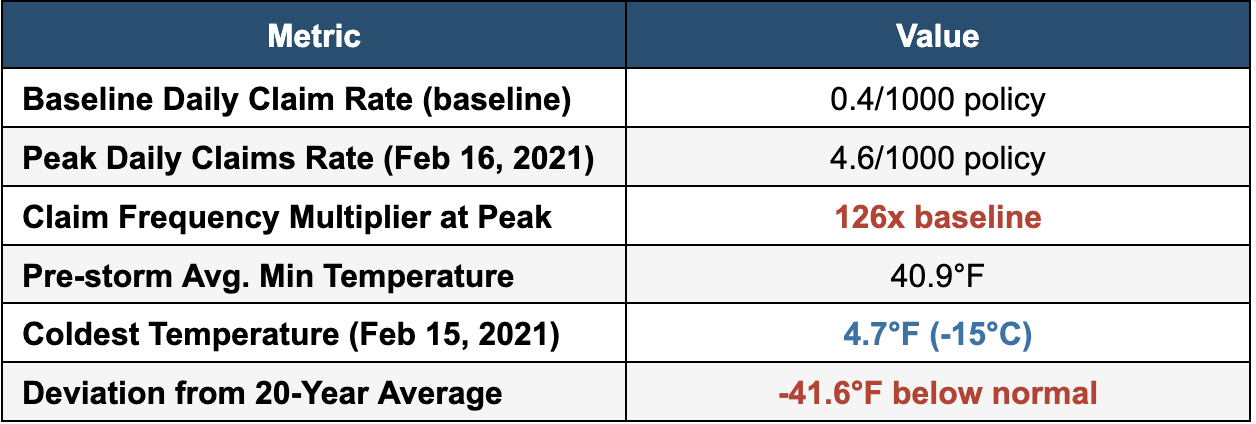
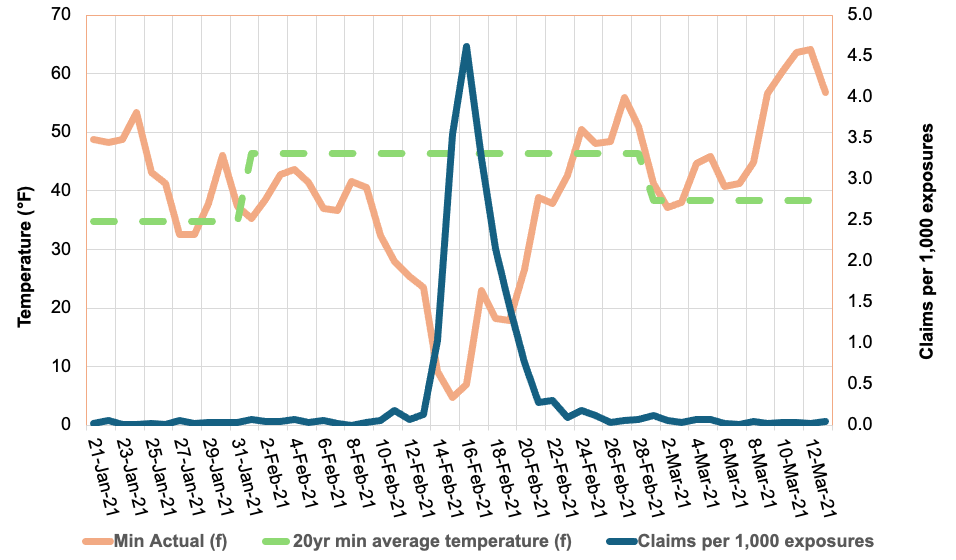
Figure 1: Daily claim rates (blue line) surged 126X above the baseline in a temporal spike as temperatures (orange line) plunged below the 20-year average (dashed green line) during Winter Storm Uri.
The chart reveals a clear inverse relationship: as minimum temperatures dropped from the mid-40s°F to below 5°F, daily claim rates didn’t just rise, they increased 126X, from a baseline of 0.04% to 0.46% at the peak. This dramatic surge underscores the significant consequences of extreme cold events on insurance liability.
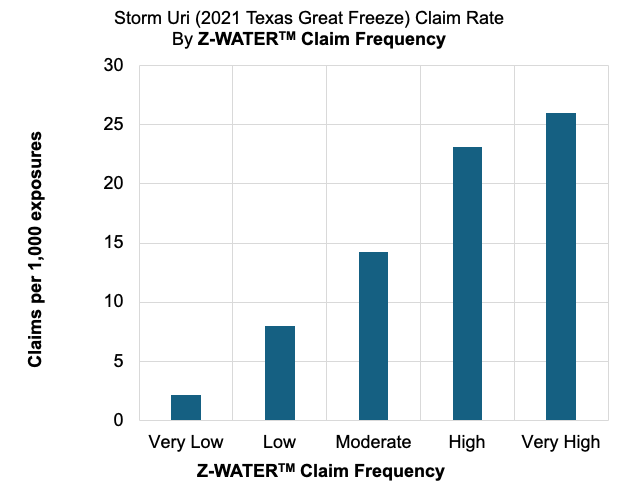
Figure 2: ZestyAI’s Z-WATER™ demonstrated an 11X increase in claim frequency between ‘Very High’ and ‘Very Low’ risk tiers during Winter Storm Uri
We used ZestyAI’s Z-WATER™ to segment the property-specific non-weather water risk across the 10-day storm window. Z-WATER™ is a risk model that accounts for how plumbing design, local climate, and infrastructure reliability interact to drive non-weather water and freeze losses. By capturing real-world dynamics, such as temperature swings that stress pipes and electrical grid failures that amplify claims, the model delivers a scientifically grounded view of property-level risk.
The results were definitive: properties that Z-WATER™ scored as ‘Very High’ risk filed 26 claims per 1,000, compared to just 2.2 claims per 1,000 for those scored as ‘Very Low’, an 11X increase in claim frequency.
This accurate segmentation reveals a clear path to managing volatility. Z-WATER™ provides a deep understanding of a home’s resilience across the full spectrum of loss mechanisms, from everyday plumbing failures to expensive outlier events like Storms Uri and Fern. By enabling precise intra-territory risk splitting, the model allows carriers to price and underwrite more reliably, ensuring premiums reflect the true risk profile while protecting the portfolio against systemic losses.
The January 2026 Storm: History Rhyming?
While we can already see the immediate impact of Winter Storm Fern, the primary difference between Fern and Winter Storm Uri is the duration of the freezing event itself, rather than any changes in how quickly policyholders are filing their claims.
As shown in Figure 1, NWW claims rise rapidly as temperatures fall and taper off quickly once conditions normalize. The risk in prolonged cold events lies in how long properties stay below the Plumbing Design Temperature; the longer the freeze, the greater the likelihood of systemic plumbing failure.
During Winter Storm Uri, extended sub-freezing conditions significantly increased the number of days in which vulnerable properties were exposed to frozen pipe failures, driving aggregate losses to historic levels. Fern is now exhibiting a similar duration profile, with sub-freezing conditions persisting for up to 10 consecutive days across parts of the Northeast. The National Weather Service has warned this “could be the longest duration of cold in several decades,” raising the likelihood of elevated losses even if individual claims remain tightly clustered in time.
For carriers, the warning signs are already flashing:
- The Power Failure Multiplier: During the storm's peak, over 1 million customers lost power. In the South, where homes lack the heavy thermal insulation of northern properties, a power outage is the primary driver of catastrophic pipe bursts. Without active heating, a property can reach the "burst threshold" within hours.
- The $30,000 Claim Severity Benchmark: Recent State Farm data underscores the high stakes of these events. Winter water damage claims totaled over $628 million, with the average claim payment now exceeding $30,000. For carriers, this high per-claim severity means even a moderate frequency surge can quickly erode Q1 margins.
- Regional Fragility in the South: While the initial assessments are still surfacing, early industry estimates for privately insured losses from Winter Storm Fern puts the damage at $4 billion to $7 billion. With Texas and Tennessee identified as the hardest-hit states, carriers are facing a "Uri-style" scenario in which infrastructure wasn't designed for a 10-day deep freeze.
From Reactive to Predictive: Solving the $6.7 Billion Freeze Risk Equation
The 2021 Texas freeze taught us that traditional approaches to freeze risk are highly insufficient. Many properties that experienced burst pipes were in areas that rarely see extended freezing temperatures, meaning they lacked adequate winterization.
This is where predictive analytics becomes essential. By modelling the interaction between property-level vulnerabilities and local temperature thresholds, carriers can better identify which properties are most vulnerable to freeze events before the damage actually occurs.
Key Risk Drivers Identified in Our Latest Analysis:
- The Design Mismatch: The greatest risk isn't just the cold; it's the sudden change in temperature. Properties in states like Texas or Tennessee face a higher risk because they are built to release heat, not trap it. They lack the heavy insulation and deep-buried pipes needed to survive a 10-day freeze.
- The Power Grid Vulnerability: Our analysis shows that areas prone to power outages face a compounded risk. In the South, a home’s primary defense is its heating system so when the power fails and the heater stops, the "burst threshold" can be reached in just a few hours.
- Building Vulnerabilities: Our analysis shows that older homes and properties with plumbing routed through exterior walls are disproportionately represented among $30,000 non-weather water losses.
The Bottom Line for Carriers
The 2021 Texas freeze was a pivotal moment for the industry, generating more than 500,000 claims and $11.2 billion in insured losses in a single state. Today, Winter Storm Fern represents an even broader systemic threat, with weather alerts impacting 230 million people across more than 30 states.
While the final tally for Fern is still developing, the data is already clear: temperature shocks drive claims at exponential rates. With early industry assessments estimating privately insured losses between $4 billion and $7 billion, it is evident that the prolonged duration and geographic anomaly of extreme weather events are the primary drivers of this volatility.
For carriers looking to protect their Q1 margins, predictive analytics are no longer a luxury; they are a requirement. By analyzing property-level characteristics, regional vulnerabilities, and historical temperature deviations, you can move from reactive claims handling to proactive risk management.
The question isn't whether another major freeze will occur, but whether your portfolio is prepared for the next 126-fold surge.
Learn More About Z-WATER
ZestyAI’s Z-WATER™ provides the industry’s most granular view of interior water risk, helping carriers accurately and reliably assess properties in areas prone to temperature shock events. By analyzing detailed property-level characteristics alongside historical weather patterns and regional risk factors, our advanced models predict the likelihood of Non-Weather Water (NWW) and freeze claims as well as their associated severity. This deeper level of analysis empowers carriers to make smarter pricing decisions before the next major storm hits.
Methodology: Analysis based on aggregated claims from multiple Texas carriers during Winter Storm Uri (February 2021). Temperature data reflects mean daily minimums across the exposure footprint, weighted by ZIP Code to account for geographic density. The claim/exposure ratio was calculated by dividing daily claims by the average policy-day exposure.
-----------------------------------------------------------------
1CNN Weather, "More than 230 million people under alerts for potential ice, heavy snow and extreme cold," January 2026. [link]
2Fox News, "Noem coordinates with Mississippi officials as state recovers from deadly winter storm," January 2026. [link]
3Insurance Innovation Reporter, “KCC Estimates $6.7 Billion in Insured Losses from Winter Storm Fern,“ February 2026 [link]
4Texas Department of Insurance, "Insured Losses Resulting from the February 2021 Texas Winter Weather Event," March 2022. [link]
5Fox Business, “More than 1 million Americans lose power as monster winter storm sweeps across the US,” January 2025 [link]
6Carrier Management, “Frozen Pipes Lead to $628M in Losses for State Farm,” January, 2026 [link]
7 Barrons, “Winter Storm Fern Packed a Wallop. Now the Cost Estimates Are Rolling In.,“ February 2026 [link]
Nearly $1 Trillion in California Homes Labeled “Low Risk” Despite Elevated Wildfire Danger
Wildfire risk in the United States is no longer confined to the edges of forests or traditionally high-risk zones. New analysis using ZestyAI’s property-level wildfire models shows that millions of homes classified as low or no wildfire risk under federal assessments face elevated wildfire danger when evaluated at the property level.
This analysis was recently featured in Vox, which examined how wildfire behavior is evolving — and why broad, backward-looking risk maps are increasingly misaligned with how fires spread today.
👉 Read the full article on Vox → https://www.vox.com/climate/476932/california-wildfire-los-angeles-risk-ai-housing-climate
Wildfire risk is closer — and more granular — than most maps show
Many homes damaged or destroyed in the 2025 Los Angeles wildfires were still classified as “low risk” under federal wildfire assessments. ZestyAI’s property-level analysis provides a different perspective.
By evaluating individual structures — including vegetation proximity, defensible space, building characteristics, and neighborhood-level fire dynamics — ZestyAI identified more than 3,000 properties worth approximately $2.4 billion in areas impacted by the Palisades and Eaton fires that showed elevated wildfire risk despite being classified as low or no risk under FEMA’s census-level assessments.
Across California, the classification gap is even broader. Approximately 1.2 million properties, representing roughly $940 billion in residential property value, are designated as low or no wildfire risk under federal maps, despite AI-driven property-level models indicating elevated wildfire danger.
Why census-level wildfire maps fall short
Wildfires do not spread evenly across census tracts or counties. Ember-driven ignition, structure-to-structure spread, wind conditions, and localized vegetation patterns create uneven outcomes, where one home survives and the next is destroyed.
Federal wildfire assessments are designed to provide a baseline view of community-level risk. FEMA has noted that its National Risk Index is not intended to serve as a property-specific risk assessment. When risk is evaluated at the individual property level, meaningful differences emerge that aggregated maps are not designed to capture.
What more granular wildfire risk intelligence enables
More detailed wildfire risk data can support:
- Targeted mitigation efforts at the property and neighborhood level
- More informed rebuilding and land-use decisions
- Clearer, more defensible underwriting and portfolio strategies
- Improved dialogue between insurers, regulators, and communities
A shift in how wildfire risk is understood
Wildfire risk is evolving faster than the systems built to measure it. Homes are no longer just adjacent to wildfire hazards; they increasingly influence how fires ignite, spread, and intensify, even in dense urban environments.
Property-level risk intelligence does not remove hard decisions. But without it, those decisions are made using an incomplete picture of where wildfire risk truly exists.
Read the full Vox article here.
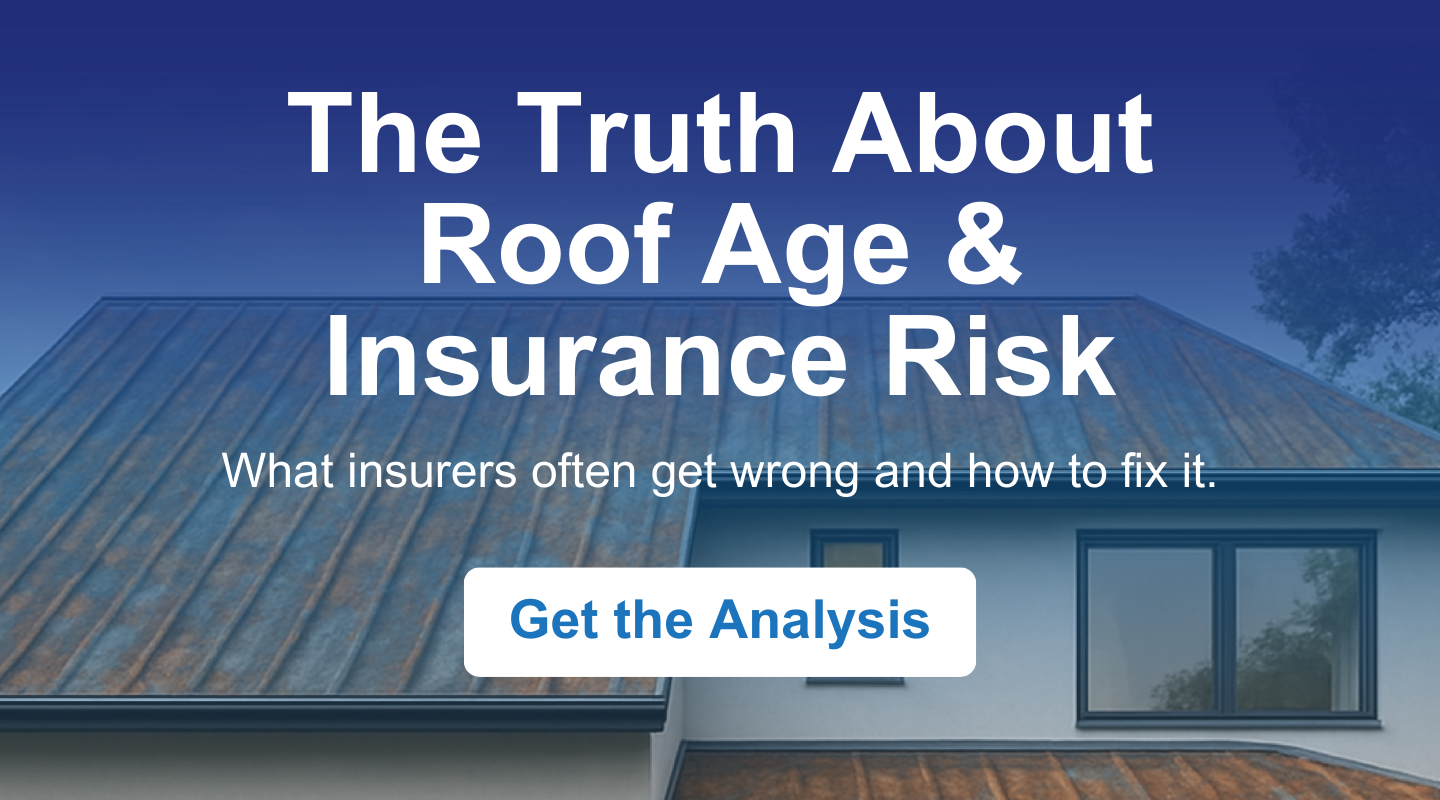
The Roof Age Blind Spot in P&C Insurance
Roof age is a powerful predictors of property risk, yet insurers continue to rely on self-reported data that is often wrong. Our analysis uncovers just how costly that blind spot can be.
In property insurance, roof age is one of the most critical factors in assessing risk. Yet too often, carriers rely on self-reported or agent-supplied data that is incomplete or inaccurate.
ZestyAI’s recent analysis of 500,000+ properties revealed widespread discrepancies in reported roof age. The result? Mispriced policies, unexpected losses, and operational inefficiencies that impact the bottom line.
As climate volatility grows and reinsurance pressure intensifies, overlooking the true condition and age of a home’s largest, most exposed surface is a risk no carrier can afford.
What’s Inside
- Uncover the biggest myths and blind spots in roof age records.
- Understand why traditional data sources, like claims systems and permits, fall short in providing accurate roof age.
- Learn how a multi-source verification strategy, combining aerial imagery, permits, tax records, and AI, offers a blueprint for improvement and 97% national coverage.
- Explore why roof age is a predictor of losses across multiple perils, not just wind and hail.
- Discover the one-two punch of verified roof age and real-time condition insights, delivering a complete view of risk, even for young roofs with hidden problems.
- Align your roof age data with growing regulatory expectations, particularly in states like Florida.
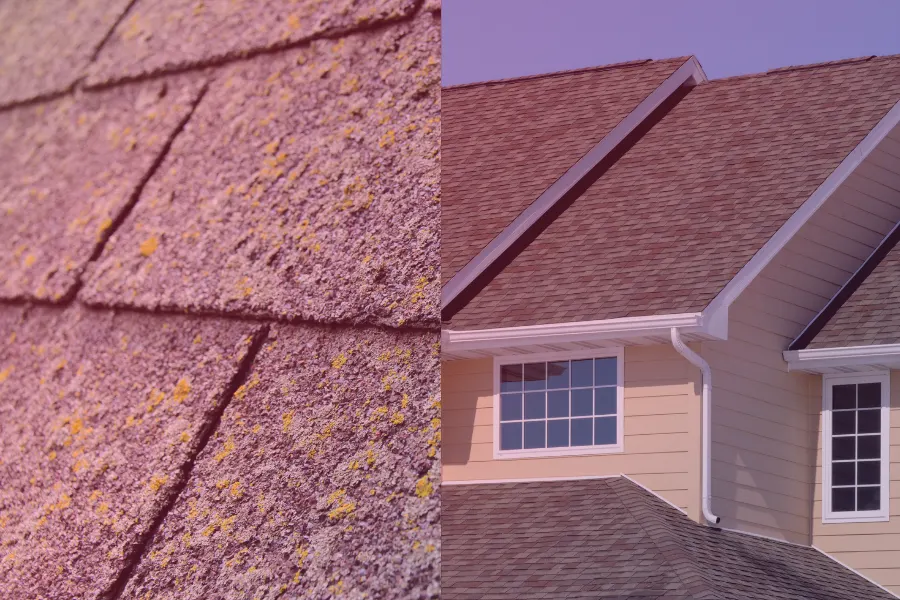
Deferred Maintenance Adds $317B in Exposure for Insurers
New research from ZestyAI reveals that 62% of U.S. homeowners are deferring critical home maintenance, adding up to $317 billion in potential claims exposure for insurers.
These findings come as Severe Convective Storms (SCS) caused an estimated $58 billion in insured losses in 2024, surpassing hurricane-related losses and marking the second-costliest SCS year on record.
Tornadoes, hail, and wind events now account for over 60% of all U.S. catastrophe claims, and research from the Insurance Institute for Business & Home Safety (IBHS) shows that roof damage accounts for up to 90% of residential catastrophe losses.
Key Findings from ZestyAI’s Homeowner Survey
According to ZestyAI’s nationally representative survey, 62% of homeowners have delayed essential repairs due to budget constraints, representing nearly 59 million U.S. homes with unaddressed vulnerabilities. Forty percent said they would rely on an insurance claim to cover major repairs like roof replacement, adding up to an estimated $317 billion in potential exposure for carriers.
Alarmingly, 63% of homeowners who weren’t living in their home at the time of the last roof replacement don’t know how old their roof is, making it even harder to detect aging systems before they fail. Meanwhile, 12% admitted they would delay repairs indefinitely, further increasing their risk of property damage.
Severe Convective Storms: The Growing Catastrophe Risk
This blind spot compounds known risks: prior ZestyAI analysis has identified over 12.6 million U.S. properties at high risk for hail-related roof damage, representing $189.5 billion in potential roof replacement costs.
“Deferred maintenance has long been a known risk factor, but today the stakes are higher than ever,” said Kumar Dhuvur, Co-Founder and Chief Product Officer of ZestyAI. "With claim severity rising and storm losses compounding, insurers need more than hazard maps to navigate this landscape."
"Property-level insights allow carriers to proactively address known vulnerabilities, improve underwriting precision, and work with homeowners to reduce losses before they happen.”
ZestyAI’s findings support a growing push toward data-driven, preventative underwriting strategies, especially as carriers face rising claim severity and pressure to improve combined ratios across storm-prone states.
.webp)
Now Streaming: LA Fires in Focus – What Insurers Need to Know
What Worked, What Didn’t, and What’s Next for Insurers
With insured losses projected to exceed $30 billion, the recent Los Angeles wildfires rank among the costliest in U.S. history—reshaping how insurers think about risk, resilience, and readiness.
Watch the Full Webinar → LA Fires in Focus: What Insurers Need to Know
In this on-demand webinar, experts from the Insurance Institute for Business & Home Safety (IBHS), the Western Fire Chiefs Association, Cal Poly’s WUI Fire Institute, and ZestyAI unpack what really happened—from frontline response to lab-based research and model performance—and share critical strategies insurers can use to prepare for what’s next.
Watch this session if you’re a Product Managers, Underwriters, Actuaries, and Risk & Innovation leaders looking to make informed decisions in an increasingly volatile wildfire landscape.
What You’ll Learn
- Key takeaways from the Los Angeles wildfires
- Research on structure-to-structure fire spread and resilience factors
- How wildfire risk models performed—what we got right (and wrong)
- Practical strategies to reduce exposure and strengthen resilience
Meet the Experts
- Anne Cope, Chief Engineer, IBHS
- Bob Roper, CEO, Western Fire Chiefs Association
- Frank Frievalt, Director, WUI Fire Institute at Cal Poly
- Kumar Duhvur, Co-Founder & CPO, ZestyAI
Now Streaming: LA Fires in Focus – What Insurers Need to Know
What Worked, What Didn’t, and What’s Next for Insurers
With insured losses projected to exceed $30 billion, the recent Los Angeles wildfires rank among the costliest in U.S. history—reshaping how insurers think about risk, resilience, and readiness.
Watch the Full Webinar → LA Fires in Focus: What Insurers Need to Know
In this on-demand webinar, experts from the Insurance Institute for Business & Home Safety (IBHS), the Western Fire Chiefs Association, Cal Poly’s WUI Fire Institute, and ZestyAI unpack what really happened—from frontline response to lab-based research and model performance—and share critical strategies insurers can use to prepare for what’s next.
Watch this session if you’re a Product Managers, Underwriters, Actuaries, and Risk & Innovation leaders looking to make informed decisions in an increasingly volatile wildfire landscape.
What You’ll Learn
- Key takeaways from the Los Angeles wildfires
- Research on structure-to-structure fire spread and resilience factors
- How wildfire risk models performed—what we got right (and wrong)
- Practical strategies to reduce exposure and strengthen resilience
Meet the Experts
- Anne Cope, Chief Engineer, IBHS
- Bob Roper, CEO, Western Fire Chiefs Association
- Frank Frievalt, Director, WUI Fire Institute at Cal Poly
- Kumar Duhvur, Co-Founder & CPO, ZestyAI
ZestyAI Helps Insurers Get Ahead of Colorado’s New Wildfire Risk Rules
Transparent AI Models and Mitigation Data Power Compliance with HB 1182.
As Colorado’s HB 1182 introduces new requirements for wildfire risk transparency and mitigation recognition, ZestyAI is helping insurers comply with proven, mitigation-ready solutions.
What HB 1182 Requires from Insurers
Recently signed into law, HB 1182 requires insurers to disclose how wildfire risk models impact rates, account for property- and community-level mitigation efforts, notify policyholders annually of their risk scores and available discounts, and provide a clear appeals process for disputed scores.
The new regulations take effect July 1, 2026, across homeowners and condo policies, including admitted carriers and the FAIR Plan.
Carriers need to move early to ensure their risk models, rating plans, and customer communications meet the law’s requirements. ZestyAI’s explainable AI models are already in use by the Colorado FAIR Plan and leading carriers to assess mitigation and support policyholder communications in Colorado and other wildfire-prone states.
"As regulatory expectations around transparency and customer engagement continue to evolve, HB 1182 sets a clear framework for wildfire risk modeling," said Bryan Rehor, Head of Regulatory Affairs at ZestyAI.
"ZestyAI’s models were built with these principles in mind, offering carriers a proven, low-friction way to meet these requirements while delivering a better experience to policyholders."
How ZestyAI Helps Carriers Meet HB 1182 Requirements
- Built for Transparency: ZestyAI’s explainable AI models allow carriers to clearly communicate how risk scores are generated, what factors are considered, and how mitigation actions influence risk.
- Mitigation-Ready Risk Modeling: Property- and community-level mitigation efforts are integrated into risk assessments, supporting discounts and appropriate pricing.
- Consumer Risk Score Disclosures: ZestyAI enables carriers to generate individual risk scores and mitigation factors for annual policyholder notifications.
- Appeals and Score Adjustments: Carriers can update risk scores in real time based on new property information, offering transparency and responsiveness to policyholders.
- Regulatory Alignment: ZestyAI’s wildfire, hail, wind, and severe storm models have been reviewed and approved for use in Colorado, helping carriers meet standards with confidence.
- Multi-State Scalability: Carriers can streamline compliance across Colorado and other regulatory environments using the same ZestyAI platform.
A Clear Path to Compliance in Colorado—and Beyond
ZestyAI maintains strong relationships with state insurance regulators and actively participates in dialogue around evolving requirements.
At the national level, ZestyAI engages with organizations such as the NAIC and leading industry advocacy groups to stay ahead of broader regulatory trends.
Through in-house Rating and Advisory organizations, ZestyAI files its models directly with state departments of insurance, ensuring each solution is rigorously vetted and aligned with jurisdiction-specific standards before reaching the market.
California FAIR Plan Expands ZestyAI Partnership
After three years of successful collaboration, the insurer of last resort extends its use of AI-driven insights to support wildfire coverage access for high-risk communities.
ZestyAI today announced a four-year expansion of its partnership with the California FAIR Plan.
Since 2021, the insurer of last resort has leveraged ZestyAI’s Z-FIRE™ to enhance risk assessment, ensuring that homeowners unable to obtain private insurance still have access to wildfire coverage.
How Z-FIRE Supports Access to Wildfire Coverage
With coverage spanning nearly 100% of U.S. properties, Z-FIRE is already trusted by more than one-third of California’s insurance market to refine underwriting, enhance risk segmentation, and ensure that premiums accurately reflect the true wildfire exposure and vulnerability of each structure.
The model leverages AI-driven analysis of over 2,000 historical wildfires, integrating satellite and aerial imagery, topography, and property-level characteristics to provide precise, property-specific risk assessments.
This scientifically validated approach is backed by decades of research, including studies from the Insurance Institute for Business & Home Safety (IBHS).
“We’re honored to continue supporting the California FAIR Plan in providing reliable insurance coverage in high-risk regions,” said Attila Toth, Founder & CEO of ZestyAI.
“By providing Z-FIRE scores directly to policyholders, the California FAIR Plan has increased transparency around wildfire risk and empowered homeowners to take meaningful mitigation steps—like defensible space measures and fire-resistant building materials—to better protect their homes and communities.”
ZestyAI works closely with regulators to ensure transparency, validation, and continuous monitoring of its AI-driven models.
Regulatory Alignment Across the Western U.S.
The company has secured key regulatory approvals across the U.S., including all Western states for Z-FIRE and broad acceptance of its severe convective storm models from Texas to Colorado, the Midwest, and the Great Plains.
The California Department of Insurance (CDI) has reviewed Z-FIRE as part of recently approved rate filings. Insurers can continue filing to use the model for rate segmentation and underwriting without additional review under the Pre-Application Required Information Determination (PRID) process.
Building on its success in California, ZestyAI has partnered with other insurers of last resort, including the Colorado FAIR Plan, further expanding the adoption of AI-driven risk models to help protect families and communities.
.webp)
A Sharper Angle: Why Oblique Imagery Is Powering Property Risk Assessment
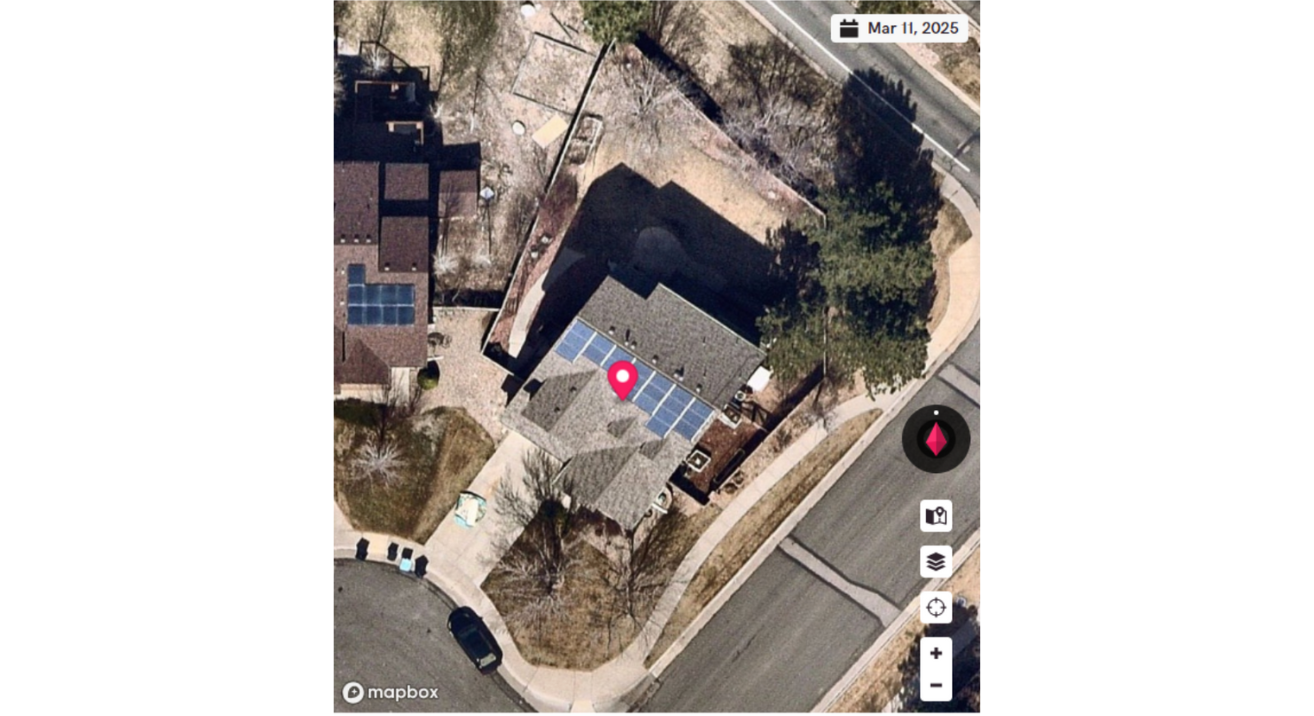
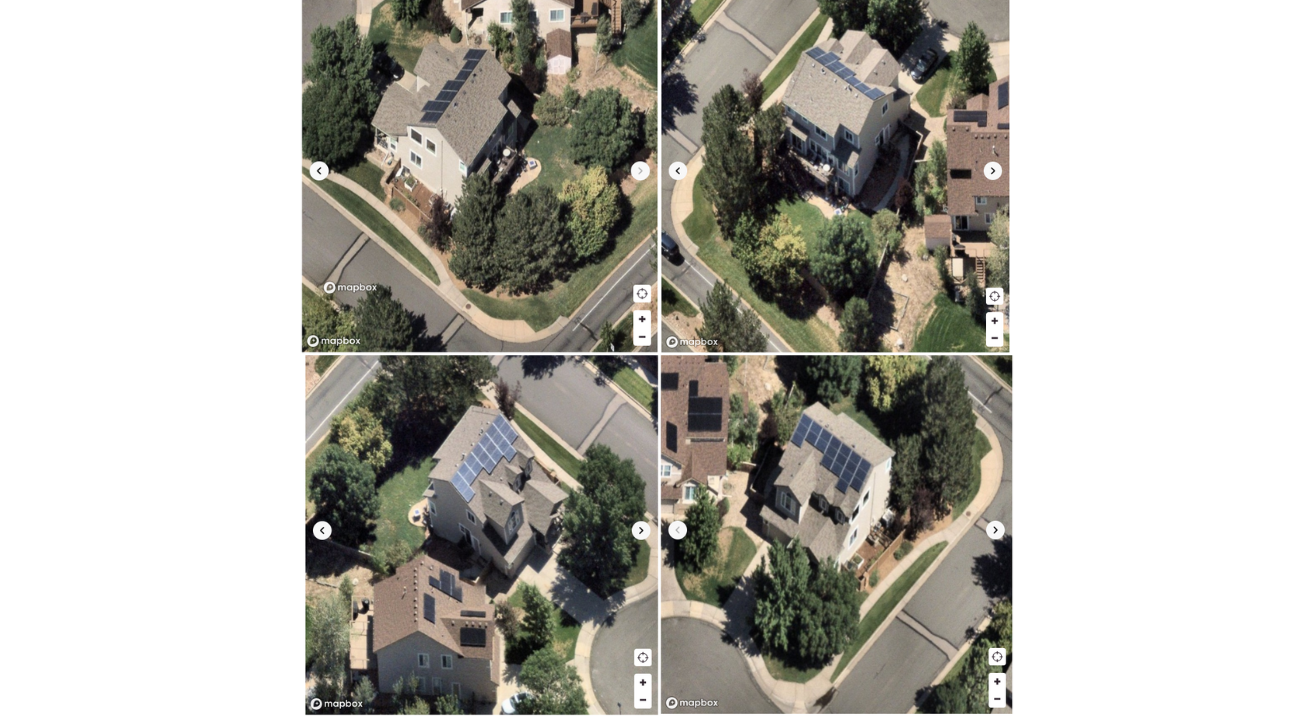
Insurance carriers have long relied on aerial imagery to assess property risk, but not all imagery offers the same level of insight. Oblique imagery—angled aerial photos that show the sides of buildings, not just the rooftops—is gaining traction as an essential tool for property underwriting, inspections, and claims.
ZestyAI is proud to now offer oblique imagery from major imagery providers directly within our platform. That means carriers get access to the most comprehensive, up-to-date, and high-resolution views available, streamlined into a single interface, and always in context with our industry-leading property risk insights.
Why Oblique Imagery Matters
Unlike traditional top-down (orthogonal) imagery, oblique views provide side-angle perspectives that reveal critical features often missed from above. This added dimension helps insurers:
- Spot more risk factors: Identify decks, porches, attached structures, handrails, and overhangs—details that are often invisible from above but meaningful for underwriting and rating.
- Gain a more complete picture: Assess roof geometry and slope, siding condition, and visible maintenance issues without needing an in-person inspection.
- Underwrite with confidence: Reduce uncertainty in borderline or complex risks by giving underwriters a full visual context.
- Support faster claims verification: Pre-loss oblique imagery strengthens documentation, helps reduce disputes, and expedites claim handling.
As Rick Smith, Underwriting Manager at Standard Casualty, explains:
“We can get overhead and oblique shots of those locations. We can accomplish through aerial photography what we do through an on-site inspection at a fraction of the cost, which is really important for us.”
The Problem: Fragmented, Outdated, or Incomplete Views
Many carriers still rely on patchwork imagery or public sources like Google Street View.
The result?
- Coverage gaps: Rural, coastal, or wildfire-prone regions may not be frequently or adequately captured, leaving insurers with limited visibility in high-risk areas.
- Stale or seasonal views: Images can be several years old or captured in winter conditions, where snow, shadows, or vegetation obscure key features. Public tools like Google Street View are often even more outdated, sometimes by five years or more.
- No risk context: Raw imagery alone doesn't tell the full story. Without integrated risk scores or property intelligence, it’s just a picture, not a decision-making tool.
These challenges lead to slower decisions, higher inspection costs, and greater exposure to unknown risks.
ZestyAI’s Advantage: A Complete, Unified View
ZestyAI removes these roadblocks by offering a seamless, integrated oblique imagery experience, built directly into our property risk platform. Here’s what sets us apart:
- Aggregated imagery from major providers: No more relying on a single source. We deliver the widest available footprint and intelligently surface the best imagery for each property.
- Highest recency and resolution: Our platform automatically displays the most recent, clearest, and most relevant imagery available, so you never miss what matters.
- Contextualized insights: Oblique views are shown alongside our AI-powered risk scores and property features, empowering faster and more informed decisions.
- Workflow-ready: Designed for use across underwriting, inspection triage, and claims support, with full scalability for enterprise teams.
Real Impact for Carriers
Insurers using ZestyAI’s oblique imagery capabilities are already seeing measurable improvements:
- Reduced reliance on field inspections
- More accurate roof and structure classifications
- Faster quote turnaround with fewer touchpoints
- Better risk segmentation and fewer surprises at renewal
Combined with ZestyAI’s property-level risk models for perils like wildfire, severe storms, and water damage, oblique imagery helps carriers make decisions with more confidence and clarity every step of the way.
See What You’ve Been Missing
Oblique imagery adds a critical dimension to property assessment, and when it’s seamlessly integrated with ZestyAI’s AI-powered insights, the result is faster decisions, better risk selection, and more confident underwriting.
See your risk from every angle.
Kin Partners with ZestyAI to Power California Entry with AI-Driven Wildfire Risk Insights
As Kin expands in California, the insurer will use ZestyAI’s Z-FIRE model to assess wildfire risk at the property level and support responsible growth.
ZestyAI today announced a new partnership with Kin Insurance, a direct-to-consumer, digital home insurance provider committed to serving catastrophe-exposed markets.
As part of its expansion into California, Kin has deployed Z-FIRE, ZestyAI’s wildfire risk model, to accurately assess property-level wildfire exposure and expand access to coverage in high-risk areas.
The model was integrated in just 10 days, enabling Kin to move quickly in meeting the needs of California’s evolving market.
Meeting California’s Growing Need for Property-Level Wildfire Insight
California continues to face a widening insurance gap, driven by more frequent natural disasters and insurer withdrawals.
This partnership supports Kin’s commitment to bringing insurance options back to communities impacted by limited availability of coverage.
Z-FIRE uses machine learning to evaluate each property’s unique characteristics, including defensible space, building materials, topography, vegetation, and more, to predict which properties are most likely to experience a wildfire and which ones will survive.
Why Kin Chose Z-FIRE to Support Responsible Growth
Michael McCright, vice president, pricing and risk management at Kin, said:
“California requires a smarter, more modern approach to home insurance risk management. ZestyAI’s Z-FIRE model brings the level of insight we need to confidently assess risk and offer coverage in areas at risk of wildfire.”
“Kin’s expansion into California is exactly the kind of forward-thinking move our technology was built to support,” said Attila Toth, Founder and CEO of ZestyAI. “Together, we’re helping show that with the right data and tools, insurers can re-enter challenging markets with confidence—and deliver meaningful protection to homeowners who need it most.”
“Equally important, Z-FIRE empowers insurers to recognize and reward mitigation efforts at the property level, encouraging homeowners to take action that reduces risk for themselves and their communities.”
Real-World Performance: Z-FIRE in the Los Angeles Wildfires
Z-FIRE’s performance has been validated through real-world events: Following the recent Los Angeles wildfires, Z-FIRE’s highest-risk ratings closely corresponded with the hardest-hit areas, with 94% and 87% of the areas affected by the Palisades and Eaton fires rated as High Risk by the model.
Among homes located within these perimeters, those flagged as having the highest vulnerability to damage were 50% more likely to be destroyed—highlighting the critical value of property-specific insights, even in dense urban settings.
ZestyAI works closely with regulators to ensure transparency, validation, and continuous monitoring of its AI-driven models.
The company has secured regulatory approvals across all Western states for Z-FIRE, along with broad acceptance of its severe convective storm suite of models in Texas, Colorado, the Midwest, and the Great Plains.
.webp)
ZestyAI's AI-Powered Storm Risk Models Gain Michigan Approval
Michigan becomes 17th state to approve ZestyAI’s AI-powered storm suite as regulators respond to rising SCS losses
The Michigan Department of Insurance and Financial Services has approved ZestyAI's Severe Convective Storm suite, including the proprietary Z-HAIL™, Z-WIND™, and Z-STORM™ models.
Michigan Faces Rising Losses From Severe Convective Storms
The approval comes as Michigan contends with rising weather-related insurance losses.
According to NOAA’s National Centers for Environmental Information (NCEI), the state has experienced over $5 billion in insured storm damage since 2019, with hail and straight-line winds accounting for the majority of claims. In 2024, a series of intense summer storms alone caused more than $1.2 billion in insured losses.
Why Carriers Need Property-Level Precision
ZestyAI’s AI-driven platform predicts the likelihood and severity of claims from severe convective storms at the individual property level by analyzing the interaction of local climatology with property-specific characteristics. In contrast, most risk assessment models today rely on broader territory or ZIP code-level evaluations, overlooking critical property-level factors.
Each model is built and validated on extensive real-world claims data and delivers transparent explanations of the key drivers behind every risk score, helping carriers make more accurate underwriting and rating decisions.
How ZestyAI’s Storm Models Improve Risk Assessment
Key capabilities include:
- Z-HAIL: Predicts hail damage risk and claim severity using property-specific attributes like roof complexity, historical losses, and accumulated damage, identifying which homes are most likely to file a claim, even within the same neighborhood.
- Z-WIND: Combines AI-generated 3D analysis of roof condition, complexity, and potential failure points with local climatology to deliver pivotal insights into property-specific wind vulnerability and severity.
- Z-STORM: Predicts the frequency and severity of storm damage claims, including hail and wind, examining the interaction between climatology and the unique characteristics of every structure and roof.
What Michigan’s Approval Means for Insurers
“As severe weather becomes more frequent and costly, insurers need tools that keep pace with evolving risks,” said Bryan Rehor, Director of Regulatory Affairs at ZestyAI.
“This approval gives Michigan carriers access to precise, property-level insights that support smarter underwriting and help reduce preventable losses.”
Michigan's approval marks the 17th state to embrace ZestyAI's Severe Convective Storm suite, reflecting increasing regulatory confidence in AI-powered risk models that deliver actionable insights while supporting industry-wide resilience efforts.
Now Streaming: LA Fires in Focus – What Insurers Need to Know
What Worked, What Didn’t, and What’s Next for Insurers
With insured losses projected to exceed $30 billion, the recent Los Angeles wildfires rank among the costliest in U.S. history—reshaping how insurers think about risk, resilience, and readiness.
Watch the Full Webinar → LA Fires in Focus: What Insurers Need to Know
In this on-demand webinar, experts from the Insurance Institute for Business & Home Safety (IBHS), the Western Fire Chiefs Association, Cal Poly’s WUI Fire Institute, and ZestyAI unpack what really happened—from frontline response to lab-based research and model performance—and share critical strategies insurers can use to prepare for what’s next.
Watch this session if you’re a Product Managers, Underwriters, Actuaries, and Risk & Innovation leaders looking to make informed decisions in an increasingly volatile wildfire landscape.
What You’ll Learn
- Key takeaways from the Los Angeles wildfires
- Research on structure-to-structure fire spread and resilience factors
- How wildfire risk models performed—what we got right (and wrong)
- Practical strategies to reduce exposure and strengthen resilience
Meet the Experts
- Anne Cope, Chief Engineer, IBHS
- Bob Roper, CEO, Western Fire Chiefs Association
- Frank Frievalt, Director, WUI Fire Institute at Cal Poly
- Kumar Duhvur, Co-Founder & CPO, ZestyAI
See How Insights Turn Into Decisions
ZestyAI transforms data into action. Get a demo to see how the same AI powering our reports helps carriers make faster, smarter, regulator-ready decisions.