
What 500+ Regulatory Approvals Reveal About Filing Third-Party Risk Models
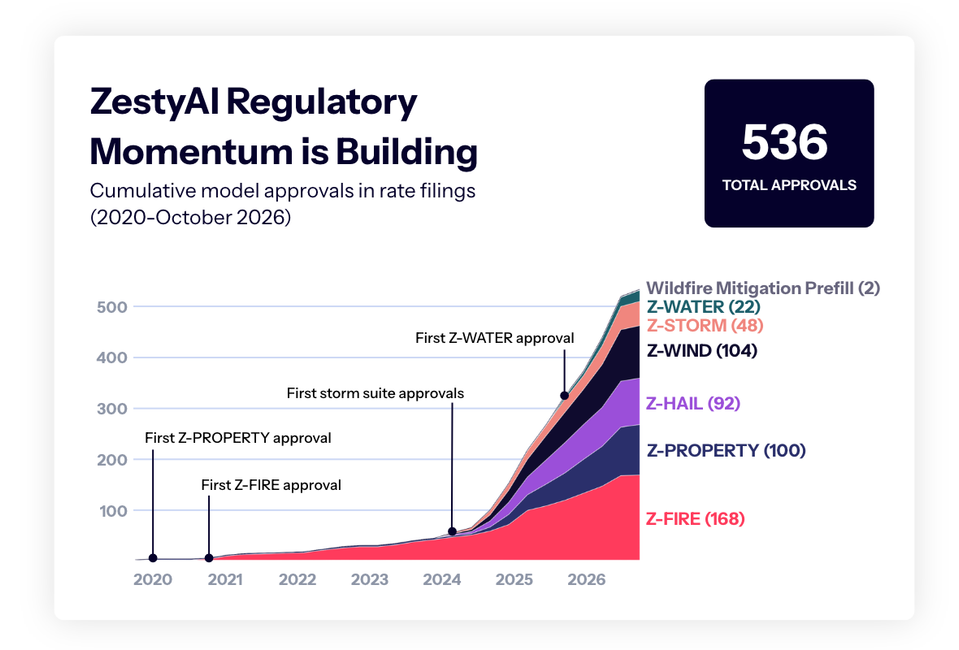
State insurance departments have approved ZestyAI’s models more than 500 times, across wildfire, hail, wind, and water – a reflection of the traction that we’ve built with regulators and carriers alike.


ZestyAI has a dedicated regulatory team that supports clients through adoption filings. Being on both sides of so many filings has given us a clear view of what gets a model approved, and what draws an objection.
We reviewed 285 approved carrier adoption filings, all of them public in SERFF, and distilled the lessons that any pricing, product or regulatory team can take into its next filing, whichever model it uses:
- How state departments differ in their approach to a third-party model;
- What departments expect when a model drives rating, eligibility, or both;
- How carriers temper and cap new factors, and how to support it;
- Why the policyholder notice is often the first objection, and what approved notices include;
- And a checklist for a successful filing.
These 536 approvals come from two sources: ZestyAI’s own Rate Service Organization (RSO) filings (which establish a model in a state before any carrier relies on it); and the subsequent carrier adoption filings that follow (where a carrier utilizes the model within its own rating plan or underwriting guidelines).
Decisions in a Carrier Adoption Filing
Once a model is established in a state, the carrier's adoption filing defines how the model is used in its own plan, which comes down to a few decisions:
- Deciding whether the model drives rating, eligibility or both;
- Fitting the factors into an existing plan and deciding what they replace;
- Deciding how far to temper or cap the indicated factors at introduction;
- Writing the eligibility rule, the policyholder notice, and the appeals process that is now required in states such as California and Colorado.
Whether you are filing a third-party model for the first time or expanding one into new states, here is what the approved filings show about each decision.
State departments differ in how they approach a third-party model
That difference shapes a filing before any decision about use. Some are open to innovation and engage early; others prefer to keep the vendor at arm’s length and review the model only through the carrier’s own filing. Each state attaches its own conditions to model adoption filings.
Nevada’s recent approval of our wind and hail models is a good example: a model output may not be the sole basis for a declination, cancellation or non-renewal; the carrier must consider individual property attributes and retain the ability to override a result on the basis of its own inspection, agent documentation or policyholder evidence; and each insurer must file the specific way the scores enter its rating plan.
Other states set their own conditions, through statute, bulletin or the terms of an approval, on notice content, mitigation credits, or eligibility use. A rule approved without comment in one state can draw an objection in the next.
Different expectations when filing for rating vs. eligibility vs. both
The simplest but perhaps most consequential decision that carriers need to make is whether the model will drive rating, eligibility, or both.
Both uses get consumer-protection questions about notice, mitigation, and the policyholder's ability to dispute a score. The difference is in the support the department expects:
- For rating: Actuarial justification of the factors and their fit with the rest of the plan.
- For eligibility: A rule that can be explained and applied to an individual property.
The use case also affects which variables a department will accept. In one state, concerns about imagery-derived roof condition attributes led us to file a version of the wind and hail models without them and to remove those attributes from the reason codes and appeal workflow there; Nevada accepted the same attributes with conditions on disclosure to carriers and on carrier override. When a department asks that a variable be removed for a given use, we supply a state-specific configuration so the carrier’s implementation matches what the department reviewed.
For rating, the dominant filing structure has been a peril-specific factor built from two ZestyAI scores: a Level 1 (frequency or community) factor multiplied by a Level 2 (severity or property) factor, applied to the base rate.
One example is a national mutual's adoption of Z-WIND and Z-HAIL across 22 US states. The carrier fit the new factors with a generalized linear model (GLM), using its existing wind and hail tier factors as offsets, and policy year, Coverage A, and age of home as controls. It then set the legacy tier factors to 1.000 and removed its tree overhang factor, since the new factors now carried those characteristics, and attached a dislocation exhibit. One of those filings, in a Midwestern state, was revenue-neutral and was approved in six weeks, with no objections pertaining to the models themselves.
For eligibility, approved filings almost never use a single ZestyAI score as the trigger.
ZestyAI’s peril risk models like Z-FIRE, Z-HAIL, and Z-WATER produce 50 to 100 distinct risk classifications, created by combining two scores together. This produces precision-level underwriting that state regulators find more palatable than traditional models. Rather than demarcating an entire region as high risk, carriers are able to utilize ZestyAI’s dual score structure to ensure that ineligible properties are high risk based not only on their geographic location, but also on their property and parcel-specific attributes.
While most states do not require eligibility guidelines to be filed, we can observe what has been made public. One national carrier non-renews only on defined combinations of the two scores (for instance, a Level 1 of 7 is non-renewed only when the Level 2 is 10; a Level 1 of 10, when the Level 2 is 5 or higher), so that a property in a high-exposure community with low property-level vulnerability stays eligible. A Midwest-based mutual declines when Level 1 is 5 or higher or the product of the two scores reaches 25. Outside public filings, there are dozens of similar examples.

Tempering and capping
Few carriers introduce the fully indicated relativities at once to avoid price shocks on renewal customers. The filings show several ways to phase them in.
- One national mutual applied its wildfire factors at 50% of indicated, calling it a conservative introduction that it would revisit; the department asked whether and when the carrier would move to full indicated.
- A large Western carrier that restructured its plan into wildfire and non-wildfire perils around Z-FIRE paired the new factors with a capping rule limiting any premium increase to 75% of current premium, inside a filing that was revenue-neutral overall.
- A residual market plan in a mountain state set its wildfire and severe convective storm factors on a blend of the Z-FIRE, Z-HAIL and Z-WIND relativities and the AAL relativities supplied by its reinsurance broker.
Departments want to see the tempering supported, and the end result consistent with the model: when one carrier placed a score factor on top of an existing wildfire territory factor, the department wanted proof that stacking the new factor on an existing territory factor did not double count wildfire risk.
The policyholder notice: a common first objection
Across perils, the first objection is more often about the policyholder than about the model.
The filings that cleared quickly attached the notice at submission: the score, the range of possible scores, the property attributes driving it, the mitigation actions that would change it, and how to dispute it.
Approved non-renewal notices establish the best practices: disclosing the score and three property-specific reasons for each of the Level 1 and Level 2 scores, as well as clearly laying out the process for policyholder appeals. The same pattern now appears outside wildfire: a Texas manufactured-home program’s approved notice discloses the third-party data used and that roof quality is assessed from aerial imagery, and Nevada conditioned its approval of our wind and hail models on insurers maintaining a dispute process for roof quality results.
Checklist for a Successful Filing with ZestyAI
Here are the best practices to bring your filing to a successful outcome sooner, based on our 536 model approvals.
- Decide rating, eligibility, or both, and how scores will be utilized on both quotes and renewals.
- Confirm whether your model provider holds an approved Rate Service Organization filing in the state, and reference it for the model description and inputs.
- Fit the factors within the existing structure, state which legacy variables are neutralized, and attach the dislocation.
- Decide how the indicated factors will be tempered or capped at introduction, and be ready to show the path from there.
- Confirm the state's conditions on model use, particularly for eligibility, and document the override process.
- Draft the policyholder notice and dispute process before submission.
- Research and complete state-specific requirements before the filing is submitted.
- Involve your model provider's regulatory team well in advance of your filing. At ZestyAI, our regulatory support covers the model memoranda and documentation, independent validation, filing and objection response support in the state, and preparation for department calls.
A large national homeowners carrier that is midway through a multi-state adoption described their experience of working with ZestyAI:
The adoption experience reinforced the value of bringing more property-specific data into product design and underwriting decisions.
One of the biggest lessons learned was the importance of engaging regulatory and implementation partners early, especially when introducing newer data or model concepts. Having strong vendor support to work through questions and explain the methodology has also been important. ZestyAI has been a great partner in the process!
– Large national homeowners carrier, ZestyAI client
Looking ahead: The next 500 approvals will not look like the first 500.
Departments are examining computer vision models more closely than they did two years ago, states keep issuing bulletins on aerial imagery and AI governance, and we expect to begin Rate Service Organization filings for Z-SPARK in the first quarter of 2027 on the same path we used for Z-WIND, Z-HAIL, Z-STORM, and Z-WATER.
If you are considering a third-party model for rating or eligibility in a specific state, or would like the filing language behind any example here, please reach out to hello@zesty.ai.
Sources: Figures are from ZestyAI's regulatory approval ledger as of October 21, 2026. Filing examples come from public SERFF records and were researched in ZORRO Discover, ZestyAI's regulatory intelligence platform.