
Resources

VYRD Selects ZestyAI to Bring AI-Powered Risk Analytics to Florida Homeowners Portfolio
Property-level insights reduce hurricane-related losses, improve risk selection, and support exposure management at scale
VYRD, a Florida-based homeowners insurance company focused on delivering stability and protection in a challenging coastal market, has partnered with ZestyAI, the leading provider of AI-powered property risk analytics, to gain deeper visibility into property condition and risk exposure across its book of business.
By leveraging the ZestyAI platform, VYRD gains access to advanced risk insights that help identify vulnerabilities contributing to hurricane-related losses, such as roof degradation, overhanging vegetation, and yard debris. These insights support more accurate underwriting, proactive portfolio management, and better visibility into changing property conditions over time.
VYRD is using two core capabilities of Z-PROPERTY: Digital Roof applies AI to high-resolution aerial imagery to assess roof complexity, materials, and condition, highlighting structural vulnerabilities before they become claims. Location Insights evaluates the broader parcel, surfacing risk factors like vegetation overhang, yard debris, and secondary structures that can amplify storm losses or drive claims severity.
“Staying ahead of risk requires strong partnerships and smarter data,” said David Howard, President and CEO of VYRD.
“ZestyAI’s ability to deliver timely, property-level insights helps us strengthen our understanding of exposure across the homes we protect and continue delivering on our promise of dependable coverage for Florida policyholders.”
Z-PROPERTY helps VYRD assess properties at scale, surface emerging risk patterns, and make more informed decisions across the policy lifecycle. This partnership extends VYRD’s tech-forward, policyholder-first strategy—using trusted data not just at point-of-quote, but throughout ongoing portfolio management.
“Florida is one of the most unforgiving insurance markets in the country,” said Attila Toth, Founder and CEO of ZestyAI. “VYRD is taking a proactive, data-driven approach—using AI to uncover hidden property-level vulnerabilities, strengthen portfolio decisions, and build resilience where it matters most.”

From High Risk to High Confidence: How One Carrier Is Rewriting the Rules of Rural Underwriting
In wildfire- and hail-prone regions, underwriting manufactured homes demands more than rules and redlines. It requires precision.
Property insurers are under growing pressure to do more with less. The risks are increasing, regulatory expectations are rising, and the margin for error keeps shrinking. In regions where wildfire, hail, and wind are intensifying, the question becomes even more urgent: how can carriers continue writing business in high-exposure areas while managing loss ratios and navigating compliance?
The challenge becomes even more complex when the homes involved are in remote locations. These properties are often far from city infrastructure, difficult to inspect, and lack consistent, structured data. That’s the reality one regional carrier faced.
Their book included thousands of rural properties, many of them manufactured homes on private land across states like Texas, Arizona, and New Mexico, as well as other regions they serve nationwide. Each presented its own underwriting hurdles, from ambiguous fire protection data to increased storm exposure and aging roof systems.
To remain active in these areas and grow responsibly, the team knew they needed a more precise way to evaluate risk at the individual property level. Broad rules were no longer enough, and legacy models designed for urban density offered little support.
The Manufactured Home Challenge: Rural, Exposed, and Hard to Inspect
Standard Casualty has specialized in insuring manufactured and modular homes for decades, serving policyholders across a wide range of states, including Texas, Arizona, and New Mexico. It’s a segment that brings unique challenges, particularly when it comes to visibility and data.
“Many of the properties we insure are located in rural areas with little to no street-level data,” said Rick Smith, Underwriting Manager at Standard Casualty.
“Some are difficult to geocode. Others are so remote that a physical on-site inspection can be challenging or expensive.”
In states like Arizona and New Mexico, many homes fall within or near the wildland-urban interface (WUI), where wildfire exposure is increasing. In Texas, hail and wind are persistent threats. And across all markets, aging structures and outdated roof data complicate rating and eligibility decisions.
The team recognized they couldn’t rely solely on fire zones or broad peril maps. They needed more nuanced, property-specific data to support confident decision-making at scale.
Getting the Full Picture, Even Without a Site Visit
“One of the big innovations for us is the availability of aerial photography,” Smith explained. “We’re seeing a lot more of our risks located in remote areas. They’re either very difficult to find or it’s very expensive to do an on-site inspection. Aerial photography really solves that problem for us.”
Using ZestyAI’s platform, the team now accesses high-resolution aerial and oblique imagery, property-specific peril scores, and roof condition insights, without always requiring physical inspections.
ZestyAI works with all the major aerial imagery providers, giving underwriters access to a broader range of coverage and more recent images than any single source could offer. That means more properties are visible, more clearly, and more often.
“We can actually accomplish through aerial photography what we can do through an on-site inspection, at a fraction of the cost, which is really important for us."
If a structure is misidentified or not aligned, underwriters can reposition the property tag themselves.
“With the ZestyAI platform, it’s very easy."
We can simply move the identifier tag with our mouse onto the correct building, click a button, and it automatically reruns the scoring and the evaluation,” Smith said.
Aerial views also improve their ability to assess roof condition and wildfire vulnerability. “Sometimes the current photo may have been taken late in the day, and there are shadows on the roof. We can back up to a photo taken six months earlier and get a clearer picture of what’s going on.”
Risk Differentiation at the Parcel Level
ZestyAI’s approach stood out by combining hazard probability with structure-specific vulnerability.
“For every peril — wildfire, hail, or wind — we now get two things,” said Smith. “First, the probability of the event occurring at that location. Second, the expected severity if it does."
"That allows us to say: these two homes are in the same neighborhood, but only one is truly high-risk.”
This dual scoring model, based on climate science and property characteristics, allows the team to evaluate each property on its own merits. “That kind of granularity is really a game changer for us in terms of underwriting,” Smith added.
Beyond Underwriting: A New Frontier in Rating and Renewal
ZestyAI’s insights also support dynamic pricing and renewals. Rather than relying on static or annual updates, risk scores adjust continuously based on the most recent information available — from new aerial imagery and roof condition changes to building permits and property improvements.
“We’re not just using the model once and forgetting it,” Smith said. “The scoring gets augmented, and as a result, the premium gets augmented as well. That means our pricing reflects current risk — not just what we assumed at inception.”
Because the models are approved for use in both underwriting and pricing, Standard Casualty can incorporate granular risk insights into its rating approach, streamlining the process of keeping rates aligned with actual conditions.
“It would take months of actuarial and analytical work to try to get to that level of granularity. And this is happening instantaneously as we renew our business.”
Retention Through Mitigation: A Smarter Approach to Non-Renewals
While many insurers are pulling back or issuing non-renewals in high-peril regions, Standard Casualty has taken a different approach: empowering policyholders to reduce their risk and stay insured.
“We can run the property eight months ahead of renewal,” Smith explained. “If we see wildfire vulnerability, we don’t just cancel. We notify the policyholder, show them what needs to change — defensible space, roof repairs, vegetation removal — and give them a chance to improve. That’s how we retain the risk and still operate responsibly.”
This proactive strategy improves retention, builds customer trust, and advances the company’s mission: improving lives by providing affordable coverage.
“This is the direction we need to go as an industry,” Smith emphasized. “We need to help policyholders understand the importance of mitigation and give them guidance so their costs — and everyone’s losses — are reduced.”
Built to Scale: Regulatory Readiness That Grows With You
One often overlooked barrier to adopting new risk models is regulatory complexity. For Standard Casualty, this was a key factor in choosing ZestyAI.
“We looked at a lot of vendors,” said Smith.
“But ZestyAI stood out because they were already approved in the states we care about and had a clear filing strategy for others.”
That alignment means the team can expand into new markets without rebuilding processes from scratch. The same tools and workflows that support Texas can be applied in Arizona, New Mexico, or future states, streamlining both operations and compliance.
“The Right Tools. The Right Decisions. The Right Time.”
As carriers navigate mounting loss pressure, tighter margins, and rising expectations from regulators and policyholders alike, Smith believes one thing will separate those who retreat from those who adapt:
“ZestyAI gives us the right tools to make the right decisions at the right time. That’s what allows us to write in places other carriers are leaving. That’s how we grow profitably, even in high-risk territories.”
Deferred Maintenance Adds $317B in Exposure for Insurers
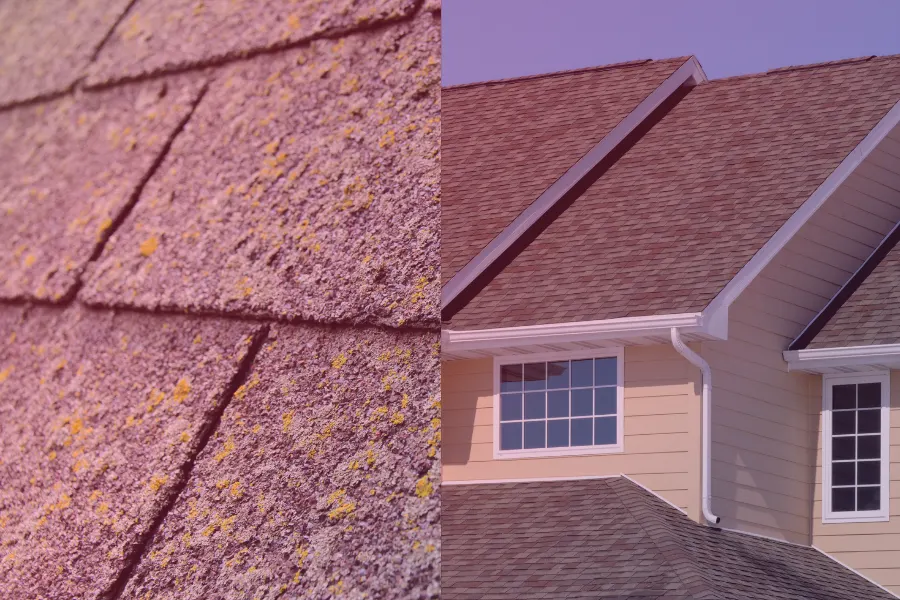
New research from ZestyAI reveals that 62% of U.S. homeowners are deferring critical home maintenance, adding up to $317 billion in potential claims exposure for insurers.
These findings come as Severe Convective Storms (SCS) caused an estimated $58 billion in insured losses in 2024, surpassing hurricane-related losses and marking the second-costliest SCS year on record.
Tornadoes, hail, and wind events now account for over 60% of all U.S. catastrophe claims, and research from the Insurance Institute for Business & Home Safety (IBHS) shows that roof damage accounts for up to 90% of residential catastrophe losses.
Key Findings from ZestyAI’s Homeowner Survey
According to ZestyAI’s nationally representative survey, 62% of homeowners have delayed essential repairs due to budget constraints, representing nearly 59 million U.S. homes with unaddressed vulnerabilities. Forty percent said they would rely on an insurance claim to cover major repairs like roof replacement, adding up to an estimated $317 billion in potential exposure for carriers.
Alarmingly, 63% of homeowners who weren’t living in their home at the time of the last roof replacement don’t know how old their roof is, making it even harder to detect aging systems before they fail. Meanwhile, 12% admitted they would delay repairs indefinitely, further increasing their risk of property damage.
Severe Convective Storms: The Growing Catastrophe Risk
This blind spot compounds known risks: prior ZestyAI analysis has identified over 12.6 million U.S. properties at high risk for hail-related roof damage, representing $189.5 billion in potential roof replacement costs.
“Deferred maintenance has long been a known risk factor, but today the stakes are higher than ever,” said Kumar Dhuvur, Co-Founder and Chief Product Officer of ZestyAI. "With claim severity rising and storm losses compounding, insurers need more than hazard maps to navigate this landscape."
"Property-level insights allow carriers to proactively address known vulnerabilities, improve underwriting precision, and work with homeowners to reduce losses before they happen.”
ZestyAI’s findings support a growing push toward data-driven, preventative underwriting strategies, especially as carriers face rising claim severity and pressure to improve combined ratios across storm-prone states.

Why Jencap Chose ZestyAI for Wildfire Risk Modeling
In today’s property insurance market, understanding wildfire risk at the individual structure level is more critical than ever. For wholesale brokers like Jencap, the ability to deliver actionable, data-driven insights to retail agents and carriers is essential, especially as wildfire conditions evolve rapidly across the country.
That’s why JenCap turned to ZestyAI.
In the video above, Ben Beazley, EVP and Head of Property at JenCap, shares two key reasons why ZestyAI’s Z-FIRE™ model stood out:
- Structure-level precision: Z-FIRE analyzes wildfire risk at the individual property level—factoring in building materials, defensible space, vegetation, topography, and historical fire patterns to predict which homes are most vulnerable and which are more likely to withstand a fire.
- Continuously refreshed data: While the core model remains stable and DOI-approved, Z-FIRE is updated with the latest fire perimeters, confirmed loss locations, and vegetation data. This ensures it reflects the most current wildfire seasons and emerging risk patterns.
- Z-FIRE is already approved for rating and underwriting in every major wildfire-prone state. For JenCap and many others, it’s become a vital tool for evaluating wildfire exposure and supporting smarter decisions in high-risk areas.
.webp)
Z-FIRE Was Built for This: Addressing the Threat of Urban Conflagration
From dense neighborhoods to high-intensity burn zones, Z-FIRE has long accounted for the drivers of urban wildfire risk.
Not every wildfire spreads through forests. Some move house to house, block to block, driven by wind, heat, and proximity. As these events become more common, insurers are asking sharper questions about how to assess risk in densely built environments.
Z-FIRE was designed to account for the real-world conditions that enable this type of fire behavior, capturing the structural, spatial, and environmental factors like building density, defensible space, mitigation strategy, climatology, and slope that contribute to urban conflagration.
What Is Urban Conflagration?
Urban conflagration refers to a fire that spreads rapidly through a densely built environment, jumping from structure to structure rather than moving solely through vegetation. Unlike traditional wildfires that primarily burn forests or grasslands, these events are driven by building materials and the adoption of fire mitigation practices, the spacing between structures, and proximity to areas that are known to be challenging for firefighters.
Wind and terrain—particularly steep slopes—often accelerate the spread, pushing fire fronts into residential areas and compounding the risk of widespread destruction. For insurers, urban conflagrations represent a uniquely challenging peril, where fire behavior is shaped as much by the built environment as by natural fuels. Without a model built to capture these dynamics, they’re nearly impossible to assess accurately.
We’ve seen what happens when wind-driven embers reach tightly packed communities. In fires like Marshall, Lahaina, and the recent Palisades and Eaton Fires, wildfires didn’t stop at the wildland-urban interface—they became full-scale urban conflagrations.
These events are stark reminders that wildfire risk doesn’t end at the edge of the forest and that densely populated areas can produce concentrated, catastrophic losses.
For insurers, these events raise a critical question: Where are the next high-concentration loss scenarios hiding in the portfolio?
When urban conflagration strikes, damage rates spike, and PML exposure can increase exponentially. Identifying the neighborhoods where construction patterns, terrain, and fuel conditions create the potential for that kind of fire behavior is no longer optional; it’s essential.
At ZestyAI, we’ve been asking, and answering, these questions for years. The Z-FIRE model was designed to do exactly that.
Built to Reflect Real-World Urban Risk
From its inception, Z-FIRE has accounted for the drivers of urban conflagration. Its two-level architecture combines neighborhood-level dynamics with property-specific characteristics, offering a detailed and scalable view of wildfire risk—even in densely built environments.
Level 1 (L1): Neighborhood Risk Score
L1 predicts the likelihood that a property will fall within a wildfire perimeter. It does this by analyzing climatology, historical wildfire behavior, terrain, fuel type, and wildfire suppression ratings to understand where fires are likely to start, spread, and grow.
Two variables are particularly important for identifying urban conflagration risk:
- Fuel Type, which accounts for both vegetative fuels and the built environment. In densely developed areas, clusters of structures can serve as fuel, particularly when combined with slope, dry conditions, or limited defensible space.
- Wildfire Suppression Rating (WSR), which indicates areas where fire suppression is likely to fail due to access, water availability, or firefighting capacity. Rather than relying on WSR alone, Z-FIRE factors in proximity to high and very high WSR zones, enabling it to capture risk spillover into nearby neighborhoods.
What sets Z-FIRE apart is how these variables interact. The model doesn’t assess them in isolation—it evaluates how multiple risk factors compound one another. This layered, interaction-driven approach allows Z-FIRE to surface hidden vulnerabilities that simpler, one-dimensional models often miss and accurately identify regions with high conflagration risk.
- L1 evaluates wildfire risk based on local terrain, fuel types, and building density. Critically, Z-FIRE incorporates two critical variables that are key indicators of conflagration risk. Both “fuel type” and proximity to areas with a High or Very High wildfire suppression rating.
- Fuel Type accounts for both vegetation and for developed land characteristics. While vegetative fuel and its management are key for wildfire, building density can become a large contributor to conflagration risk if combined with the other high-risk factors. It is important to remember that Z-FIRE allows for unlimited variable interaction; a high-density neighborhood can be at high risk of other factors, contributing to conflagration risk.
- Wildfire Suppression Rating (WSR) reflects the risk that a high-intensity fire may become impossible to manage by firefighters. Because those areas tend to be located in the WUI, Z-FIRE does not only rely on the WSR score, but also uses the distance proximity to high or very high WSR.
Level 2 (L2): Property-Specific Risk Score
At the structure level, L2 evaluates both nearby vegetation and building fuel density, a key driver of structure-to-structure ignition. This metric, validated by the Insurance Institute for Business & Home Safety (IBHS), helps Z-FIRE model how a single ignition can escalate within tightly packed neighborhoods, even in the absence of natural fuels.
Z-FIRE was trained on real-world events with clear urban conflagration patterns. In the 2017 Tubbs Fire, for example, flames spread deep into Santa Rosa, destroying dense subdivisions like Coffee Park. Similarly, recent fires such as Palisades and Eaton moved rapidly through built-up areas, where tightly spaced structures provided a continuous path of fuel.
Case in Point: Palisades and Eaton, CA
In the recent Palisades and Eaton Fires, Z-FIRE’s predictive accuracy was once again put to the test. Our analysis showed that over 91% of the affected area was already classified by Z-FIRE as high or very high risk based on Level 1 (L1) neighborhood scores.
Notably, none of the impacted areas were categorized as “Very Low Risk,” a strong validation that Z-FIRE captured the inherent vulnerability of these communities well before ignition.

Looking at Level 2 (L2) property-specific scores, the correlation between predicted risk and actual destruction became even clearer.
Structures with the highest Z-FIRE risk scores were 50% more likely to be destroyed compared to those with the lowest scores in the same fire footprint.
These destruction rates align with the model’s fundamental architecture: properties with denser surrounding structures, minimal defensible space, and combustible fuels nearby face a dramatically higher likelihood of loss during a wildfire.
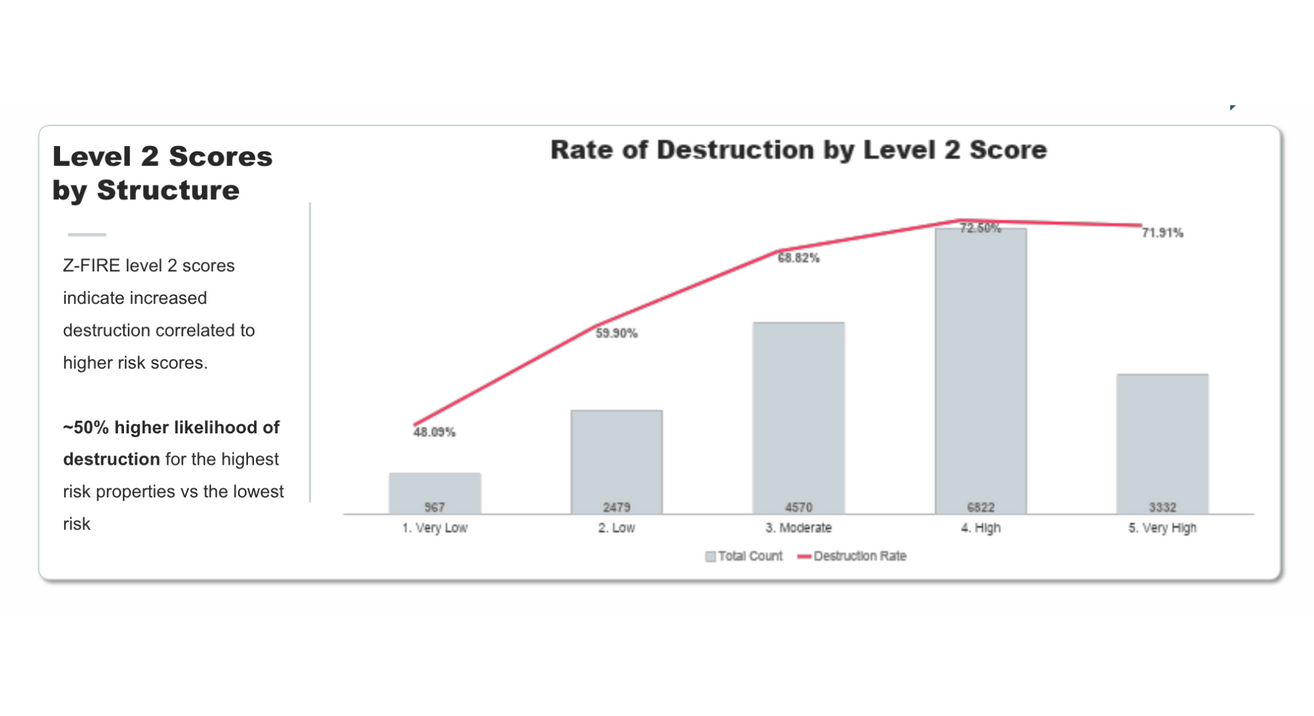
The model identified risk in this community not simply based on topography or vegetation, but because of its underlying urban structure, including building materials, spacing between homes, and neighborhood density. These are the very factors that drive vulnerability to conflagration.
Z-FIRE was designed to capture these dynamics, reinforcing its value as a forward-looking tool for rating, underwriting, and mitigation planning.
A Model Informed by What’s Happening on the Ground
Wildfire conditions are constantly changing, and Z-FIRE stays current by continuously incorporating the latest ground-truth data, including updated fire perimeters, confirmed loss locations, and vegetation conditions.
While the core model remains stable and fully approved for rating and underwriting, this steady stream of fresh data ensures that Z-FIRE reflects the most recent fire seasons and emerging risk patterns.
The 2023 and 2024 fire seasons reinforced what we’ve long understood: fire behavior is increasingly shaped by the built environment. Z-FIRE continues to perform as expected across a wide range of scenarios, including structure-to-structure ignition in densely built areas.
These results reaffirm the model’s ability to provide timely, reliable insights to support carrier decision-making in a rapidly evolving risk landscape.
Available Now, for Those Who Need It Most
For carriers looking to better understand and underwrite wildfire risk, whether in traditional WUI zones or increasingly vulnerable urban neighborhoods, Z-FIRE offers a tested, approved, and field-proven solution.
Built on over a decade of confirmed loss data and designed to capture the drivers of urban conflagration, Z-FIRE supports smarter decisions across pricing, underwriting, mitigation, and reinsurance.
Importantly, Z-FIRE is approved for underwriting and rating by Departments of Insurance (DOIs) across all western states, with Oklahoma recently added to the list. Carriers can deploy the model today with confidence, knowing it meets regulatory standards while delivering granular, property-specific insights to support risk selection, pricing, and mitigation strategies.
If you're looking to validate wildfire risk insights on your own book of business, we invite you to put Z-FIRE to the test. Our team can run a targeted evaluation to show how the model performs across your portfolio, highlighting risk segmentation opportunities and identifying properties most vulnerable to structure-to-structure spread.
Get in touch to schedule an evaluation and see how Z-FIRE can strengthen your wildfire strategy today.

ZestyAI launches AI agent to cut research time for competitive intelligence by 95%
ZORRO Discover™ automatically converts regulatory filings into actionable market intelligence — potentially saving insurers billions in costs
ZestyAI today announced the launch of ZORRO Discover™, a generative AI agent that delivers instant insights into regulatory filings and competitive market activity.
Solving a $2.5 Billion Regulatory Research Problem
Regulatory research remains one of the costliest inefficiencies in insurance, with an estimated $2.5 billion spent annually on manual reviews. The process consumes millions of hours across fragmented workflows, as filings often stretch into the thousands of pages, slowing competitive analysis and strategic decision-making.
To solve this, ZestyAI built ZORRO Discover on a proprietary generative AI pipeline, leveraging large language models optimized for insurance-specific content, including filings, objections, responses, and regulations from all 50 states.
Using agentic AI, the platform proactively navigates and synthesizes regulatory data, delivering a fast, intuitive experience tailored to the structure and language of insurance filings.
Accelerating Research by 95%
Early adopters of ZORRO Discover have found that insurers can cut research time by an average of 95%, saving thousands of work hours and millions in costs.
“For too long, regulatory filings have buried critical intelligence under layers of complexity,” said Kumar Dhuvur, Founder and Chief Product Officer of ZestyAI. “Through years of working closely with regulators, we’ve come to deeply understand these challenges.”
“ZORRO Discover puts that intelligence at insurers’ fingertips so they can act faster, stay compliant, and make smarter decisions in an increasingly competitive market.”
How Teams Use ZORRO Discover
ZORRO Discover can be used by compliance, actuarial, product, and strategy teams to accelerate competitive research and reduce regulatory risk. By replacing manual reviews with a consistent, repeatable process, the platform helps teams improve research accuracy, focus on high-impact work, and stay ahead of regulatory changes.
Key Capabilities
- Plain-language search: Analyze and compare filings across carriers, states, and time periods using intuitive queries—no deep regulatory or technical expertise required.
- Zero in on critical details instantly: Transform complex filings into executive-level insights for faster, more informed decision-making.
- Spot market opportunities early: Track shifts in rates, rules, forms, and guidelines to anticipate industry trends and act proactively.
- Run side-by-side comparisons: Evaluate pricing strategies, regulatory objections, or model usage over time and across competitors. Example: Compare windstorm mitigation discounts across three major carriers in Florida.
Expanding to Additional Lines of Business
ZORRO Discover launches with a focus on homeowners insurance and is rapidly expanding to support regulatory and competitive intelligence across auto, commercial, and additional lines of business.
Request early access to ZORRO Discover here.
Ready to see how ZestyAI works on your book of business?
Tell us a little about your needs. We'll show you how we reduce losses and help you price with precision.