
Reports & Research
Explore proprietary research packed with data, insights, and real-world findings to help carriers make smarter decisions.
.png)

AI in Insurance: How to Stay Ahead of the Curve
Artificial intelligence is reshaping the P&C insurance industry, offering new ways to streamline underwriting, enhance risk management, and navigate evolving regulations.
But as AI adoption accelerates, insurers must ensure they’re using these technologies effectively—balancing innovation with compliance.
Our latest guide explores the most impactful AI applications in insurance, including:
- AI-powered underwriting and predictive analytics
- How regulators are shaping the future of AI in insurance
- Best practices for integrating AI while ensuring fairness and transparency
As AI-driven tools become the new standard, insurers who adapt early will gain a competitive edge.
Download our free guide to leverage these innovations while staying aligned with evolving regulations.

The Truth About Roof Age: 5 Critical Insights Every Insurer Should Know
For insurers, accurate roof age data is essential. Yet, self-reported information often falls short.
Our research shows that 1 in 5 homeowners underreport roof age by an average of 8 years. These discrepancies create hidden risks that can impact underwriting, pricing, and overall portfolio performance.
How can insurers get a more accurate picture?
AI-driven insights provide 97% nationwide coverage, combining verified roof age with real-time condition data for a more comprehensive risk assessment.
Download our latest research for a breakdown of five critical insights that every insurer should know about roof age.
Plus, get access to The Roof Age Advantage, an exclusive video that unveils how AI is setting a new standard for risk evaluation.
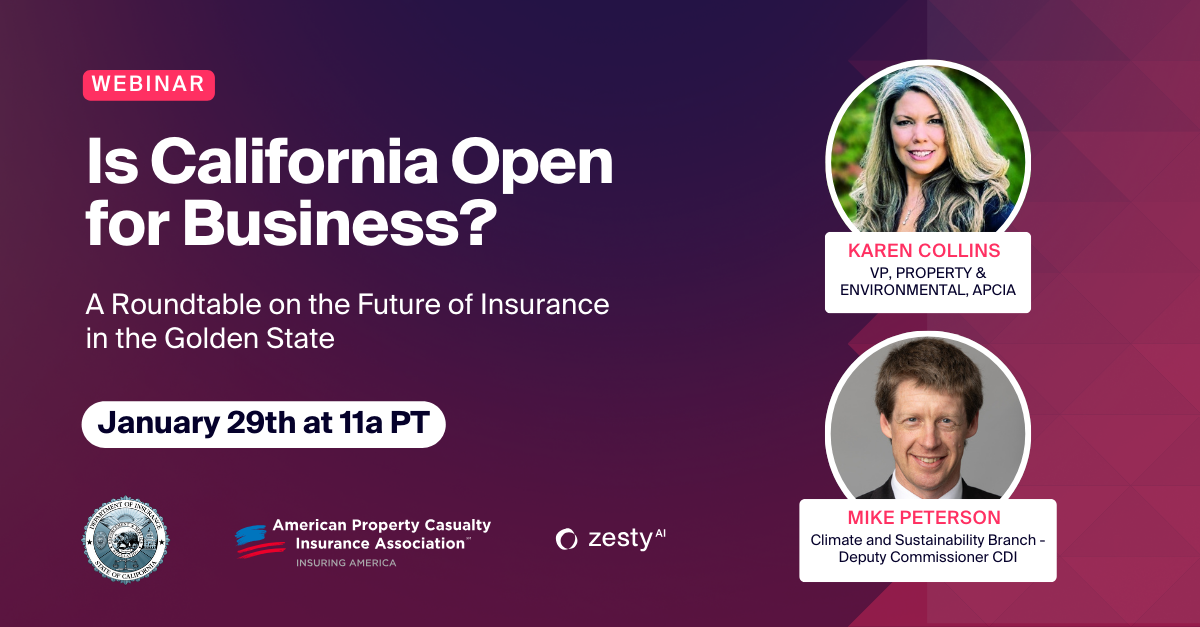
Now Streaming: Navigating California's Evolving Insurance Landscape
The California Department of Insurance (CDI) has introduced significant updates as part of its Sustainable Insurance Strategy. These new bulletins and draft regulations aim to accelerate regulatory approvals, embrace forward-looking models, and address critical reinsurance challenges.
But what do these changes mean for insurance carriers—and how can you prepare?
On January 29, 2025, we hosted a webinar, California’s Evolving Insurance Landscape: The Future of Insurance in the Golden State.
Designed for Legal & Compliance professionals, Product Managers, Underwriters, Actuaries, and Risk & Innovation leaders, the discussion featured expert insights from:
- Michael Peterson, Deputy Commissioner of Climate & Sustainability, California Department of Insurance
- Karen Collins, VP, Property & Environmental, APCIA
- Bryan Rehor, Head of Regulatory Affairs, ZestyAI
Missed the live event but want to gain actionable insights from industry leaders at the forefront of California’s insurance evolution? Watch on demand now!
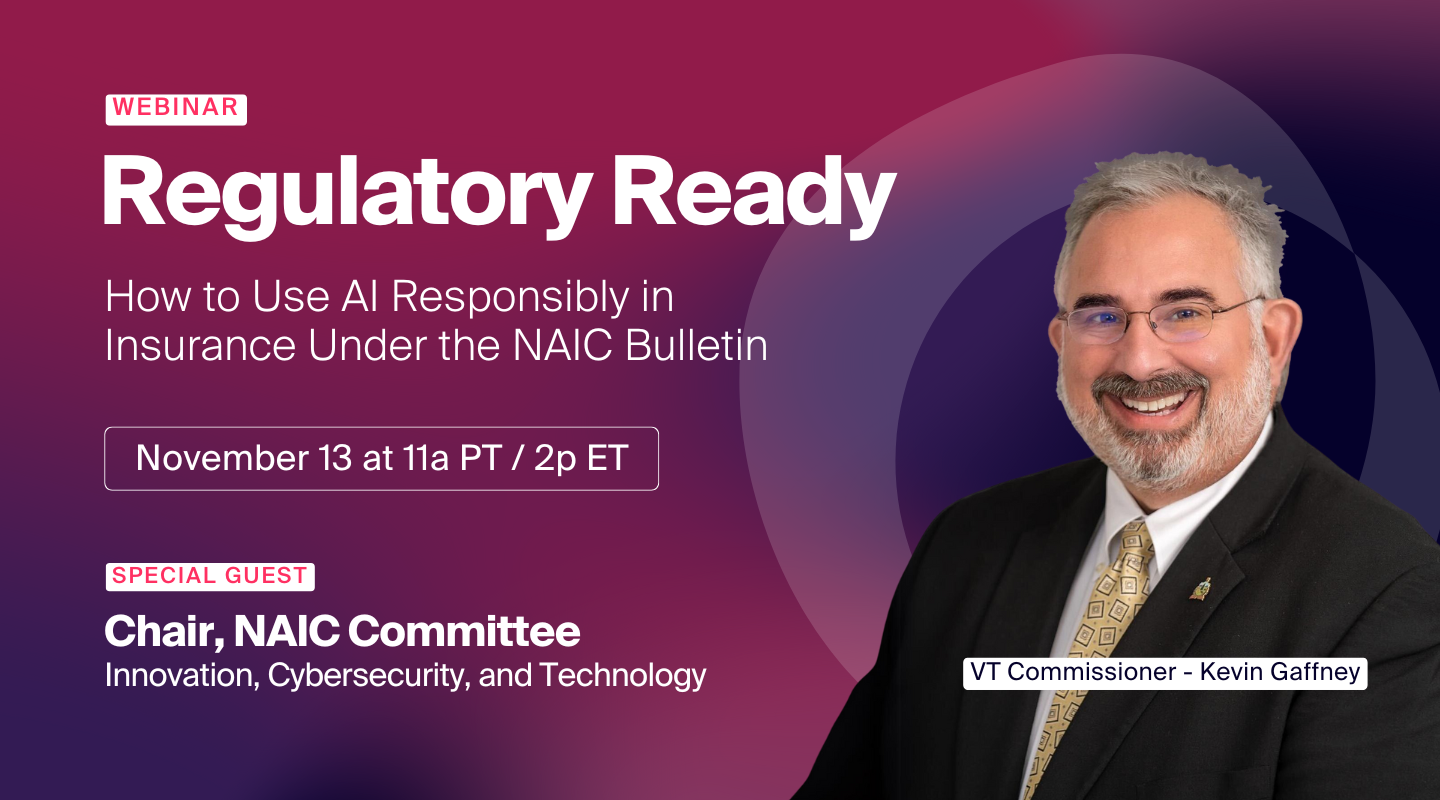
Webinar: Regulatory Ready - How to Use AI Responsibly in Insurance
Gain a deeper understanding of the NAIC bulletin's principle-based approach to AI regulation and what it means for carriers.
Regulatory Ready: How to Use AI Responsibly in Insurance Under the NAIC Bulletin
AI innovation is revolutionizing the insurance industry, but with these advancements come new regulatory challenges. To ensure responsible use of AI in insurance, it’s essential to stay informed about the latest regulatory frameworks.
Join us on November 13 at 11 PT / 2 ET for an exclusive webinar where we’ll break down how to navigate AI regulations under the NAIC Model Bulletin.
In this session, led by
- Kevin Gaffney, Vermont’s Commissioner of Financial Regulation and Chair of the NAIC’s Innovation & Tech Committee
- Bryan Rehor, Director of Regulatory Strategy at ZestyAI
you'll gain critical insights on how to align AI usage with evolving regulatory expectations.
What You’ll Learn
This webinar will provide practical takeaways that can help insurance professionals understand and comply with the latest AI standards:
- NAIC Model Bulletin Overview: Understand the core principles behind the NAIC’s AI regulation framework.
- Ensuring AI Compliance: Learn how to ensure responsible AI usage according to NAIC standards.
- Preparing for Regulatory Oversight: Get ready for closer state-level inspections and regulatory scrutiny.
- Vendor & Partner Compliance: Ensure that your partners meet regulatory requirements for transparency and fairness.
- Interactive Q&A: Take advantage of the opportunity to ask our experts about the complex world of AI and insurance compliance.
Meet the Experts
Kevin Gaffney
Vermont Commissioner of Financial Regulation
As an expert in AI regulations and the NAIC’s Model Bulletin, Commissioner Gaffney will provide key insights into how insurance companies can effectively implement responsible AI practices. His experience in overseeing state-level financial regulation will offer attendees a unique perspective on aligning AI innovation with compliance.
Bryan Rehor
Director of Regulatory Strategy at ZestyAI
Bryan Rehor will offer practical advice on maintaining AI compliance while harnessing the full potential of AI innovation. His expertise lies in guiding insurers through regulatory demands, ensuring that AI practices meet industry standards while avoiding common pitfalls.
Why You Should Attend
This webinar is tailored for professionals in insurance, particularly those in Executive, Legal, Compliance, Product Management, Underwriting, Actuarial, Risk, and Innovation roles.
Whether you’re navigating the complexities of AI regulation or preparing for the next steps in compliance, this session will provide actionable insights to help you move forward confidently.
Bonus Content
By registering for the webinar, you’ll receive our interactive guide:
“When Innovation & Regulation Meet: What Insurers Need to Know About AI and Regulatory Compliance.”
This resource will deepen your understanding of how to stay compliant while leveraging the power of AI in your insurance operations.
Don’t miss out!
Register for the webinar and ensure your spot in this exclusive event.
.png)
The State of the Industry: AI Adoption in Climate Risk Management
A survey of insurance professionals highlights AI models gaining traction, key insurer priorities, and the impact of transparency and regulatory concerns.
Facing Unprecedented Climate Challenges
The insurance industry is facing unprecedented challenges as natural catastrophic events like convective storms and wildfires become more frequent and severe. Traditional risk models, which often rely on broad territory-based segmentation, are struggling to keep up with these dynamic environmental threats. This has led to significant financial losses for insurers, who are now seeking more accurate and proactive methods to predict and manage climate risk.
AI Adoption in Property and Casualty Insurance
To shed light on the adoption of these cutting-edge techniques, ZestyAI conducted a survey of over 200 executives in the Property and Casualty (P&C) insurance sector. The survey reveals which AI-based models are gaining traction, what features insurers prioritize, and how transparency and regulatory concerns are shaping the industry. It also highlights the specific risks that are top of mind for carriers today.
AI Transforming Risk Assessment Models
The industry is turning to AI-based risk assessment models that offer a new level of precision. Companies like ZestyAI are leading the charge, providing tools that enable insurers to assess risk on a property-by-property basis, considering both individual property features and their interaction with surrounding environmental factors. These advanced models are transforming the way insurers underwrite policies, optimize portfolios, and align coverage with actual needs.
Dive deeper into our findings and explore the full report by clicking below.
Access the Report
Case Study: Adapting to Escalating Severe Convective Storm Risk
Insights from a 5-year retrospective on ZestyAI’s models in action
The Rising Threat of Severe Convective Storms
The past few decades have seen a dramatic rise in the frequency and intensity of severe convective storms, resulting in significant financial repercussions for the insurance industry. In the last year alone, insured losses from severe convective storms reached an astounding $60 billion, marking an average annual growth rate of over 11% over the past twenty years. This alarming trend means a new approach is needed to manage and mitigate the escalating risks associated with severe weather events.
In the last year alone, insured losses from severe convective storms reached an astounding $60B, marking an average annual growth rate of over 11% over the past twenty years.
The traditional methods of risk assessment and management are no longer sufficient to cope with the increasing unpredictability and severity of these weather events. As the risk evolves, so must the solutions. Changing risks call for innovative solutions that leverage advanced technology and data analytics to enhance the accuracy and effectiveness of risk modeling.
A New Approach
ZestyAI’s Z-HAIL and Z-WIND models are specifically designed to address the challenges posed by severe convective storms. In a new retroactive case study, we explore the performance of these models on a carrier’s book of business over the prior five years, highlighting their effectiveness in delivering comprehensive coverage and precise risk segmentation.
Key findings from the case study include:
Comprehensive Coverage with High Accuracy
One of the standout results from the case study is the exceptional hit rate of 99.7% achieved by Z-HAIL and Z-WIND. This shows the models were able to accurately identify and assess the risk of severe convective storms for nearly all the properties in the carrier's portfolio.

Strong Risk Segmentation
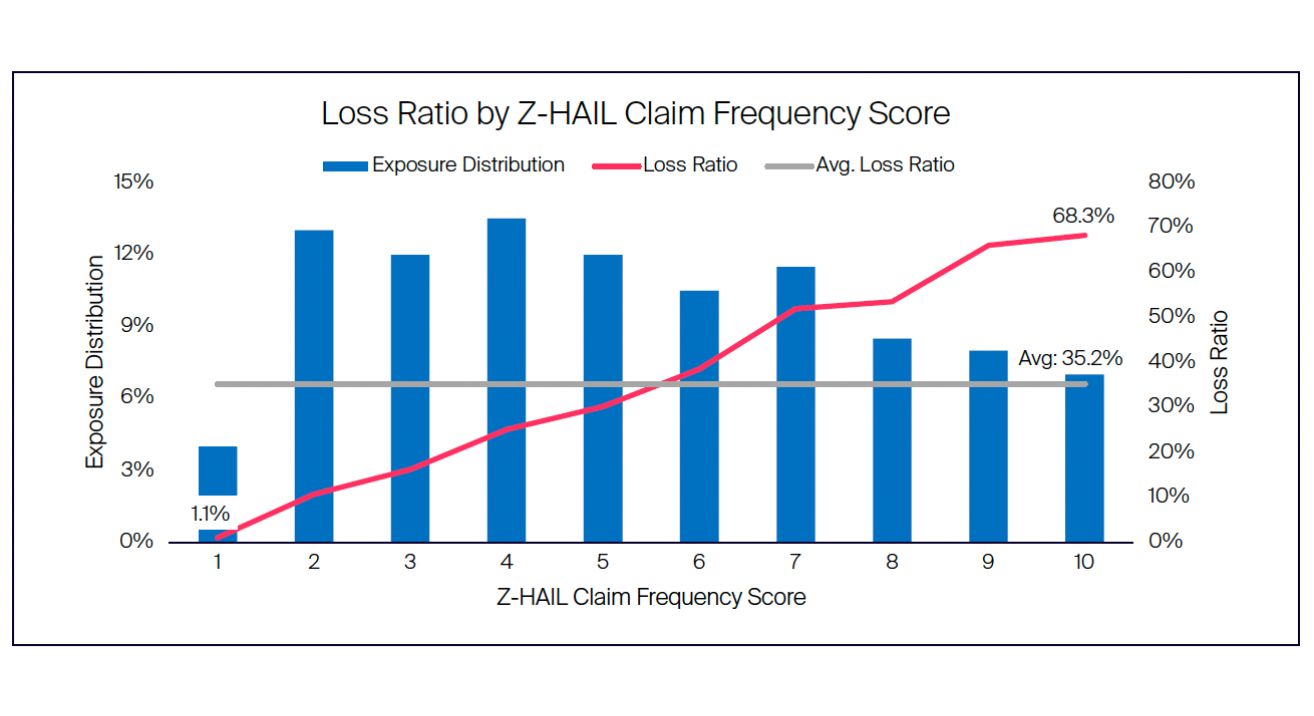
The models demonstrated remarkable capability in risk segmentation, with Z-HAIL generating a lift of 62X and Z-WIND achieving a lift of 9.7X. This means that the models were able to effectively differentiate between high-risk and low-risk properties, even within small geographic areas such as a single zip code. Accurate risk segmentation allows insurers to tailor their policies and pricing strategies more precisely, leading to better management of their risk exposure.
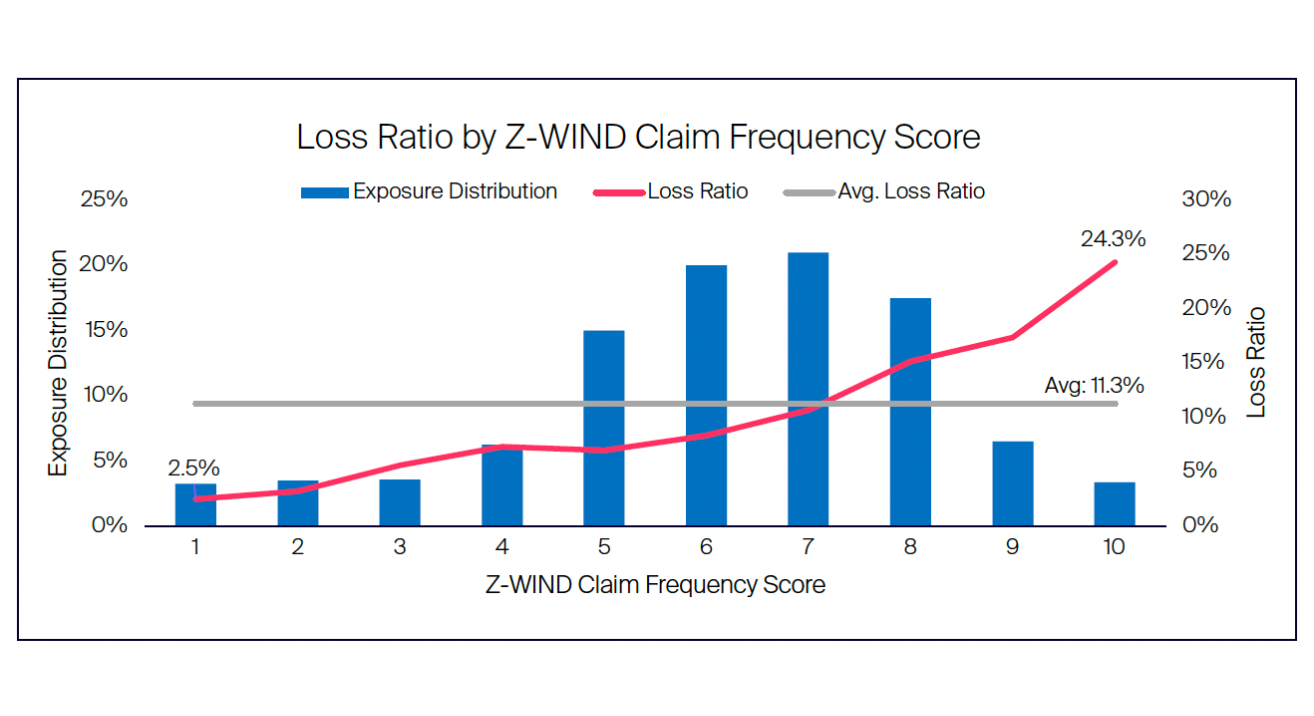
Improved Combined Ratio
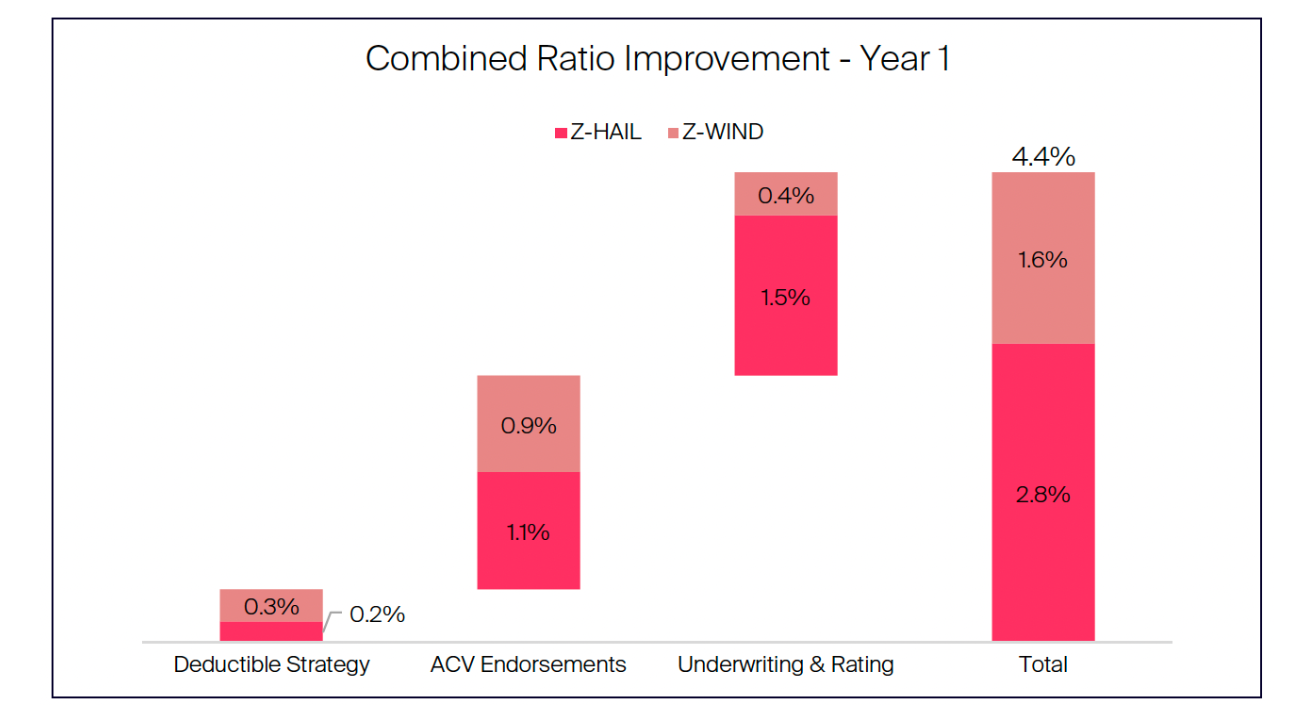
Implementing Z-HAIL and Z-WIND would significantly enhance a carrier’s combined ratio, calculated to be approximately 4 points in the first year. This improvement can be attributed to the models’ ability to optimize underwriting, rating, and the application of deductibles and Actual Cash Value (ACV) endorsement strategies. By accurately assessing the risk and applying appropriate measures, insurers can reduce their loss ratios and improve overall profitability.
The Need for Innovative Solutions
As severe convective storms continue to pose significant challenges to the insurance industry, adopting innovative solutions like ZestyAI’s severe convective storm models can help insurers better manage this escalating risk.
These models provide comprehensive coverage, accurate risk segmentation, and improved financial performance. By embracing advanced technology and data-driven analytics, insurers can navigate the complexities of severe weather events and safeguard their portfolios against future losses.
To learn more about the detailed findings and benefits
Download the full case study.
DUAL Strengthens Storm Risk Underwriting and Rating With ZestyAI
ZestyAI’s Z-STORM™ delivers property-level predictions into hail and wind risk to support rapid U.S. expansion
DUAL North America Inc.’s (“DUAL”) personal property division has selected ZestyAI’s Z-STORM™ model to enhance storm-risk underwriting and pricing as it continues its rapid US expansion.
The partnership equips DUAL with sharper risk differentiation, more accurate underwriting and pricing, and a stronger foundation for sustainable growth in regions increasingly affected by severe convective storms.
By adopting ZestyAI’s severe convective storm model, DUAL will strengthen its ability to identify and price the combined effects of hail and wind with greater precision. This will enable faster, more informed decisions and profitable expansion while maintaining regulatory compliance.
The collaboration reflects DUAL’s continued investment in advanced analytics and technology to support long-term growth.
The specialty program administrator, offering more than 40 insurance products and surpassing $1.3 billion in gross written premium in 2024, continues to broaden its capabilities across commercial, specialty, and personal lines.
Luke Wolmer, Chief Actuary at DUAL, said:
“As we continue to grow across personal property lines, having accurate risk prediction at the property level is crucial."
Z-STORM gives us a more nuanced understanding of storm vulnerability, helping us recognize differences in risk that traditional models overlook. This enhances our team’s confidence in pricing decisions and will support our continued expansion across the U.S.”
Z-STORM is an AI-powered risk model that evaluates the combined effects of hail and wind to predict the frequency and severity of storm-related damage at the property level. By analyzing the interaction between local climatology and the unique characteristics of every structure—including roof condition, material, and surrounding exposure—the model delivers precise, property-specific insights into storm vulnerability.
In September 2025, ZestyAI introduced mitigation-aware scoring to its severe convective storm suite, allowing insurers to dynamically adjust risk scores to reflect verified improvements such as roof replacements, upgraded materials, or corrected property data. This enhancement gives carriers a scalable way to recognize mitigation within pricing and underwriting workflows, advancing transparency and regulatory alignment.
Attila Toth, Founder and CEO of ZestyAI, said:
“DUAL’s adoption of Z-STORM reflects a forward-thinking approach to storm risk management."
"By applying property-level risk analytics and mitigation-aware scoring, DUAL is positioned to underwrite more precisely, grow responsibly, and strengthen community resilience across the regions that are most exposed to extreme weather”.
ZestyAI’s storm models are regulatory reviewed and ready to use across the Great Plains, Midwest, and U.S. South, regions most impacted by severe convective storms, and are actively used by carriers for rating and underwriting.

ZestyAI Expands Agentic AI Platform Across All P&C Lines
ZestyAI today announced the expansion of ZORRO Discover™ to all property and casualty insurance lines.
ZORRO Discover analyzes millions of state filings to surface real-time regulatory and market intelligence, giving carriers actionable insights to make faster, more confident decisions. Carriers using the platform have reduced adverse selection, accelerated regulatory approvals by up to 50%, and expanded analytical capacity more than 20-fold—turning what was once a manual, fragmented process into a source of strategic advantage.
The platform now delivers unified visibility across all P&C lines, including Commercial Auto and Property, Personal Auto and Property, Financial and Specialty Lines, Liability and Professional Lines, Workers’ Compensation, and Administrative filings—covering every major filing type across the United States.
Built on ZestyAI’s Agentic AI platform, ZORRO Discover scales decision intelligence across the insurance industry, transforming over a decade of U.S. insurance filings into a single, transparent system of insight. Carriers can instantly benchmark competitors, analyze rating trends, and anticipate regulator feedback and objections in real time, turning regulatory filings from a compliance requirement into a strategic advantage.
Kumar Dhuvur, Chief Product Officer and Co-Founder at ZestyAI, said:
“Every corner of P&C faces the same challenge: too many filings and too little time. Now, whether it’s workers’ comp in Texas or commercial auto in California, teams can simply ask ZORRO and get instant, verified insights in real time.”
By analyzing past objections and outcomes, teams can anticipate regulators’ questions before they arise and move filings forward with precision. Live monitoring of new submissions keeps organizations current on competitor moves and market shifts, turning what was once a fragmented, manual workflow into a real-time decision system that helps teams act quickly and strategically.
With its conversational interface, users can simply ask ZORRO to surface insights that once took hours or days to uncover. Product, actuarial, and regulatory teams can now collaborate from a single, auditable source of truth, replacing manual searches and static spreadsheets with transparent, explainable intelligence that drives faster, smarter action.
ZORRO Discover is available now for all property and casualty insurance lines.
Start your trial.
Smarter Roof Age for Smarter Risk Decisions
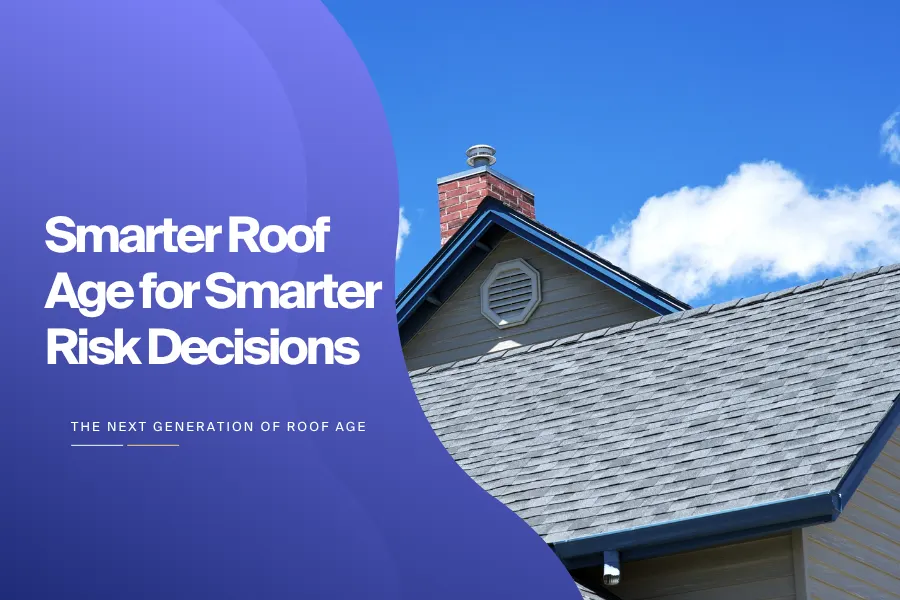
The Next Generation of ZestyAI’s Roof Age Product
At ZestyAI, we know that better data leads to better decisions. That’s why we’ve invested in a major upgrade to our Roof Age product, trusted by leading carriers to improve risk selection, pricing, and operational efficiency in property insurance.
Today, we’re excited to share what’s new, what’s improved, and how these advancements are already helping carriers strengthen underwriting, rating, and inspection workflows.
What’s New in Roof Age
We’ve taken a holistic approach to improving performance, accuracy, and efficiency. Here’s what you’ll find in the latest release:
Refit model with double the training data
We’ve significantly enhanced the Roof Age model, doubling the size of our training dataset to improve performance across diverse housing stock, roof types, and geographies.
This expanded dataset incorporates more confirmed roof replacement events and broader regional variation, allowing the model to generalize more effectively to different parts of the country, including historically underrepresented regions.
The model is now better able to distinguish between full roof replacements and other types of roof-related activity, such as solar panel installation, patched sections, partial replacements, or home additions.
These events may alter the roof’s appearance or condition, but don’t represent a comprehensive replacement. By learning the subtle visual and contextual cues that separate these scenarios, the model delivers more accurate predictions and reduces the risk of misclassification.
Enhanced estimation for challenging cases
In cases where no building permit is available and roof replacement can’t be clearly confirmed via aerial imagery, our improved Roof Age Estimation Model takes over. This model, now trained on double the dataset, is purpose-built for ambiguity.
It leverages not only imagery and property-level features but also regional climatology, using knowledge of local weather patterns and environmental stressors to inform its estimate.
For example, a roof in the Southeast exposed to intense sun and humidity will age differently than one in the Pacific Northwest or Upper Midwest. Incorporating these regional factors helps improve estimation accuracy, even when direct replacement signals are unavailable.
ZestyAI also establishes a minimum roof age, providing additional clarity and confidence. Using our extensive, 20-year aerial imagery catalog, we can identify the earliest visual evidence of the current roof.
If no replacement activity is detected over a known span of time, we can confidently assert that the roof is at least that old.
This minimum age is then used not just as a floor, but as a valuable input to further refine the overall roof age estimate, narrowing the prediction with greater precision than models limited to single-source or snapshot data.
This capability provides underwriters and actuaries with a powerful, high-confidence signal, particularly valuable for pricing segmentation, inspection prioritization, and risk selection strategies.
Intelligent cross-validation logic
The model doesn’t rely on a single data source. Even when a strong signal like a building permit is available, it cross-validates with high-resolution aerial imagery to detect inconsistencies, like permits that were filed but not followed through, or replacements that occurred without permits.
This layered logic helps ensure predictions are grounded in current conditions, not just administrative records. It also improves detection of fraud, data entry errors, or outdated assumptions in property records.
This logic creates a "trust but verify" framework that boosts both precision and confidence in every prediction.
To illustrate, imagine a home built 12 years ago. The model begins by anchoring to the construction year, then scans forward through our aerial imagery catalog and permit records to assess whether a roof replacement has occurred.
By grounding the analysis in the property's timeline, the model avoids misinterpreting the original roof as a newer installation and increases confidence in identifying true replacement events.
Expanded imagery catalog
We’ve enriched our aerial imagery sources to improve roof verification across geographies. The result: more accurate verification of roof replacements and improved model performance in hard-to-cover geographies.
This helps carriers score more properties with higher confidence, especially in rural or previously under-covered regions.
Confidence scores for every prediction
Every Roof Age prediction now comes with a confidence score, helping carriers make more informed decisions. High-confidence predictions can be fast-tracked for automated processing, while lower-confidence scores can trigger secondary review or inspection.
This added transparency empowers carriers to make risk-based decisions not only on the prediction itself, but on how much to rely on it.
Improved Performance Behind the Scenes
We’ve also made significant infrastructure upgrades to enhance product speed and reliability.
- Reduced Latency: Infrastructure improvements have cut average response times to under 2.5 seconds per property, making Roof Age a real-time-ready solution for quoting and policy decisions.
- Stricter Quality Controls: We’ve added new safeguards to filter out imagery that’s blurry, outdated, or contains visual artifacts. Only high-resolution, high-confidence inputs are used to power predictions.
- Scalability: These backend improvements also allow us to handle larger portfolios with more concurrent requests. This is ideal for carriers integrating Roof Age into enterprise systems.
Easier Access for Every Workflow
Roof Age is available wherever you need it:
- In Z-VIEW: Easily visualize Roof Age predictions and supporting evidence with property-level insights directly in our web application.
- Via API: Seamlessly score entire portfolios and integrate directly into your quoting, pricing, or inspection strategies.
Ready to See the Results for Yourself?
The feedback from the market has been tremendous, and we’re just getting started. Want to see the results for yourself? We’re inviting carriers to pilot the new Roof Age model and evaluate its performance on their own book of business.
Get in touch to schedule your Roof Age pilot
Brava Roof Tile Selects ZestyAI’s Roof Age and Z-PROPERTY™ to Advance Data-Driven Roof Performance
AI-driven roof and parcel-level insights validate real-world performance of synthetic roofing solutions
ZestyAI announced that Brava Roof Tile, a leader in premium synthetic roofing solutions backed by Golden Gate Capital, has selected ZestyAI to validate the real-world performance of its roofing systems during past storms.
How Brava Roof Tile Uses ZestyAI’s Property and Roof Intelligence
Brava Roof Tile is leveraging three of ZestyAI’s proven solutions to bring greater clarity to roof performance and replacement opportunities. Roof Age synthesizes building permit data with 20+ years of high-resolution aerial imagery, applying advanced machine learning to deliver verified roof age estimates with 97% U.S. coverage.
Within Z-PROPERTY™, Digital Roof applies AI to assess roof complexity, materials, and condition, flagging vulnerabilities before they become costly failures, while Location Insights evaluates the broader parcel to surface risk factors such as vegetation overhang, yard debris, and secondary structure.
Together, these insights provide comprehensive coverage, unmatched accuracy, and fast deployment at scale, turning property-level data into actionable guidance on roof vulnerabilities and replacement opportunities.
Validating Real-World Resilience With Property-Level Data
“Brava is committed to helping homeowners protect their most valuable asset with roofs that combine durability, sustainability, and beauty,” said Matt Pronk, Chief Financial Officer of Brava Roof Tile.
“With ZestyAI, we gain a clear, data-driven view of how roofs perform in the real world and use those insights to guide families toward stronger, longer-lasting protection.”
“Brava Roof Tile is showing how ZestyAI's risk analytics can be applied to validate resilience in the real world,” said Attila Toth, Founder and CEO of ZestyAI.
“Our mission is to protect families, communities, and their financial wellbeing, and our unmatched coverage and accuracy make that possible at scale."
How ZestyAI Models Work: A Deep Dive into Property-Level Risk
At ZestyAI, we’re often asked:
What Does “Property-Level” Mean?
What Makes ZestyAI Different from Traditional Risk Models?
Are ZestyAI Models Approved for Use in Underwriting and Rating?
This post answers the most common questions we receive from underwriters, actuaries, regulators, and technology partners—using wildfire, hail, wind, water, and storm perils as examples of how we turn complex data into actionable insights.
What Does “Property-Level” Mean?
Traditional risk models often rely on ZIP codes, territories, or broad regional averages to assess hazard and vulnerability. Stochastic models may support property-specific analysis, but they typically require external data sources, which adds cost, complexity, and inconsistency.
At ZestyAI, we assess each structure based on its physical characteristics and how it interacts with the surrounding environment.
We assess:
- Parcel boundaries and building footprints
- High-resolution aerial and oblique imagery
- Topography, slope, and vegetation
- Structural details like roof shape, materials, and defensible space
By integrating climatology with the built environment, we generate contextual risk scores that capture how each property’s physical characteristics, regional climatology, and historical loss experience interact to shape real-world risk.
That drives smarter decisions in underwriting, pricing, and mitigation, without relying on assumptions or manually sourced data.
What Makes ZestyAI Different from Traditional Risk Models?
Traditional risk tools often rely on:
- Broad hazard zones that can’t distinguish risk within a ZIP code
- Infrequent model updates that fail to reflect current conditions
- Over-simplified proxies—often relying solely on factors like year built—without accounting for deeper structural nuance
- Manual inspections that are slow, inconsistent, and costly
ZestyAI takes a fundamentally different approach.
Our models:
- Use gradient boosted machines that capture complex interactions between property features and environmental conditions
- Are trained on millions of actual insurance claims, not simulations, ensuring outputs reflect real-world loss experience
- Leverage both imagery (e.g., high-resolution aerial and oblique photos) and non-imagery sources (e.g., permits, climatology, topography)
- Continuously incorporate new data to reflect changing exposures
- Provide parcel-level risk scores with full transparency and regulator-ready documentation
With 97%+ U.S. property coverage, ZestyAI delivers national models with localized precision, helping carriers segment risk, price accurately, and respond to today’s evolving climate risks.
Are ZestyAI Models Approved for Use in Underwriting and Rating?
Yes. ZestyAI’s models, including Z-FIRE™, Z-HAIL™, Z-WIND™, Z-WATER™, and Z-STORM™, have been approved for use in underwriting and rating across the U.S.
Our regulatory approach is grounded in a few key principles:
- Transparency: We provide clear, regulator-ready documentation, including model methodology, variable selection rationale, and statistical validation.
- Collaboration: We work directly with carriers and state regulators throughout the filing process, from pre-submission briefings to objections.
- Responsible Innovation: Our models are trained on real-world claims, regularly updated with new data, and built with fairness and explainability in mind.
We support filings with:
- Detailed methodology and input documentation
- Variable importance rankings and validation studies
- Pre-built regulatory summaries to streamline the review
- Ongoing support throughout the regulatory lifecycle
ZestyAI has a track record of success navigating regulatory review. We help carriers adopt cutting-edge risk models with confidence and compliance.
Roof Age vs. Roof Condition: What’s the Difference?
ZestyAI’s models distinguish between roof age and roof condition, treating them as complementary signals that together provide a more accurate picture of roof-related risk, especially for hail and wind.
Roof Age is validated using a combination of building permit data and aerial imagery, analyzed through multiple proprietary methods simultaneously. We assign confidence scores to each roof age and apply minimum roof age rules to avoid false positives, ensuring the data is robust, even in jurisdictions with limited permitting records.
Roof Condition is assessed through computer vision models applied to high-resolution aerial imagery. These models detect visual signs of degradation, such as discoloration, wear, patching, and debris, that may not correlate with official replacement dates.
Why does this matter?
Because many insurers rely solely on reported roof age, which is often missing, outdated, or self-reported.
Our approach captures:
- Properties with older roofs that are still in good shape (and may be lower risk)
- Properties with newer roofs already showing signs of wear (and may be higher risk)
- Up-to-date roof vulnerability that static datasets can’t match
Together, roof age and condition power smarter decisions in underwriting, pricing, and mitigation—grounded in observable reality, not assumptions.
Modeling Approach: Why Gradient-Boosted Machines (GBMs)?
ZestyAI's risk models use gradient boosted machines (GBMs), a machine learning technique that delivers powerful predictive performance while remaining transparent and regulator-ready.
We use GBMs because they:
- Achieve high predictive accuracy by combining many simple decision trees into an ensemble that learns from its own errors over time, ideal for capturing complex insurance risk signals.
- Model non-linear interactions between variables, such as how roof complexity, condition, and regional climatology jointly influence risk, something traditional models or GLMs often miss.
- Enable transparency and explainability, with tools like feature importance rankings, partial dependence plots, and SHAP values that help underwriters, actuaries, and regulators understand what’s driving risk scores.
- Support a wide range of input types, from imagery-derived features to structured data like permits, topography, and property characteristics, all in one unified framework.
The result: a modeling approach that delivers real-world impact, supporting smarter underwriting, better pricing, and confident regulatory adoption.
How Z-FIRE Evaluates Wildfire Risk
Z-FIRE is ZestyAI’s structure-level wildfire risk model, built to capture both traditional wildland fire exposure and the growing threat of urban conflagration. Unlike traditional hazard maps that apply uniform risk zones across ZIP codes or counties, Z-FIRE delivers granular, property-specific risk scores for every structure in the U.S.
The model includes two levels of scoring:
- Level One: Exposure Risk – Evaluates how likely a structure is to fall within a future wildfire perimeter, based on vegetation, slope, elevation, proximity to the wildland-urban interface (WUI), historical burn patterns, and regional climatology.
- Level Two: Structure Vulnerability – Assesses how likely that structure is to be damaged if a wildfire occurs nearby. This score factors in structural characteristics like building materials, defensible space, and surrounding fuels, extracted from aerial imagery using computer vision.
Together, these scores provide a more complete view of wildfire risk: not just where fires may happen, but how individual structures are likely to perform.
Z-FIRE also captures non-traditional wildfire scenarios, including embers and wind-driven fires that jump the WUI and ignite dense suburban and urban neighborhoods. This makes the model particularly valuable for identifying concentration risk, urban conflagration, and managing PML across books of business.
Z-FIRE is validated on millions of insurance claims and performs reliably across all geographies—from the forests of California and the grasslands of Texas to emerging risk zones in Colorado, Oregon, and the Eastern U.S.
How Z-HAIL Accounts for Roof Vulnerability
Z-HAIL is a property-specific hail risk model designed to assess not just the likelihood of hail, but how damaging it will be to a specific structure.
Unlike traditional models that rely on historical hail frequency alone, Z-HAIL captures the interaction between local climatology and structural resilience by analyzing:
- Hail climatology: storm frequency, hailstone size, and intensity at a hyperlocal level
- Roof geometry and materials: pitch, complexity, covering type, and other features that influence how hail impacts a roof
- Property-specific vulnerability factors: including building height, exposure, and roof condition (derived from imagery and computer vision)
By modeling how hail behaves in a given location and how a specific roof is likely to perform under those conditions, Z-HAIL delivers precise risk segmentation at the parcel level.
Carriers using Z-HAIL have seen significant improvements in underwriting performance. In an independent third-party review, Z-HAIL demonstrated a 20× lift in loss ratio segmentation between high- and low-risk properties—enabling more accurate pricing, better risk selection, and actionable mitigation strategies.
How Z-WIND Analyzes Wind-Driven Damage
Z-WIND is a property-specific model that evaluates vulnerability to both straight-line winds and tornadic activity by analyzing how wind climatology interacts with structure-level characteristics.
The model captures:
- Roof geometry: including shape, pitch, and surface area, which influence uplift forces
- Building elevation: to assess exposure to wind at various heights
- Local terrain and land cover: which impact wind speed, turbulence, and exposure to flying debris
- Historical wind climatology: including storm frequency and intensity
- Real-world claims data: to ensure outputs reflect actual loss performance
Z-WIND generates property-level frequency and severity scores, helping insurers move beyond broad wind zones to more precisely identify risk at the structure level. By understanding how specific buildings respond to local wind conditions, Z-WIND enables more accurate pricing, underwriting, and mitigation strategies across both inland and coastal regions.
How Z-WATER Tackles Non-Weather Water Losses
Z-WATER is an AI-powered model that predicts the frequency and severity of non-weather water and freeze claims at the property level, covering every structure in the contiguous U.S.
While many traditional models depend heavily on basic indicators such as “year built,” Z-WATER combines those inputs with a broader set of property, climate, and infrastructure features to capture the interaction between three core dimensions of risk:
- Construction & Architecture: Property-specific features that influence vulnerability and claim severity, such as number of bathrooms, number of stories, presence of a pool, and overhanging vegetation (a signal for potential tree root intrusion).
- Climatology: Environmental stressors like temperature swings and freeze/thaw cycles that contribute to pipe bursts and system strain.
- Local Infrastructure & Hydrology: How local plumbing systems and electrical grids perform when real-world cold snaps or heat waves exceed what regional codes anticipated, exposing systemic weak points that lead to burst pipes and interior water damage.
These variables are derived from aerial imagery, tax assessment data, and regional climate and infrastructure datasets, all processed through ZestyAI’s proprietary AI framework.
Z-WATER helps insurers:
- Set fair and adequate rates based on true exposure
- Target high-risk homes for mitigation (e.g., water sensors or shutoff valves)
- Streamline operations by automating low-risk decisions and focusing resources where they matter most
What Is Z-STORM?
Z-STORM is a predictive, property-specific model built for carriers that rate hail and wind as a combined peril. It provides structure-level risk scores across the contiguous U.S., enabling more accurate pricing, underwriting, and mitigation decisions.
Unlike traditional territory-based approaches, Z-STORM models how storm climatology interacts with the built environment—capturing the real-world conditions that drive loss at the individual property level.
The model incorporates:
- Storm climatology: frequency and severity of wind and hail events at a hyperlocal scale
- Structural features: roof shape, material, pitch, and condition—key factors in a structure’s vulnerability
- Environmental context: including open terrain and nearby vegetation, which can amplify damage
Z-STORM predicts both:
- Claim frequency: the likelihood a property will experience a storm-related claim
- Claim severity: the expected loss as a percentage of Coverage A, providing a more precise view of financial exposure
This dual prediction enables carriers to:
- Accurately rate combined wind and hail risk at the property level
- Target mitigation strategies (e.g., roof improvements that reduce exposure to both hazards)
- Improve risk segmentation and pricing
Z-STORM offers a single, AI-powered solution for capturing the true complexity of convective storm risk—from climate data to construction detail to expected loss outcome.
.webp)
California Casualty Selects Z-FIRE™ to Support California’s Sustainable Insurance Future
AI-driven wildfire analytics enhance underwriting precision and ensure mitigation efforts are reflected in coverage
ZestyAI announced today a new partnership with California Casualty, a trusted auto and home insurance provider serving educators, police officers, firefighters, and healthcare workers for over 110 years.
The collaboration will enhance California Casualty’s wildfire underwriting and pricing capabilities while reinforcing its long-term commitment to serving California’s community heroes and supporting the California Department of Insurance’s Sustainable Insurance Strategy (SIS).
Enhancing Accuracy, Supporting Affordability
California Casualty will deploy ZestyAI’s Z-FIRE™ model and Wildfire Mitigation Pre-Fill to better align premiums with property-specific wildfire risk and recognize homeowners’ efforts to mitigate that risk.
These advanced models analyze each property’s vulnerability based on factors such as topography, vegetation, building materials, defensible space, and the characteristics of the built environment.
Unlike traditional models that stop at the wildland-urban interface, Z-FIRE accounts for the dynamics of urban conflagration, where fire spreads rapidly from structure to structure in densely built neighborhoods. Wildfire Mitigation Pre-Fill complements this by automatically surfacing mitigation features at scale, bringing greater accuracy and transparency to underwriting.
Todd Brickel, Senior Vice President, Chief Risk & Product Officer at California Casualty, said:
“As wildfire threats intensify, our responsibility is to ensure that educators, peace officers, firefighters, and healthcare professionals continue to have access to reliable and affordable coverage."
"Partnering with ZestyAI equips us with data-driven insights needed to price risk accurately, reward mitigation, and sustain our role as a long-term solution in California’s insurance market.”
Commitment to California
California Casualty has long stood with California’s community heroes, protecting their homes in both city neighborhoods and wildfire-exposed areas. Even as other insurers have reduced their footprint, California Casualty continues to expand access to coverage in support of Commissioner Ricardo Lara’s Sustainable Insurance Strategy.
Through its investment in advanced wildfire analytics, the company is ensuring that affordability and availability can coexist in California’s evolving insurance landscape.
The strength of Z-FIRE’s analytics was reaffirmed during the 2025 Los Angeles wildfires, when the Palisades and Eaton fires escalated into fast-moving urban conflagrations.
The model’s performance reinforced how advanced analytics can anticipate where fire risk is greatest and help insurers strengthen preparedness and resilience well before events occur.
These insights enable California Casualty to maintain confidence in providing coverage for community heroes throughout California’s most challenging environments.
Attila Toth, CEO of ZestyAI, said:
“We are proud to partner with California Casualty, a company that has served community heroes for more than a century.”
“Our AI-driven models provide the transparency, accuracy, and property-level detail needed for insurers to remain confident in challenging markets, rewarding mitigation efforts and supporting regulatory goals for long-term stability.”
Built and validated on more than 2,000 historical wildfire events and two decades of claims data, Z-FIRE has been widely adopted by insurers across the West and recognized by regulators for use in both underwriting and rating.
See How Insights Turn Into Decisions
ZestyAI transforms data into action. Get a demo to see how the same AI powering our reports helps carriers make faster, smarter, regulator-ready decisions.