
Reports & Research
Explore proprietary research packed with data, insights, and real-world findings to help carriers make smarter decisions.
.png)
ZestyAI Publishes Data-Driven Look at 2022 Wildfire Season
2022 Wildfire Season Overview looks back at 2021 and ahead to what may be a long year of wildfires in 2022.
Today, ZestyAI released its 2022 Wildfire Season Overview. Each year, ZestyAI prepares a comprehensive overview to help guide insurers based on recent wildfire events, persistent drought conditions, and advancements in artificial intelligence for managing wildfire risk.
If it seems like wildfires are burning at all times of the year, it's not just you. Very destructive events, like last December's Marshall Fire, are occurring in months not typically associated with high wildfire danger. Those who study wildfires, including ZestyAI, have begun to start thinking in wildfire "years" instead of wildfire "seasons'. Strong wildfire years, with 10+ million acres burned, have quickly become the new normal. The last 10 years have been the worst on record for property and casualty (P&C) insurers when it comes to wildfire. 8 of the top 20 fires in California history, and more than half of the acreage burned by them, occurred in just the years 2020 and 2021.
What can insurers do to prepare themselves for persistent wildfires?
- Understand the Data: Instead of sticking with decades-old approaches, assess wildfire risk at the property level.
- Continue to Bring Transparency and Education to Homeowners: Insights from AI-based wildfire risk models may be passed on to homeowners and agents, enabling a much better understanding of wildfire risk.
- Find the Right Technology Partner: Aerial and satellite imagery, machine learning, and infinitely scalable cloud computing resources were combined to build the most granular wildfire risk assessment model (Z-FIRE™). Using Z-FIRE™, ZestyAI can accurately estimate an individual property’s wildfire risk, plus highlight the key property-level factors that contribute to that risk.
Click here to download ZestyAI's 2022 Wildfire Season Overview.
ZestyAI offers insurers and real estate companies access to precise intelligence about every property in North America. The company uses AI, including computer vision, to build a digital twin for every building in North America, encompassing 200B property insights accounting for all details that could impact a property’s value and associated risks, including the potential impact of natural disasters. Visit https://zesty.ai for more information.
The 2021 Wildfire Season has Devastating Potential
A Data-Driven Conversation about the US West’s Megadrought
Current climate conditions in the West reveal that 2021 may have a higher than normal risk for wildfire losses. While much of this report focuses on California, historically the worst victim of wildfire in the US, the entire western US is of concern in 2021. In particular, the expansion of deep drought into Colorado is of major concern.
Drought is a leading factor in seasonal wildfire risk. With drought extending through every western state this spring, insurers should consider looking deeply into how they are addressing this growing peril. According to AON, last year’s wildfires in the US West cost insurers over $8 billion.
We've released a complete detailing the devastating potential for 2021's wildfire season. The full report is available here.
Nearly Doubling a Property’s Wildfire Survival Rate: New Study from ZestyAI in Collaboration with IBHS Shows Impact of Key Mitigation Action
Research across more than 71,000 properties involved in wildfires draws significant links between fuel management and property survival.
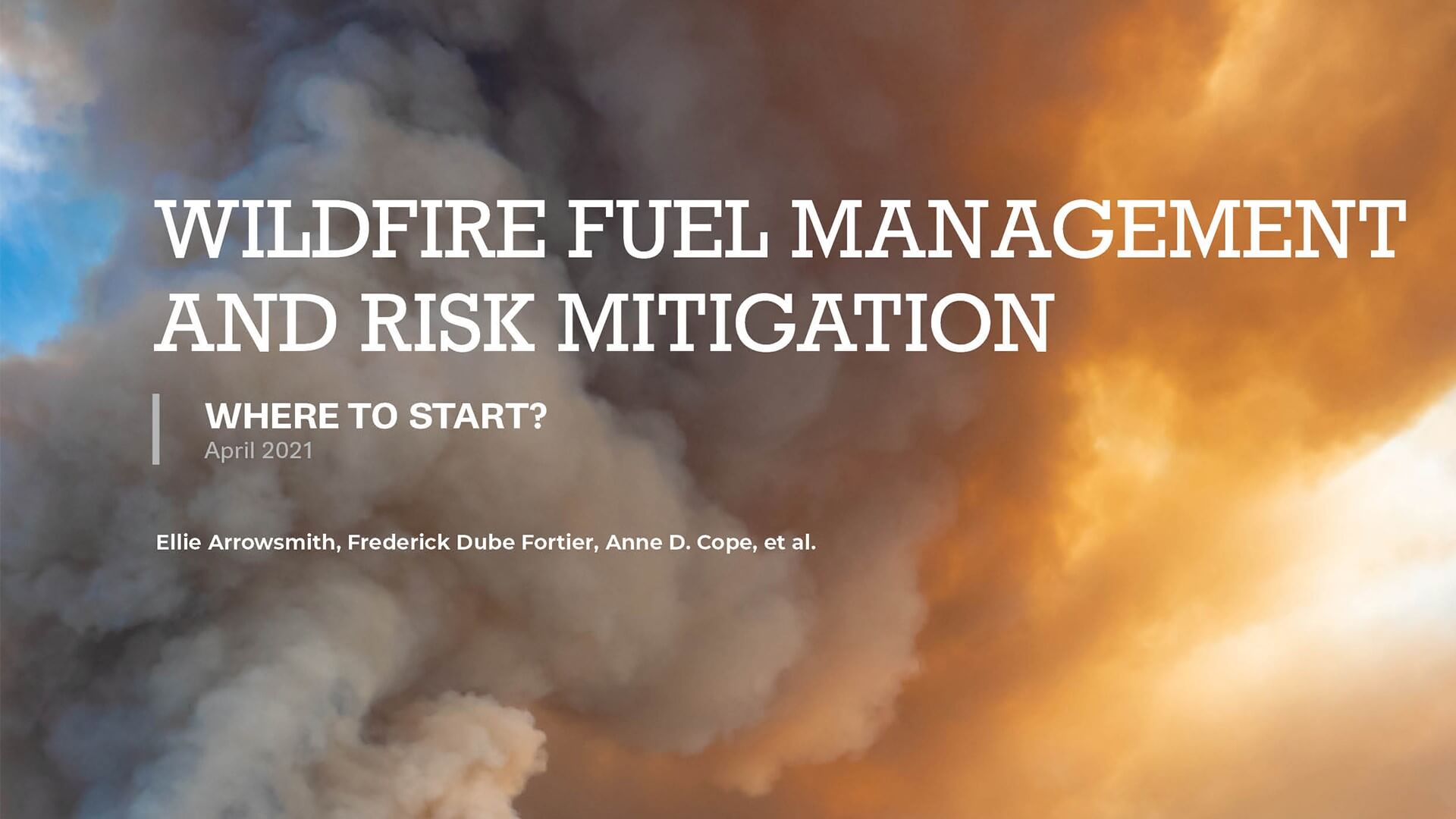
Oakland,Calif., April 8, 2021: ZestyAI, a leader in climate risk analytics powered by Artificial Intelligence (AI), and the Insurance Institute for Business & Home Safety (IBHS) today released new research on how fuel management impacts destruction rates from wildfires. They found property owners who clear vegetation from the perimeter of their home or building can nearly double their structure's likelihood of surviving a wildfire.
ZestyAI, in conjunction with, IBHS studied more than 71,000 properties involved in wildfires between 2016 and 2019 to assess the relationship between vegetation, buildings, and property vulnerability. To do this, ZestyAI leveraged a combination of computer vision and AI to analyze high resolution satellite and aerial imagery of the properties that fell within the wildfire perimeter, which allowed them to determine what effects a property's physical environment had on its likelihood of survival. They found buildings with a high amount of vegetation within 5 feet of the structure were destroyed in a wildfire 78 percent of the time -- a rate nearly twice as high as those with small amounts of perimeter vegetation. This pattern held true as ZestyAI analyzed the other defensible zones, ranging from 30 to 100 feet around the property.
"It's common sense that increased vegetation increases wildfire risk, but this study shows just how powerful individual action can be in safeguarding structures. Mitigation actions that can cut risk nearly in half are statistically meaningful to anyone with a stake in this peril," said Attila Toth, CEO of ZestyAI. "These findings also underscore how wildfire research at IBHS and artificial intelligence at ZestyAI translates to real-world impact at the intersection of homeowners, community leaders, regulators, and insurance carriers. This type of collective action will help protect our communities from the devastating impact of wildfire, which unfortunately has continued to increase over the last decade."
The study also supported and confirmed takeaways from IBHS's Suburban Wildfire Adaptation Roadmaps released last year, which go beyond the home ignition zone to detail additional actions needed across eight aspects of a home to address a home's wildfire vulnerability. ZestyAI's new research found that having other structures in close proximity to a property increases its wildfire risk, particularly for properties in areas with moderate to high vegetation coverage. Buildings in these areas that had another structure within 30 to 100 feet from the property were destroyed in a wildfire 60 percent of the time, compared to a 31 percent destruction rate for homes without another structure in close proximity.
"This research further demonstrates to homeowners, community leaders, and policy makers just how impactful taking the mitigation actions laid out in the Suburban Wildfire Adaptation Roadmaps can be in protecting homes from wildfire ignition," said Roy E. Wright, President & Chief Executive Officer at IBHS. "Quantifying the effect of mitigating fuel density risk, one of the critical actions identified in the Roadmaps, is a first piece in the larger puzzle of what groups of mitigation actions most improve the chance of home survival and by what level."
ZestyAI is uniquely equipped to support this type of research because of the proprietary wildfire property loss database it developed for Z-FIRE™, its AI model that generates property-specific predictive risk scores. Z-FIRE™ has been trained on more than 1,200 wildfire events across several decades and accounts for the property-level factors that contribute to wildfire risk, including defensible space, building material, and roof pitch, which legacy models fail to consider.
Wright added, "While it is not possible to eliminate wildfire risk we are not powerless against it. We must take a pragmatic approach to mitigate risk at all levels and ultimately reduce property damage through data and science. Through collaborations with modelling organizations like ZestyAI, advanced technology like computer vision and AI help us better understand the impact of these actions at a larger scale. It is encouraging to see emerging progress in just the first months of 2021."
For additional insights you can read the full research paper, ‘Wildfire Fuel Management and Risk Mitigation - Where to Start?' here. For more information on ZestyAI please visit www.zesty.ai, and for more information on IBHS please visit www.ibhs.org.
About ZestyAI (www.zesty.ai): Increasingly frequent natural disasters, such as wildfires, floods and hurricanes devastated communities and drove $2.2 Trillion in economic losses over the past decade. ZestyAI uses 200Bn data points, including aerial imagery, and artificial intelligence to assess the impact of climate change one building at a time. ZestyAI has partnered with leading insurance companies and property owners helping them protect homes, businesses and support thriving communities. ZestyAI was named Top 100 Most Innovative AI Company in the world by CB Insights in 2020, and Gartner Cool Vendor in Insurance by Gartner Research in 2019. For more information visit: https://www.zesty.ai/
About the Insurance Institute for Business & Home Safety (IBHS)
The IBHS mission is to conduct objective, scientific research to identify and promote effective actions that strengthen homes, businesses and communities against natural disasters and other causes of loss. Learn more about IBHS at DisasterSafety.org.
ZestyAI Research: Up to $9.8Bn in Losses Already Caused by Wildfires in 2020
As of September 18th, between $5.9Bn and $9.8Bn in losses have occurred this year alone.
The Zest
ZestyAI has been keeping a close eye on the wildfires burning in the Western United States. Whether by evacuation or smoke, most of our employees have felt the impact firsthand.
Utilizing our vast wildfire data and artificial intelligence resources, we have estimated that as of September 18th, between $5.9Bn and $9.8Bn in losses have occurred this year alone.
What has made 2020 unique?
Two key aspects have made the 2020 Wildfire Season exceptional: the number of acres burned and the timing of the fires.
2018, which previously held the California record for acres burned at 1,975,086 has been eclipsed with months left in the seasons. More than 3.3 million acres have already been charred by wildfire this year in California alone, and more than 5 million in the Western US.
Fire season tends to start in September and peak in November. In August, a large scale lightning event occurred, triggering many of the California wildfires. Oregon, which typically has a shorter wildfire season has also seen early and widespread wildfires.
Analysis Methodology
Using ZestyAI’s comprehensive historical wildfire loss data, up-to-date wildfire perimeter locations for the 2020 season, residential and commercial property information, and fueled by ZestyAI’s AI-driven wildfire damage risk scores, the expected destruction and cost of the 2020 wildfire season so far was calculated for California, Oregon, and Washington.
To estimate the destruction and damages, ZestyAI identified every structure involved in the 2020 wildfire perimeters and their associated wildfire vulnerabilities. Using the historical relationship between the risk profile of the structure, asset value, and economic loss, ZestyAI was able to estimate the full economic loss of those events (including non-insured assets such as uninsured property, and non-insured economic cost). Actual information from CalFire on CZU and LNU incident was used to validate the methodology.
From our extensive historical loss data, a relationship between structural damage expected and the cost of wildfire events was developed based on local property and loss information and expanded to include additional considerations such as smoke damage, displacement costs, and construction.
The 5 Most Destructive Fires So Far
Our estimates place the Claremont-Bear (North Complex) at the top of the list of most destructive in terms of number of properties lost. Four of these five wildfires occurred in California with the Alameda Drive fire occurring in Oregon.

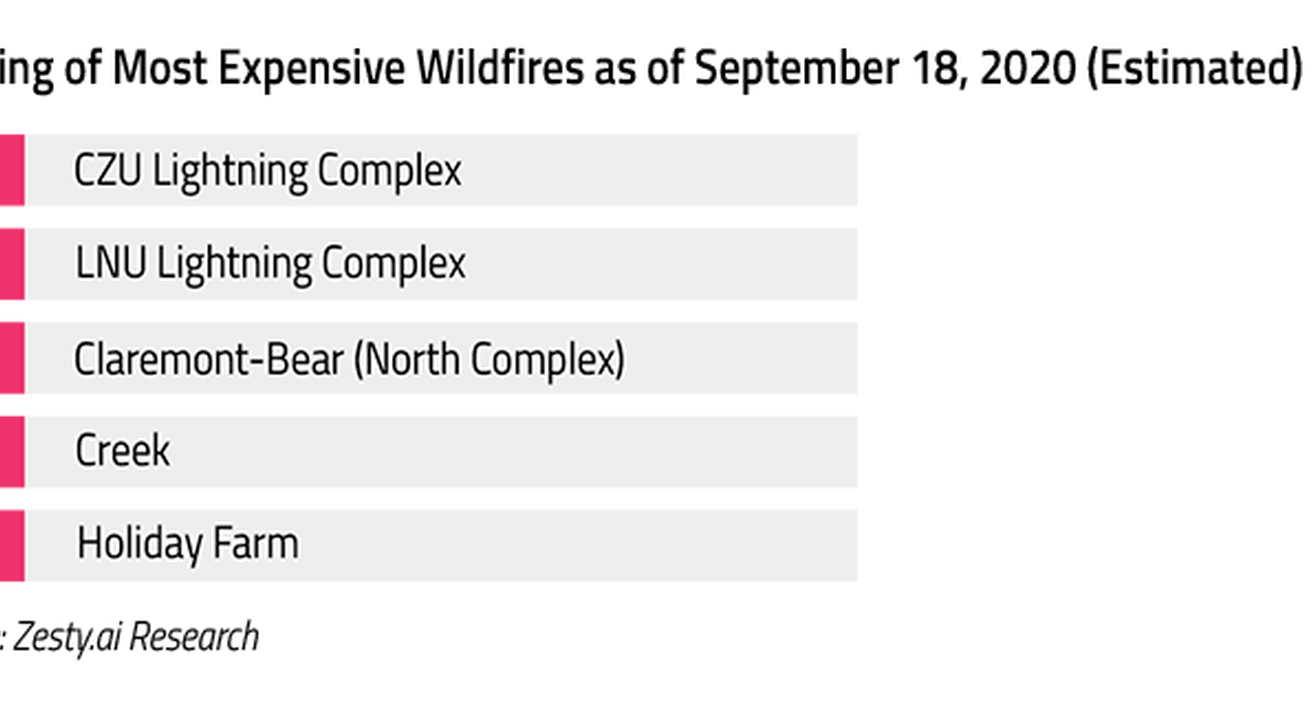
The 5 Most Expensive Fires So Far
While the Claremont-Bear (North Complex) fire is estimated to have destroyed the most properties, the CZU Lightning Complex fire is currently estimated to be the most costly at up to $2.6B. That makes it responsible for ~27% of all total economic losses from fires in the 2020 season so far.
Putting Numbers on Destruction
By ZestyAI estimates, between $5.9Bn and $9.8Bn of economic losses have occurred in California, Oregon, and Washington so far this year. California, which also leads in acres burned (5M+) makes up the lion’s share at up to $7.9B.
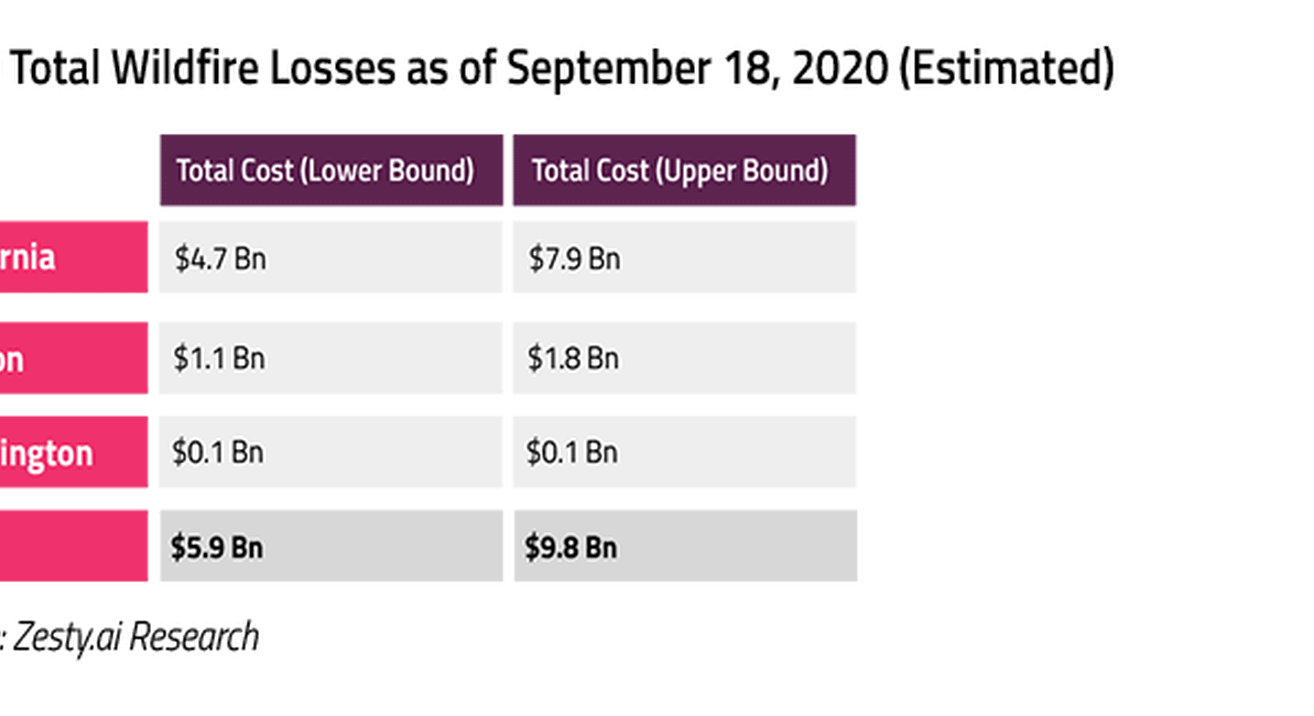
It’s important to state that the fire season is not yet over. In much of the Western US, it could be just beginning. With a number of fires still active and the potential for more to start, these numbers are almost certain to rise between now and the end of the year.
Looking Forward
Multiple estimates place the 2018 wildfire season at around $15Bn in total losses. While exceptional in terms of total acres burned, the 2020 wildfire season has not yet reached that level of economic loss. Without any doubt, this will be one of the costliest years on record, and with months left in the season, the potential exists for this year to surpass 2018 if it continues at its current pace.
ZestyAI will continue to monitor this fire season. As in years past, new data continues to refine our models and analyses. Insurance professionals and media who would like more information about this analysis or about how artificial intelligence can help insurers protect themselves and their customers from wildfire should contact us.
NEXT Insurance and ZestyAI Join Forces to Bring AI-Powered Risk Insights to Small Business Insurance
By leveraging AI-powered risk models, NEXT Insurance enhances risk assessment for smarter commercial insurance for SMEs.
ZestyAI, the leading provider of AI-powered property and climate risk analytics, today announced a strategic partnership with NEXT Insurance, a top commercial insurer specializing in small to medium-sized businesses.
Under this agreement, NEXT will adopt ZestyAI’s Z-PROPERTY™ and Z-FIRE™ models to enhance its underwriting processes with precise, property-level risk insights. Z-PROPERTY uses high-resolution aerial imagery and AI-powered analytics to assess roof condition, structural risks, and environmental hazards, helping insurers make more informed underwriting decisions.
Z-FIRE, adopted by over one-third of California’s insurance market, delivers highly accurate wildfire risk assessments based on 2,000+ historical wildfires, satellite imagery, and topographic data, ensuring that premiums reflect true wildfire exposure.
Lance Poole, Head of AI Underwriting at NEXT Insurance, said:
“ZestyAI’s peril-based risk models stood out for their ability to provide precise, actionable insights at scale, perfectly complementing our mission to help entrepreneurs thrive. This partnership strengthens our underwriting capabilities by delivering advanced data analytics that allows us to offer a faster, fully digital purchasing experience while maintaining best-in-class underwriting. By streamlining workflows and enhancing decision-making, we’re able to create innovative, tailored insurance solutions that meet the unique needs of small business owners, all while staying true to our commitment to simplicity and excellence."
Attila Toth, CEO of ZestyAI said:
"At ZestyAI, we are committed to bringing the power of AI-driven risk intelligence to the insurance industry. NEXT Insurance is redefining small business insurance with a fully digital experience, and we are proud to support that vision by providing precise, property-specific risk insights. With Z-PROPERTY and Z-FIRE, NEXT can enhance underwriting efficiency, optimize risk selection, and ultimately deliver smarter, more tailored coverage to small business owners across the country."
Safepoint Holdings Selects ZestyAI for Precision Underwriting and Streamlined Inspections
AI-driven property risk insights to enhance Safepoint’s efficiency and improve insurance offerings.
ZestyAI today announced its partnership with Safepoint Holdings, a regional property insurance group operating Safepoint, Cajun, and Manatee. Together, these platforms manage over 200,000 policyholders across Florida, Louisiana, Texas, Mississippi, and Alabama.
By leveraging ZestyAI’s advanced risk platform, Safepoint Holdings can analyze a high volume of properties with precision, enhancing underwriting accuracy and improving access to coverage for homeowners. Additionally, Safepoint Holdings is strengthening its loss cost control program by utilizing ZestyAI’s property insights to better predict and manage risk.
The partnership also enables Safepoint Holdings to optimize its inspection strategy, reducing costs and streamlining operations through high-resolution aerial imagery.
David Flitman, CEO of Safepoint Holdings. said:
“ZestyAI’s property insights have set a new benchmark for accuracy and innovation. The flexibility of their solutions and the ability to evaluate large insured portfolios in a matter of days provide tremendous value to us. This partnership will allow us to better serve our policyholders by proactively managing risk while making our operations more efficient.”
ZestyAI’s Advanced Risk Solutions Adopted by Safepoint:
- Z-PROPERTY Digital Roof™: Analyzes key drivers of roof-related risk—including material, shape, pitch, and condition—using AI-powered 3D modeling of high-resolution aerial imagery. These insights improve Safepoint’s risk selection process and optimize inspections by identifying properties requiring on-site evaluations, ensuring underwriting and renewals are both accurate and efficient.
- Z-PROPERTY Location Insights: Delivers detailed, property-specific risk insights for over 150 million properties across the U.S. Combining computer vision, machine learning, and high-resolution imagery,
Location Insights provides critical risk insights on overhanging vegetation, lot debris, and more, enabling Safepoint uncover hidden risks, streamline workflows, and better align premiums to risk. - Roof Age: Combines over 20 years of historical aerial imagery with verified building permit data to determine the accurate age of a roof with 92%+ accuracy. By eliminating reliance on self-reported or incomplete data, Safepoint can enhance pricing precision, reduce claims exposure, and make informed decisions about eligibility and coverage.
“By integrating our solutions, Safepoint Holdings can make better risk decisions, reduce costs, and expand coverage in states with high climate risk like Florida, Louisiana, Texas, Mississippi, and Alabama,” said Attila Toth, Founder and CEO of ZestyAI. “We’re excited to support Safepoint Holdings with the insights they need to serve their policyholders.”
This partnership comes at a pivotal time as Safepoint Holdings focuses on expanding its portfolio. With ZestyAI’s property-specific data, Safepoint Holdings can scale efficiently while maintaining reliable, cost-effective coverage for its policyholders. Safepoint Holdings operates with a combined policyholder surplus of approximately $150 million, with Safepoint Insurance Co. holding $70 million.
ZestyAI’s AI-Powered Wildfire Risk Model Available for Immediate Use in California Rate Filings
ZestyAI’s Z-FIRE™ Continues to Support California Insurers Amid Regulatory Changes.
ZestyAI, the leader in AI-powered climate and property risk analytics, announced that Z-FIRE™, its advanced wildfire risk model, is filing-ready in California.
Z-FIRE can continue to be filed for rate segmentation and underwriting without further review under the Pre-Application Required Information Determination (PRID) process, which is currently focused on models that determine a catastrophe load factor.
Z-FIRE was last included in an approved California rate filing in 2024.
Z-FIRE leverages AI-driven analysis of over 2,000 historical wildfires, integrating satellite and aerial imagery, topography, and property-level characteristics to provide precise risk assessments. This approach is rooted in decades of science and experimentation by researchers, including the Insurance Institute for Business & Home Safety (IBHS).
With coverage spanning nearly 100% of U.S. properties, Z-FIRE is already trusted by more than one-third of California’s insurance market, including the California FAIR Plan, the state's insurer of last resort, to refine underwriting, enhance risk segmentation, and ensure that premiums accurately reflect the true wildfire exposure and vulnerability of each individual structure.
"For years, leading insurers have trusted ZestyAI to manage wildfire exposure in California and refine pricing segmentation with precision," said Attila Toth, Founder and CEO of ZestyAI. "Now, insurers can continue to confidently integrate it into their rate filings."
They can trust that Z-FIRE meets the highest actuarial and scientific standards, ensuring transparency and reliability for regulators, carriers, and policyholders alike.
ZestyAI continuously validates Z-FIRE’s performance through post-event analyses, assessing how well its risk designations align with real-world fire impacts.
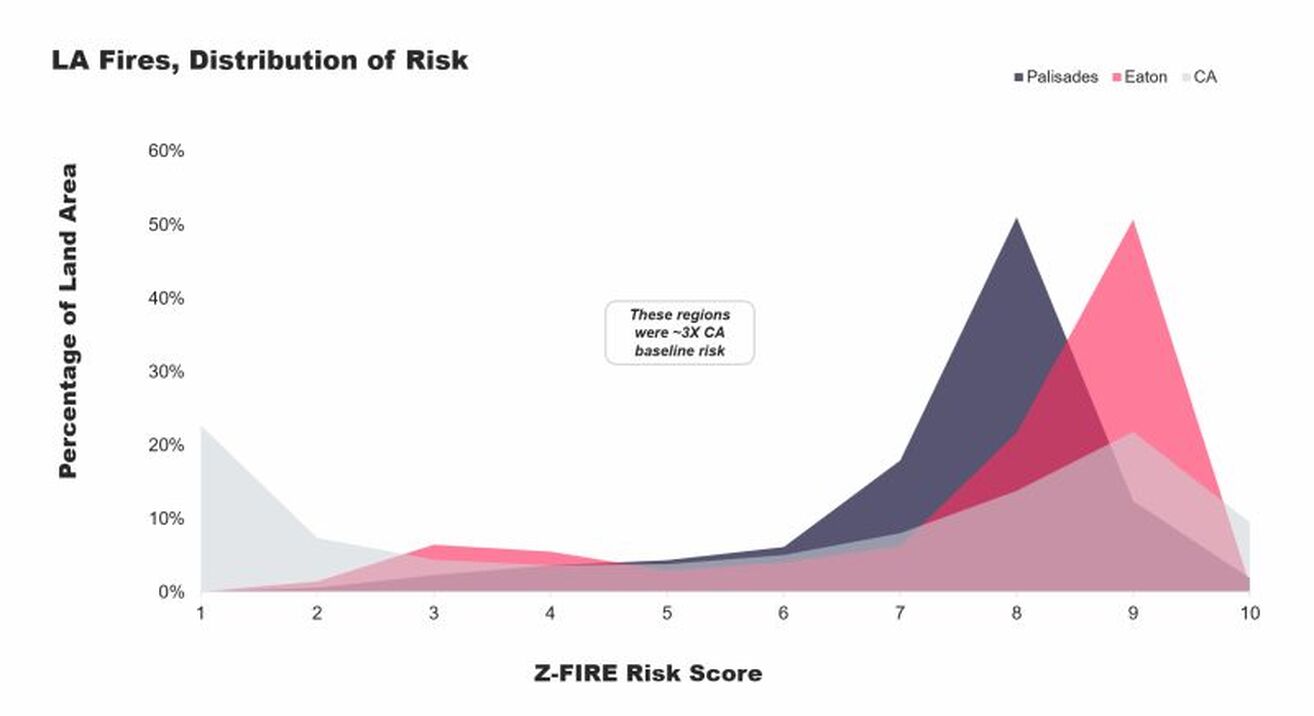
Following the recent Los Angeles wildfires, preliminary analysis indicates that Z-FIRE’s highest-risk ratings closely correspond with the hardest-hit areas, with 94% and 87% of the areas affected by the Palisades and Eaton fires rated as high or very high risk by the model.
The model also captured how property-specific characteristics influenced damage patterns, even within the same fire perimeter, reinforcing the importance of granular, structure-level insights in wildfire risk assessment. Z-FIRE’s data also reveals more than 1.5 million structures in California face a high or very high risk of being within a wildfire perimeter.
With granular, property-specific insights, Z-FIRE allows insurers to move beyond binary "insure or drop" decisions. Instead, they can work with policyholders to reduce vulnerability—whether through defensible space measures, fire-resistant roofing, or other mitigation efforts.
Since its adoption, Z-FIRE has helped insurers confidently write hundreds of thousands of policies that might have otherwise been non-renewed or declined. By incorporating vegetation density, roof materials, and structural characteristics, the model enhances risk segmentation, reduces volatility, and strengthens market stability.
ZestyAI has engaged with the California Department of Insurance (CDI) over the years, including discussions during the early regulatory considerations of Z-FIRE. After an independent actuarial review in 2020, multiple carrier rate and underwriting filings leveraging Z-FIRE have been approved by the CDI. Moreover, ZestyAI participated in seven CDI workshops in 2023-24 and co-hosted a January 2025 webinar on the new regulatory framework.

AI in Insurance: How to Stay Ahead of the Curve
Artificial intelligence is reshaping the P&C insurance industry, offering new ways to streamline underwriting, enhance risk management, and navigate evolving regulations.
But as AI adoption accelerates, insurers must ensure they’re using these technologies effectively—balancing innovation with compliance.
Our latest guide explores the most impactful AI applications in insurance, including:
- AI-powered underwriting and predictive analytics
- How regulators are shaping the future of AI in insurance
- Best practices for integrating AI while ensuring fairness and transparency
As AI-driven tools become the new standard, insurers who adapt early will gain a competitive edge.
Download our free guide to leverage these innovations while staying aligned with evolving regulations.

The Truth About Roof Age: 5 Critical Insights Every Insurer Should Know
For insurers, accurate roof age data is essential. Yet, self-reported information often falls short.
Our research shows that 1 in 5 homeowners underreport roof age by an average of 8 years. These discrepancies create hidden risks that can impact underwriting, pricing, and overall portfolio performance.
How can insurers get a more accurate picture?
AI-driven insights provide 97% nationwide coverage, combining verified roof age with real-time condition data for a more comprehensive risk assessment.
Download our latest research for a breakdown of five critical insights that every insurer should know about roof age.
Plus, get access to The Roof Age Advantage, an exclusive video that unveils how AI is setting a new standard for risk evaluation.
Merging Centuries of Expertise with AI for a New Era of Risk Assessment
In 2024, U.S. insured catastrophe losses soared to $113 billion. Learn how we combine centuries of insurance expertise with AI to help insurers navigate an increasingly volatile climate.
The property and casualty (P&C) insurance industry has always been about protecting people and property against the unexpected. But in 2024, U.S. insured catastrophe losses reached $113 billion—nearly double the 25-year average of $58 billion.
For many carriers, the gap between collected premiums and total payouts, including operating costs, continues to widen, underscoring the growing financial strain of climate-driven risks. At ZestyAI, we can’t control the forces of nature, but we’re helping insurers adapt.
From Franklin’s Fire Policies to AI-Powered Resilience
The concept of insurance dates back to the Middle Ages, when merchants sought protection from unpredictable events like storms and piracy. Over time, the practice evolved into today’s property and casualty insurance, safeguarding homes, businesses, and communities.
In the United States, Benjamin Franklin advanced the industry by founding the nation’s first fire insurance company in 1752. By refusing to insure fire-prone buildings, his company not only mitigated risk but also set new safety standards. This principle of risk reduction has guided the industry ever since.
Today, ZestyAI is building on that foundation with AI-driven risk models that help insurers address modern challenges. While the tools have changed, the mission remains the same: to protect people, property, and the future.
Modern Tools for Today’s Challenges
At ZestyAI, we’re helping insurers address modern challenges with solutions designed to fit seamlessly into their workflows. Our AI-driven platform combines high-resolution aerial imagery, proprietary data, and advanced modeling to provide a clearer, more reliable view of risk.
Unlike broad, traditional approaches, we focus on delivering actionable insights at the property level, helping insurers:
- Modernize outdated processes without overhauling their systems,
- Improve underwriting precision,
- Optimize inspections and resources, and
- Strengthen their portfolios.
A key example of this is our work in wildfire risk modeling. ZestyAI’s proprietary wildfire loss database—built using data from 1,500 events over the last 20 years—helps insurers predict property-specific risks with precision. By understanding wildfire risk at this granular level, insurers can proactively reduce losses, guide mitigation strategies, and protect their customers with greater confidence.
Discover how ZestyAI’s regulator-approved solutions set new standards for accuracy, compliance, and fairness in insurance.
See How Insights Turn Into Decisions
ZestyAI transforms data into action. Get a demo to see how the same AI powering our reports helps carriers make faster, smarter, regulator-ready decisions.