
Reports & Research
Explore proprietary research packed with data, insights, and real-world findings to help carriers make smarter decisions.
.png)

Now Streaming: Roof Risk Master Class
Effective strategies for better risk management
Are rising storm costs and inaccurate roof assessments impacting your bottom line?
Now available to stream, The Science of Roof Risk master class will equip you with the latest strategies and techniques to master roof risk assessment.
- Enhance your roof risk assessment by 60X
- Improve your combined ratio
- Reduce storm-related roof claims
- Strengthen new business selection
What we cover:
Your presenters, Ross Martin (VP, Risk Analytics) and Sam Fetchero (Head of Marketing) will share with you:
- The Problem of the Roof: Uncover the underlying factors driving rising storm losses and why traditional risk assessment methods fall short.
- The Science Behind Predicting Losses: Explore key factors impacting roof risk and loss prediction, including roof age, condition, complexity, and peril-specific models.
- Accuracy-focused Risk Models: Discover advanced modeling techniques that enhance predictive accuracy.
- Understanding Storm Climatology: Learn how storm climatology impacts roof risk and how to integrate these insights into your risk assessment strategies.
- Real-World Results: Witness a comparative analysis of these predictive factors using actual carrier data. Understand the strengths and weaknesses of each approach.
- Priorities of Leading P&C Insurers:
See what your peers asked with valuable insights to take back to your team.
Who Should Watch?
This video is ideal for Executives, Product Managers, Actuaries, Underwriters, and CAT Modelers committed to enhancing their roof risk assessment capabilities.
Bonus Guide
As a bonus for watching, you'll receive a downloadable study on the latest roof risk assessment strategies: Preparing for the Storm: The Insurers Guide to Roof Risk.
Access Now
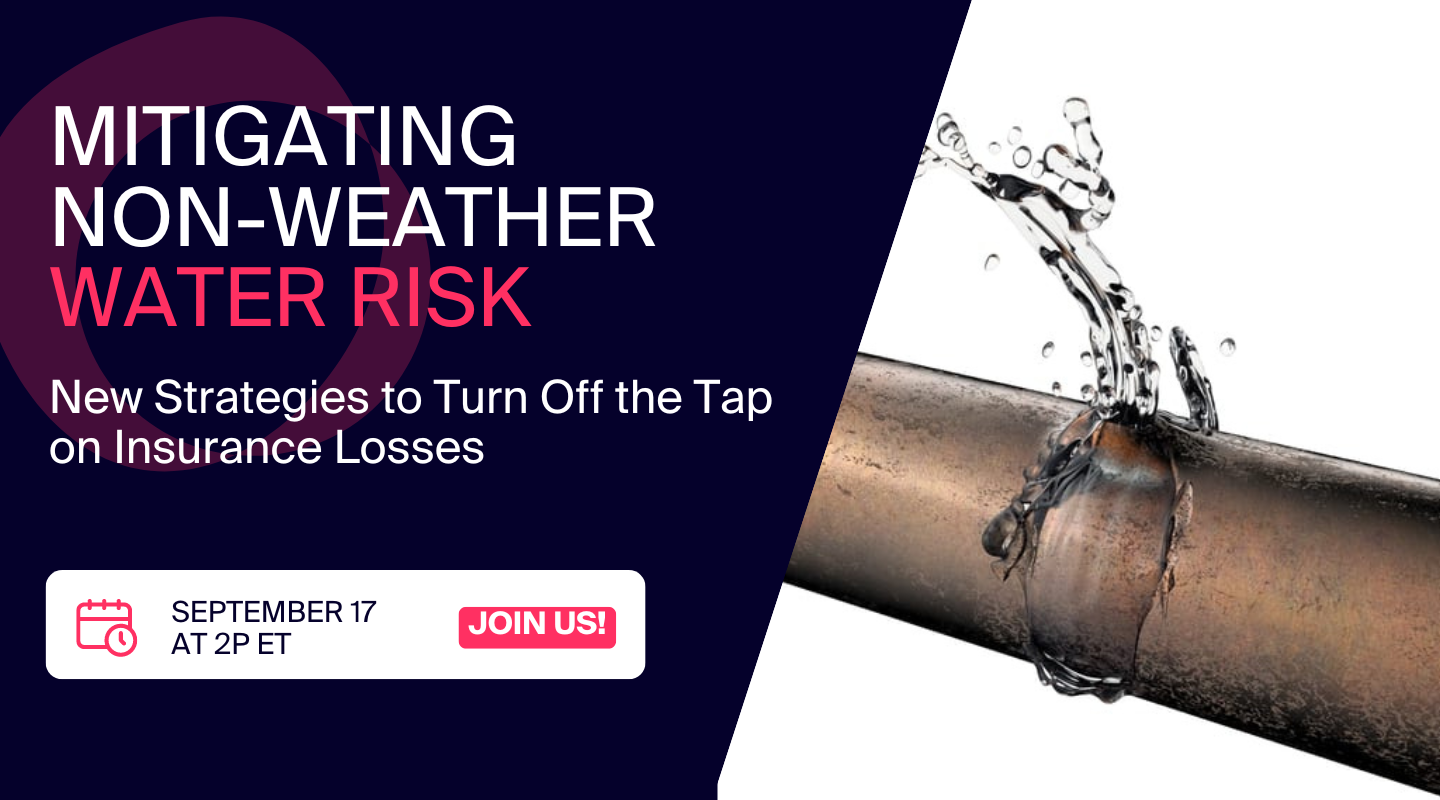
Exclusive Webinar: Mitigating Non-Weather Water Risk
New strategies to turn off the tap on insurance losses
From Costly Water Losses to Millions in Savings
Non-weather water claims are a leading cause of property insurance losses, costing insurers over $20 billion annually.
Join us for a FREE live webinar where our experts will discuss the latest trends, challenges, and insights to help you mitigate non-weather water risk.
What We'll Cover
Our experts Rob Silva, ACAS (Director of Customer Success) & Sam Fetchero (Head of Marketing) will present:
- Current Trends: Understand the rise in severity and total loss costs of non-weather water claims.
- Risk Assessment Challenges: Learn why traditional methods fall short in assessing non-weather water vulnerability.
- Key Risk Factors: Identify the main drivers of non-weather water damage.
- Strategic Insights: Discover strategies to improve your management of non-weather water claims.
- Z-WATER in Action: Experience our new AI-powered model that predicts non-weather water risk with unparalleled accuracy.
- Interactive Q&A: Get your questions answered by our experts.
Who Should Attend
This webinar is ideal for Executives, Product Managers, Actuaries, Underwriters, and CAT Modelers committed to enhancing their understanding and management of non-weather water risks.
Bonus Content
As a bonus, you'll receive our exclusive infographic, "Below the Surface: Research Reveals Knowledge Gap in Homeowner Water Loss Prevention and Coverage."
This research gives key insights into water loss experiences, coverage details, homeowner protection measures, and information on water shutoff devices and heater conditions.
Register Now
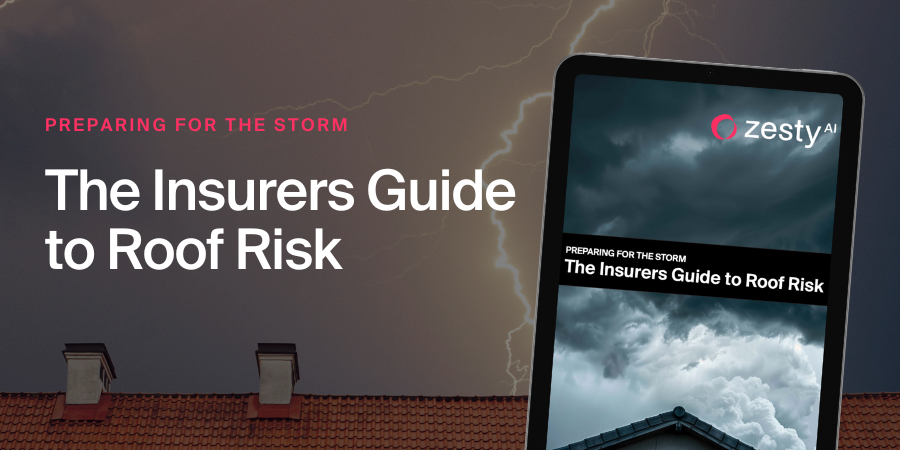
Now Available: The Insurers Guide to Roof Risk
Learn how leading insurers are mastering roof risk and maximizing lift
It’s hard to overstate how important the roof is from an insurability standpoint. The roof represents significant risks and potential opportunities, making it a critical focus area for insurers. This has become even more important in recent years as the impact of severe convective storms is often reflected in roof losses. Understanding this, ZestyAI has released new research for property insurers called The Insurers Guide to Roof Risk.
Download The Insurers Guide to Roof Risk
In an era where the severity and frequency of roof-related claims are on the rise, particularly due to the increasing impact of severe convective storms, innovative tools and strategies are essential. The Insurers Guide to Roof Risk provides actionable insights to improve risk assessment, underwriting processes, and overall business strategy.
What’s Inside the Guide?
The Insurers Guide to Roof Risk includes:
- Roof Failure Factors: Learn the underlying contributing factors behind why older roofs fail more often.
- Beyond Roof Age: Discover why roof complexity, condition, and climate are more important than roof age alone.
- Identifying Missing Risk Factors: Understand the key factors to roof risk that most traditional models miss.
- Advanced Risk Segmentation: See how using machine learning and new data sources can split risk more than 60 times better than traditional models.
- Portfolio Optimization: Access a comprehensive toolbox to optimize your portfolio and new business selection to generate exponential lift versus traditional models.
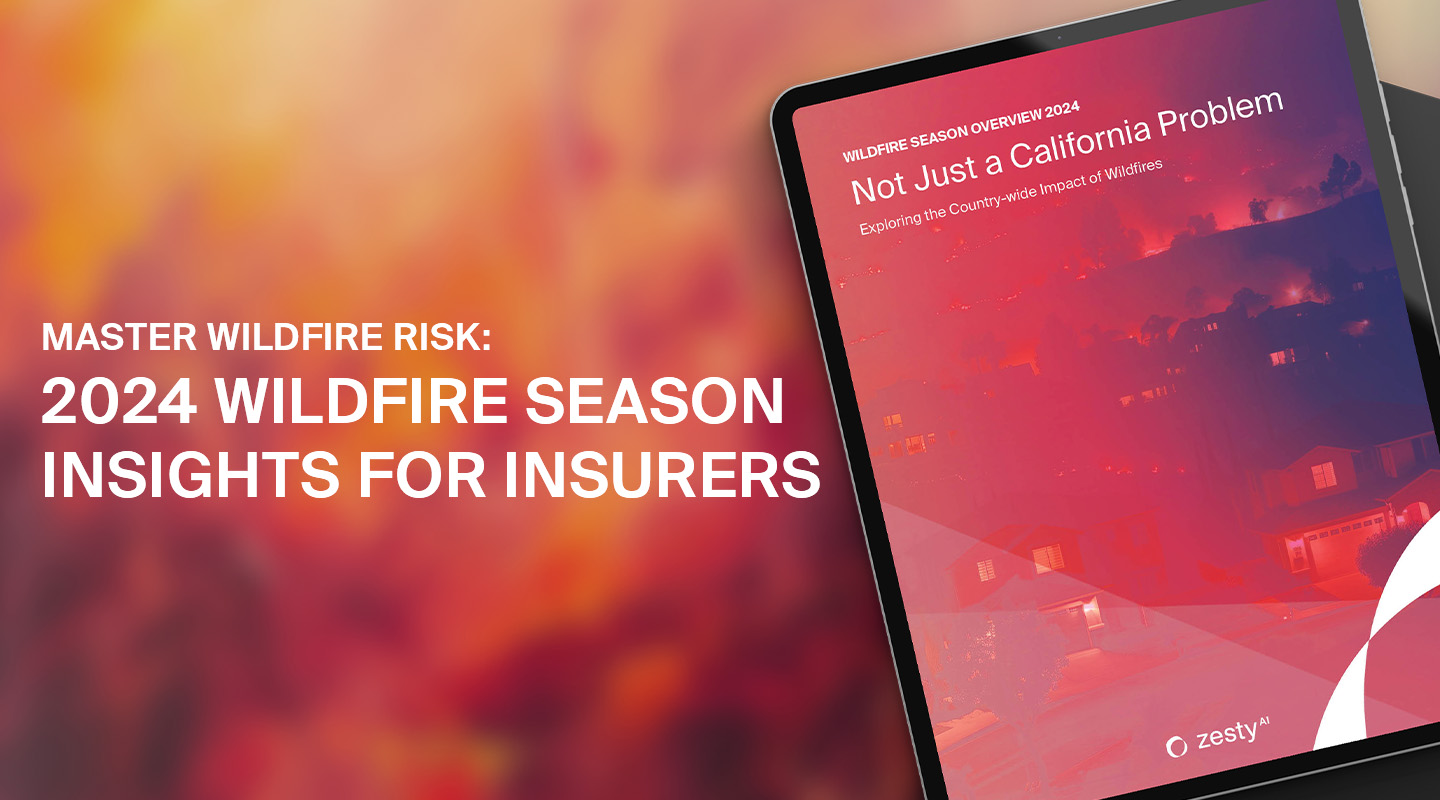
Now Available: ZestyAI’s 2024 Wildfire Season Overview
Annual Wildfire Season Overview provides insights to assist insurers in effectively managing wildfire risk.
Annual Wildfire Season Overview provides insights to assist insurers in effectively managing wildfire risk.
ZestyAI has released its annual Wildfire Season Overview for 2024. This year’s guide provides critical insights carriers need to stay ahead of the rapidly evolving wildfire landscape. Offering more than just data, this year’s guide is designed to help insurers make informed risk decisions in some of the country’s most volatile states.
Download ZestyAI's 2024 Wildfire Season Overview
This year’s guide includes:
- Countrywide Wildfire Impact Analysis: Understand how wildfires are affecting regions beyond traditional hotspots like CA, including significant events in TX & NM.
- Future Wildfire Trends: Explore predictions for the 2024 wildfire season and understand the long-term implications of current conditions on wildfire risks.
- Regulatory Insights: Stay updated on the latest regulations affecting wildfire risk assessment insurance practices.
- AI-driven Risk Models: Learn how ZestyAI's Z-FIRE model accurately predicts wildfire risks and assists insurers in making informed decisions.
- Property-Level Risk Assessments: Discover the importance of granular, property-specific risk evaluations to improve underwriting accuracy and transparency for consumers.
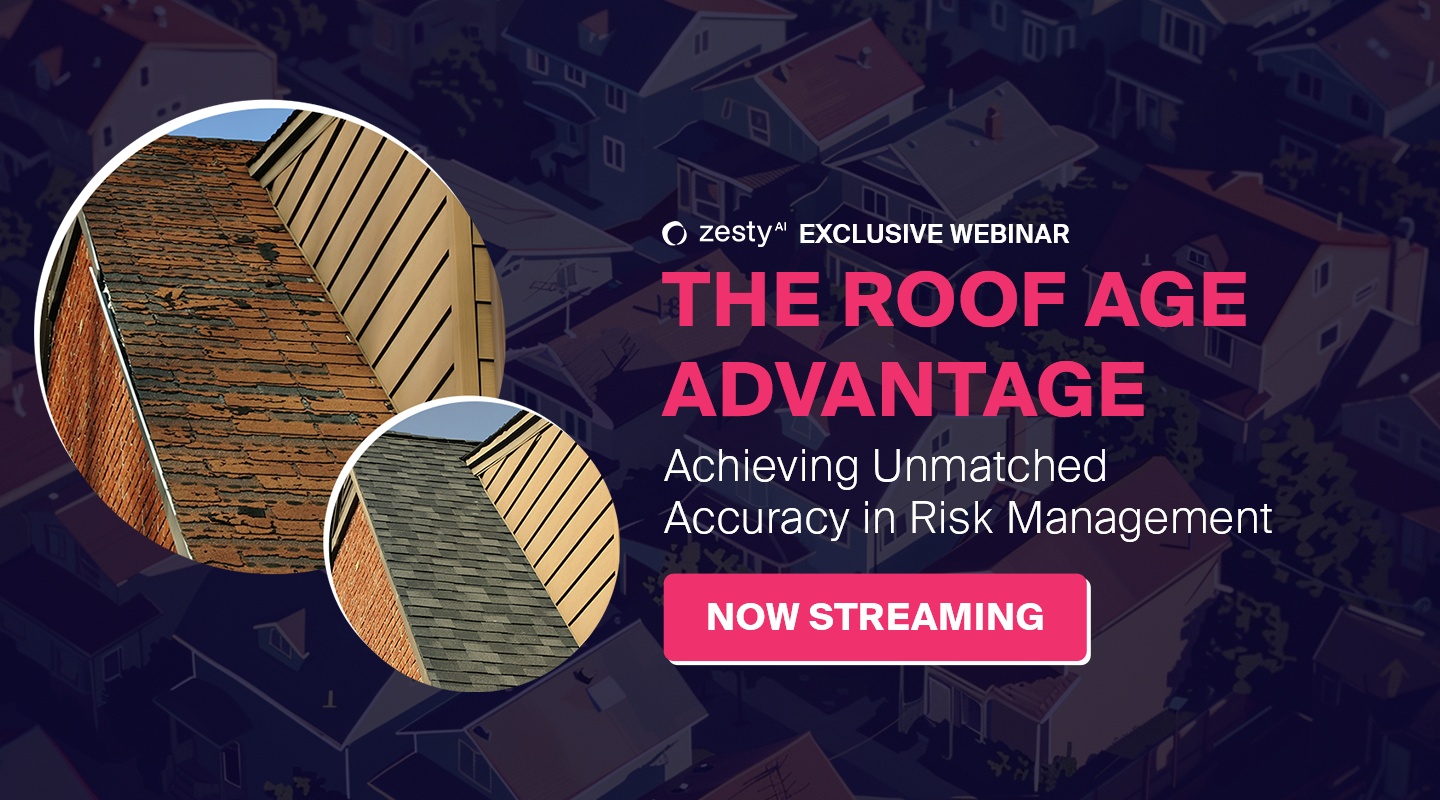
The Roof Age Advantage Webinar Now Available On Demand
Achieve unmatched accuracy in risk management
Costing insurers approximately $19 billion every year, roof claims stand as the primary driver of property insurance losses.
Traditional methods of obtaining roof age information are deeply flawed. Most carriers depend on policyholder or agent-reported data, which is often inaccurate, leading to blind spots in assessing property risk. In a recent ZestyAI survey, 63 percent of homeowners reported not knowing the age of their roof if they were not in their homes the last time it was replaced.
Join our expert panel for a deep dive into leveraging roof age analytics for a cutting-edge underwriting process and gain insider knowledge on:
- The Leading Cause of Claims: unveil the hidden truths behind roof-related claims and the costly consequences of outdated assessment methods.
- A New Era of Data: Learn about ZestyAI’s pioneering approach to roof age analytics, incorporating building permits, historical imagery, and AI for a comprehensive view
- Precision at Scale: See how to apply precise, AI-driven roof age data across your entire portfolio for consistent and reliable underwriting and claims decisions
- Technical Decision Making: Empower your actuaries and underwriters with the insights needed to enhance risk selection and optimize pricing strategies
- Efficiency in Operations: Streamline inspections and operations, focusing resources where they’re needed most, improving time-to-quote, and enriching the customer experience
- Best Practices: Learn how leading carriers are using roof age, roof condition, and peril-specific models to improve risk selection and lower combined ratios
This transformative session is available on demand. Learn how to enhance accuracy, efficiency, and profitability in property insurance.
Save Your Spot
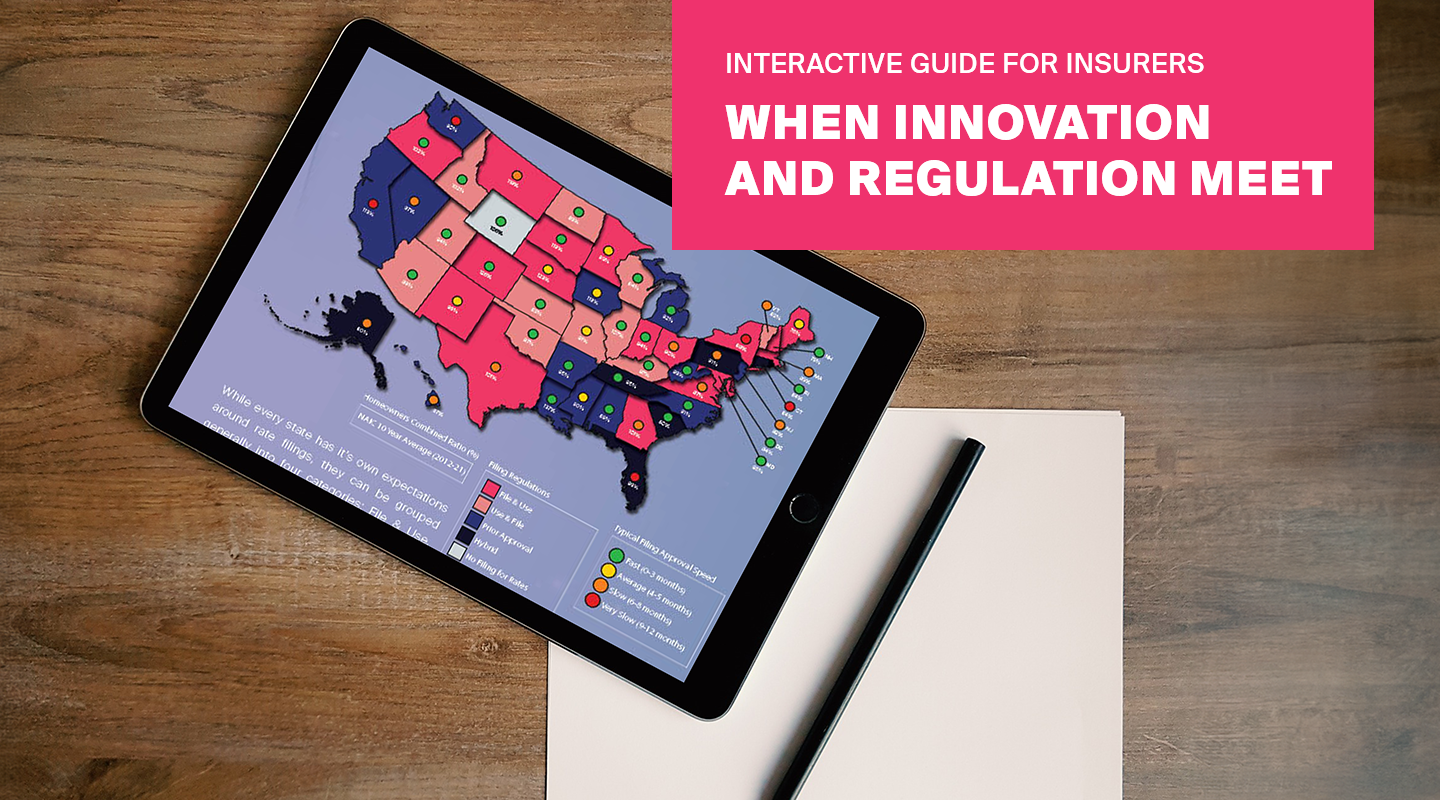
New Research: What Insurers Need to Know About AI and Regulatory Compliance
Master the future of insurance compliance with ZestyAI's interactive guide, featuring a state-by-state regulatory map, AI partnership checklist, and insights into emerging challenges.
In an ever-evolving regulatory environment, staying informed and adaptable is crucial. Our latest interactive guide, "When Innovation and Regulation Meet", offers a comprehensive toolkit for navigating the complexities of insurance compliance and the integration of AI technologies.
What's Inside?
- Regulatory Landscape Map: Delve into a detailed state-by-state analysis, uncovering the intricacies of filing laws and approval speeds.
- Staying Ahead of Regulation Changes: Learn how to stay prepared and ensure your compliance strategies are future-proof, aligning with the latest regulatory expectations.
- Essential AI Partner Checklist: Choosing the right AI partner is crucial for success. Our guide offers a meticulous checklist for selecting a partner that is not only compliant but also transparent and supportive, ensuring you make an informed decision.
- Emerging Regulatory Concerns: What do you need to know about privacy, bias, and AI oversight?
- Real-World Applications: Discover how ZestyAI's collaborative approach with regulatory entities has led to successful model approvals across the United States.
Why This Guide?
As the regulatory framework becomes increasingly complex, having a reliable and insightful resource is indispensable. Our guide is tailored for insurance professionals seeking to enhance their regulatory strategy, embrace AI innovation responsibly, and achieve a competitive edge in the market.
Ready to get up to speed on 2024's regulatory environment? Access the guide.
AI-Powered Severe Convective Storm Risk Models Approved in Ohio
Amid a surge in billion-dollar storm events, Ohio insurers gain access to advanced, property-specific risk models that strengthen underwriting.
ZestyAI announced that its Severe Convective Storm suite, including Z-HAIL™, Z-WIND™, and Z-STORM™, has received regulatory approval from the Ohio Department of Insurance.
With the addition of Ohio, ZestyAI’s Severe Convective Storm suite is now approved for use in 16 states, covering key high-risk markets across the Midwest, Great Plains, and South.
Ohio Faces Rapidly Rising Storm Losses
Ohio has experienced 36 billion-dollar loss storm events over the past five years alone, surpassing the total from the previous two decades, which saw just 33 events, according to NOAA’s National Centers for Environmental Information (NCEI). Severe convective storms, including hail, wind, and tornadoes, were the driver, contributing to over 57% of the state’s total weather-related damages since 1980.
Traditional Models Miss Critical Property-Level Differences
ZestyAI’s AI-driven platform predicts the likelihood and severity of claims from severe convective storms at the individual property level by analyzing the interaction of local climatology with property-specific characteristics. In contrast, most risk assessment models today rely on broader territory or ZIP code-level evaluations, overlooking critical property-level factors.
Each model is built and validated on extensive real-world claims data and delivers transparent explanations of the key drivers behind every risk score, helping carriers make more accurate underwriting and rating decisions.
Key capabilities include:
- Z-HAIL: Predicts hail damage risk and claim severity using property-specific attributes like roof complexity, historical losses, and accumulated damage, identifying which homes are most likely to file a claim, even within the same neighborhood.
- Z-WIND: Combines AI-generated 3D analysis of roof condition, complexity, and potential failure points with local climatology to deliver pivotal insights into property-specific wind vulnerability and severity.
- Z-STORM: Predicts the frequency and severity of storm damage claims, examining the interaction between climatology and the unique characteristics of every structure and roof.
Regulatory Approval Reflects a Shift Toward Precision Underwriting
“Too often, storm risk is priced using rough proxies instead of accurate property insights,” said Kumar Dhuvur, Founder and Chief Product Officer at ZestyAI.
“Regulatory approval in Ohio affirms the industry’s shift toward precision underwriting and rating—and opens the door to smarter, risk-aligned decisions and fewer preventable losses in one of the nation’s most important insurance markets.
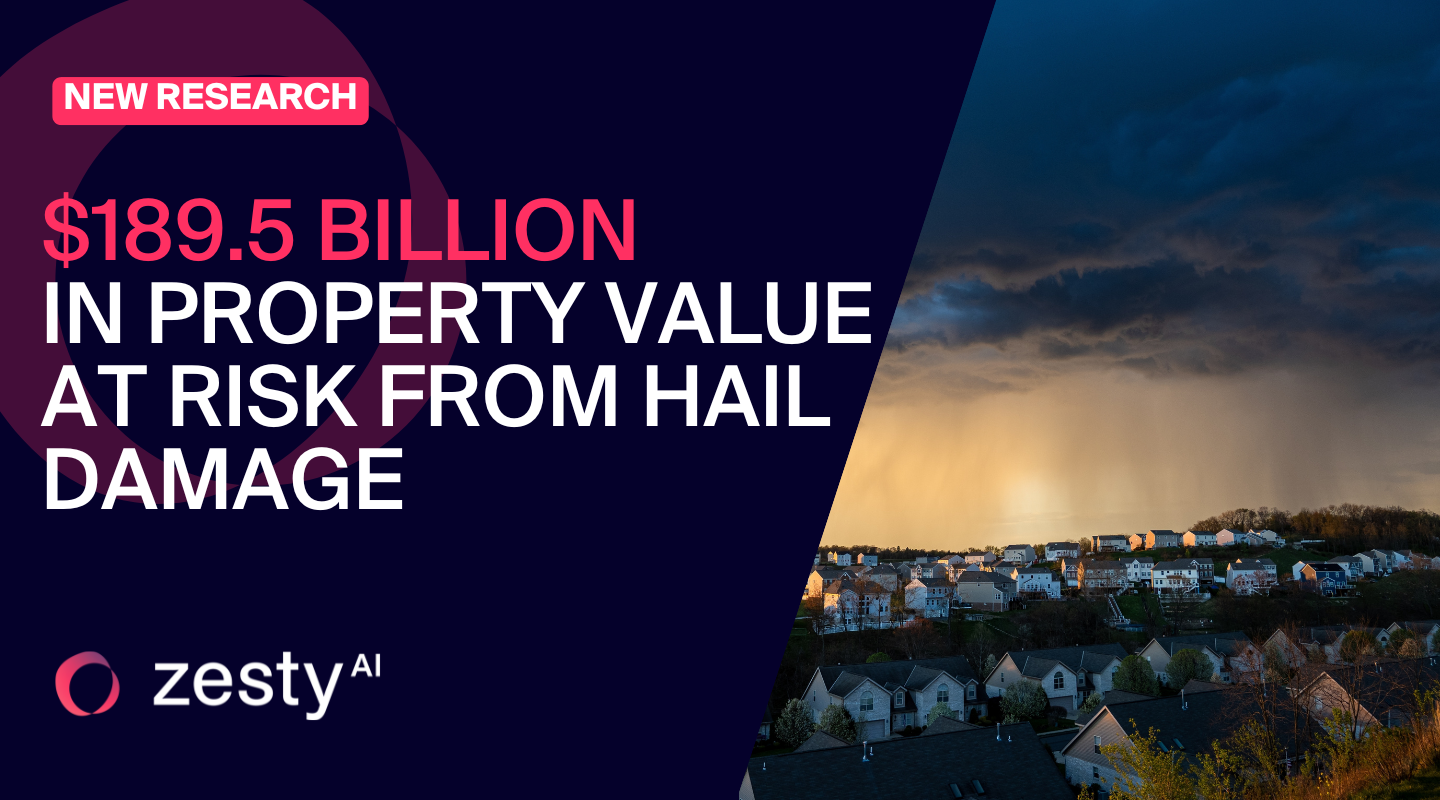
12.6 million US properties at high risk from hail damage
ZestyAI analysis reveals $189.5 billion in potential hail losses.
ZestyAI's analysis revealed that more than 12.6 million U.S. properties are at high risk of hail-related roof damage, representing $189.5 billion in potential replacement costs.
Powered by ZestyAI’s Z-HAIL™ model, the analysis underscores the growing financial threat of severe convective storms (SCS), including hail, tornadoes, and wind events. In 2024 alone, damages from SCS were estimated at $56 billion—surpassing losses from hurricanes.
Yet many insurers still rely on traditional models designed to estimate portfolio-level exposure, not property-level risk. As hail events increase in severity and frequency, these models often miss the structural and environmental conditions that drive real losses.
Kumar Dhuvur, Co-Founder and Chief Product Officer at ZestyAI said:
“Catastrophe models have helped insurers understand where storms may strike and how losses might add up at a portfolio level. But they weren’t built to assess risk at the individual property level, and they often miss the specific conditions that drive hail damage. By analyzing the interaction between structure-specific features and local storm patterns, we can distinguish risk between neighboring properties—enabling smarter underwriting, more precise pricing, and better protection for policyholders.”
Z-HAIL evaluates hail risk using a proprietary blend of climate, aerial, and property-specific data. By applying advanced machine learning to these inputs, Z-HAIL delivers highly granular predictions that reflect both the physical characteristics of a structure and the storm activity in its immediate surroundings.
Key findings from the analysis:
- 12.6 million U.S. structures flagged as high risk for hail-related roof damage
- $189.5 billion in total potential roof replacement exposure
Top five states by dollar exposure:
- Texas ($68B)
- Colorado ($16.7B)
- Illinois ($10.8B)
- North Carolina ($10.4B)
- Missouri ($9.5B)
States with the lowest dollar exposure:
- Maine ($4.7M)
- Idaho ($12.8M)
- New Hampshire ($18.5M)
- Nevada ($49.3M)
- Vermont ($64.7M)
In recent case studies, Z-HAIL has demonstrated the ability to pinpoint which properties are most susceptible to hail damage—even within the same neighborhood and exposed to the same storm. In one example from Allen, Texas, following a storm with 2.5-inch hailstones, Z-HAIL segmented risk across 483 policies, identifying no losses among properties rated “Very Low” by the model. This level of intra-territory precision gives insurers the ability to refine risk selection with confidence—even in the most hail-prone regions of the country.
-1.png)
Unlocking Insurance Access for Half a Million Homes and Business Owners
ZestyAI's property-level risk models are helping insurers expand sustainable coverage in wildfire- and storm-prone regions.
ZestyAI helped carriers and insurers of last resort extend coverage to over 511,000 properties previously deemed uninsurable in 2024. This year, ZestyAI aims to double its impact, helping to bring coverage options to over a million families and businesses, ensuring that those in catastrophe-prone regions have access to sustainable, risk-aligned insurance.
A 2024 Deloitte survey found that nearly a quarter of homeowners in high-risk states are struggling to find coverage, while over half cite affordability as a growing concern—underscoring the industry’s need for granular insights that support underwriting and pricing decisions aligned with true property-level risk.
“For too long, insurers have had to make high-stakes decisions with incomplete information,” said Attila Toth, Founder and CEO of ZestyAI. “Advanced AI models are changing that. With granular, property-specific risk insights, insurers can close protection gaps and build a more resilient market.”
Traditional risk assessment methods rely on territory- or ZIP code-level evaluations, overlooking the property-level characteristics that drive risk. This approach leads to adverse selection, inaccurate pricing, and widespread market withdrawal.
ZestyAI replaces this approach with transparent, AI-powered models that integrate climatology, geospatial data, historical losses and structural attributes to deliver precise views of wildfire, hail, and wind risk, among other perils.
The results:
- Clear mitigation guidance to help policyholders take action.
- Risk-aligned premiums that support responsible market expansion.
- Improved underwriting precision through AI-driven risk scores and near-complete U.S. coverage.
- Optimized loss cost controls via more effective deductible, Actual Cash Value (ACV), and coverage strategies.
- A supportive experience for carriers, families, and businesses—enabling faster decisions, better communication, and greater confidence in coverage options.
- Streamlined inspections that lower expenses and improve efficiency.
ZestyAI collaborates closely with regulators to ensure transparency, validation, and model oversight. Its wildfire model, Z-FIRE, is approved across all Western states, while its severe convective storm models have gained broad acceptance from Texas to Colorado and throughout the Midwest and Great Plains.
As regulators support the use of advanced models, they are also paving the way for smarter risk-based pricing and proactive mitigation—revitalizing insurance’s core mission: protecting the livelihood of home and business owners and their communities.
.png)
2025 Storm Risk Webinar Now Available On Demand
Stream our webinar for a preview of severe convective storm risk in 2025 and see how AI-driven insights can help you stay prepared.
Severe convective storms are becoming more frequent and costly, putting pressure on insurers to refine underwriting and risk management strategies.
On April 2, our experts covered:
- Key drivers behind increasing severe storm losses
- What La Niña means for the 2025 season
- How AI-powered risk models improve risk segmentation
- Live Q&A – Get expert answers to your toughest questions!
Missed the live event? Stream now!
EarthDaily Analytics Partners with ZestyAI for Advanced Property Risk Insights
Earth Observation data meets AI to address rising climate risks and enhance insurance decision-making.
ZestyAI has partnered with EarthDaily Analytics (EarthDaily), a global provider of Earth Observation analytics and data.
Through this partnership, ZestyAI’s advanced models—including Z-FIRE™, Z-HAIL™, Z-WIND™, and Z-STORM™—will be available through EarthDaily’s Ascend platform, delivering geospatial data, risk modeling, and post-event insights to insurers.
With the insurance industry facing escalating challenges from climate-driven catastrophes and increasing pressure to accurately price risk, ZestyAI’s models provide granular, property-level risk data. These models analyze factors like vegetation density, construction materials, and historical weather patterns to offer insights beyond traditional methods.
“At EarthDaily, we’re committed to delivering cutting-edge property insights to customers navigating today’s climate risks,” said Rachel Olney, VP of Insurance at EarthDaily.
With advanced AI models covering wildfire, hail, wind, and property data, ZestyAI is an ideal partner to support our mission.
"By including their advanced analytics in our Ascend platform, we’re excited to empower clients to take proactive steps in managing and mitigating risk with confidence."
ZestyAI’s solutions achieve nearly 100% hit rates, offering actionable insights that insurers and businesses can trust. By bolstering the data available in the Ascend platform with property-level insights, the partnership provides decision-makers with a new level of clarity to mitigate risks, improve underwriting, and allocate resources more effectively.
The collaboration exemplifies the growing importance of innovative technology in the insurance and property management sectors, especially as global climate risks continue to evolve.
Roof Age in Rate Filings is Down: What’s Taking Its Place?
For the first time in two decades, regulatory filings using Roof Age have declined as a new standard emerges.
For years, insurers asked:
“How old is this roof?”
Now, the real question is:
“How will this roof perform?"
The way insurers assess roof risk has evolved significantly over the past two decades. What began as a simple Roof Age-based surcharge has transformed into a sophisticated approach that considers real-time condition, storm resilience, and structural complexity.
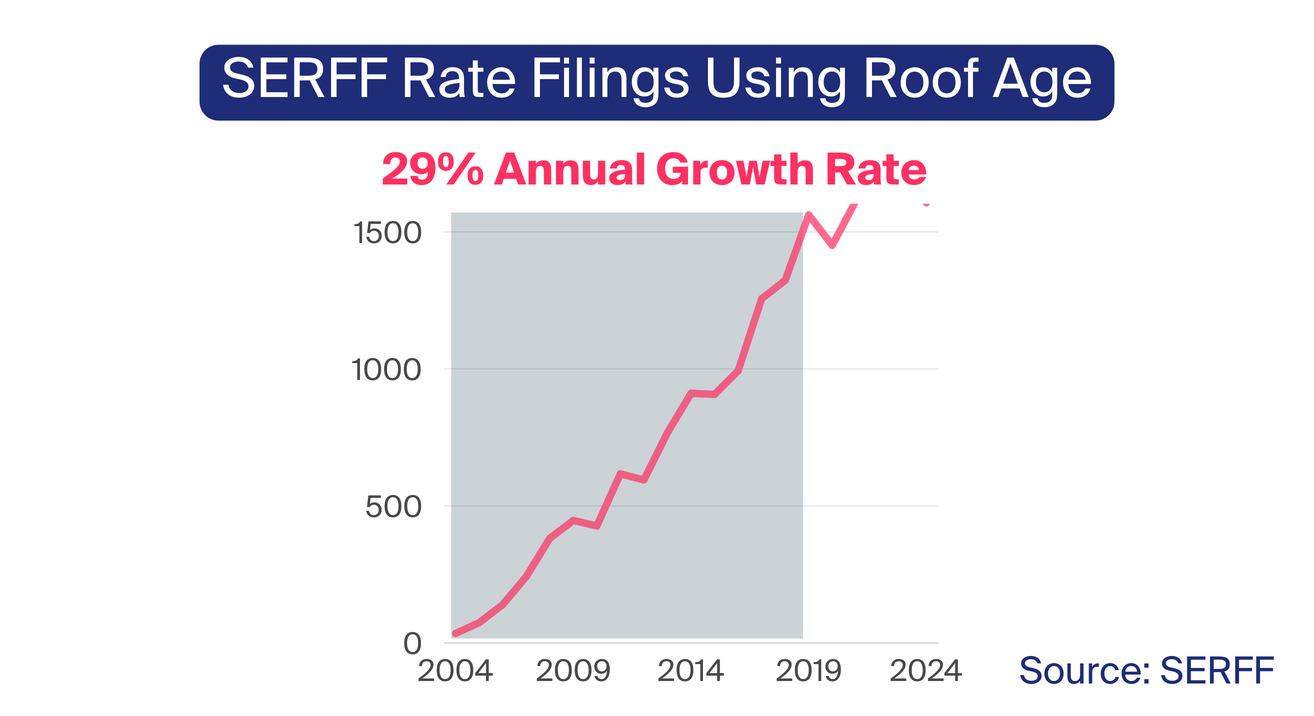
A closer look at SERFF regulatory filings traces the first recorded use of Roof Age back to 2004 when The Hartford introduced Roof Age-based pricing in Iowa.
At the time, the insurer applied a flat 10% surcharge to roofs 26 years and older—a figure that now seems outdated, as many carriers won’t insure roofs older than 15 years.
Roof Age quickly became a key rating factor—by the 2010s, Roof Age adoption in rate filings surged, growing at an annual rate of 29%.
If you fast forward just 10 years after The Hartford’s initial filing, you’ll find a stark contrast in how roof risk was assessed. By 2014, The Hartford’s rate filing in Iowa contained 51 pages of actuarial tables, detailing various roof materials and rate adjustment factors for age.
This shift reflected a broader trend—Roof Age moved from a simple surcharge to a more nuanced risk model that accounted for material durability, wear patterns, and structural longevity.
By 2018, insurers began looking beyond Roof Age, and that’s when Roof Condition first appeared in regulatory filings.
Over the past five years, its adoption has surged 32% annually, outpacing Roof Age at its peak. Insurers also began incorporating roof complexity variables, such as pitch and facets, to further refine their risk assessment models.
These advancements provided a more nuanced view of risk, moving beyond the assumption that all old roofs posed the same level of hazard.
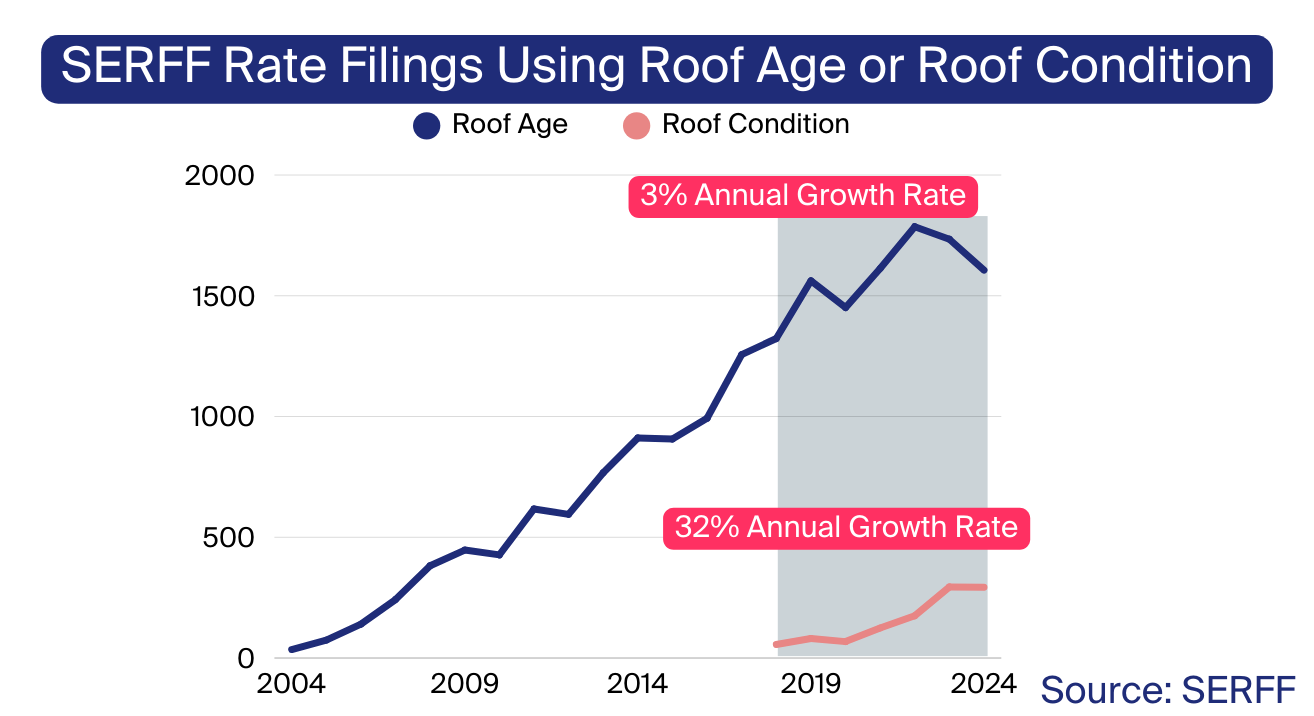
Now, for the first time in two decades, Roof Age is plateauing. Over the past two consecutive years, we've seen a decline in the number of filings incorporating Roof Age, bringing its usage close to 2019 levels.
This decline suggests that carriers are moving toward more sophisticated approaches, leveraging real-time condition assessments rather than relying solely on the number of years since installation. After all, a 10-year-old roof in poor condition can present a greater risk than a 20-year-old roof that has been well-maintained—and insurers are recognizing the importance of capturing these distinctions.
With severe convective storm-related insured losses reaching $58 billion in 2024, traditional risk assessment methods can no longer keep up.
A new paradigm is emerging, where advanced AI-driven risk models provide the precision and resilience needed to navigate an increasingly volatile climate.
At ZestyAI, we’re helping insurers make this shift with models like Z-STORM, Z-HAIL, and Z-WIND, which are already filed and approved in 14 states, including Texas, Colorado, Illinois, Oklahoma, and Louisiana.
Those who embrace these innovations will gain a competitive edge—reducing loss costs, improving operational efficiency, and ultimately shaping the future of risk assessment in property insurance.

See How Insights Turn Into Decisions
ZestyAI transforms data into action. Get a demo to see how the same AI powering our reports helps carriers make faster, smarter, regulator-ready decisions.